La Rogerie
La Rogerie is an Avize-based Champagne grower project centred on Chardonnay and the village’s Grand Cru vineyards. The domaine is associated with François Petit and Justine Boxler, bringing together a Champagne base in Avize and a separate wine activity in…
Editorial profile
La Rogerie is an Avize-based Champagne grower project centred on Chardonnay and the village’s Grand Cru vineyards. The domaine is associated with François Petit and Justine Boxler, bringing together a Champagne base in Avize and a separate wine activity in Alsace. For Champagne.co, the useful focus is the Avize work: a small, site-conscious range whose identity is increasingly expressed through specific sectors and parcels rather than a broad house-style hierarchy.
Why this producer matters
La Rogerie belongs to the contemporary generation of growers treating Avize not simply as a prestigious village name but as a collection of distinct places. Current market evidence consistently shows Bourg/Sud alongside parcel wines such as Champ Bouton and Chemin de Chalons, giving drinkers a way to compare different expressions of Chardonnay within and around Avize.
That makes the producer particularly relevant for readers interested in terroir-led Côte des Blancs Champagne. The attraction is not a large catalogue or a long-established prestige hierarchy; it is the increasingly detailed map of place that the wines create.
Vineyard and terroir
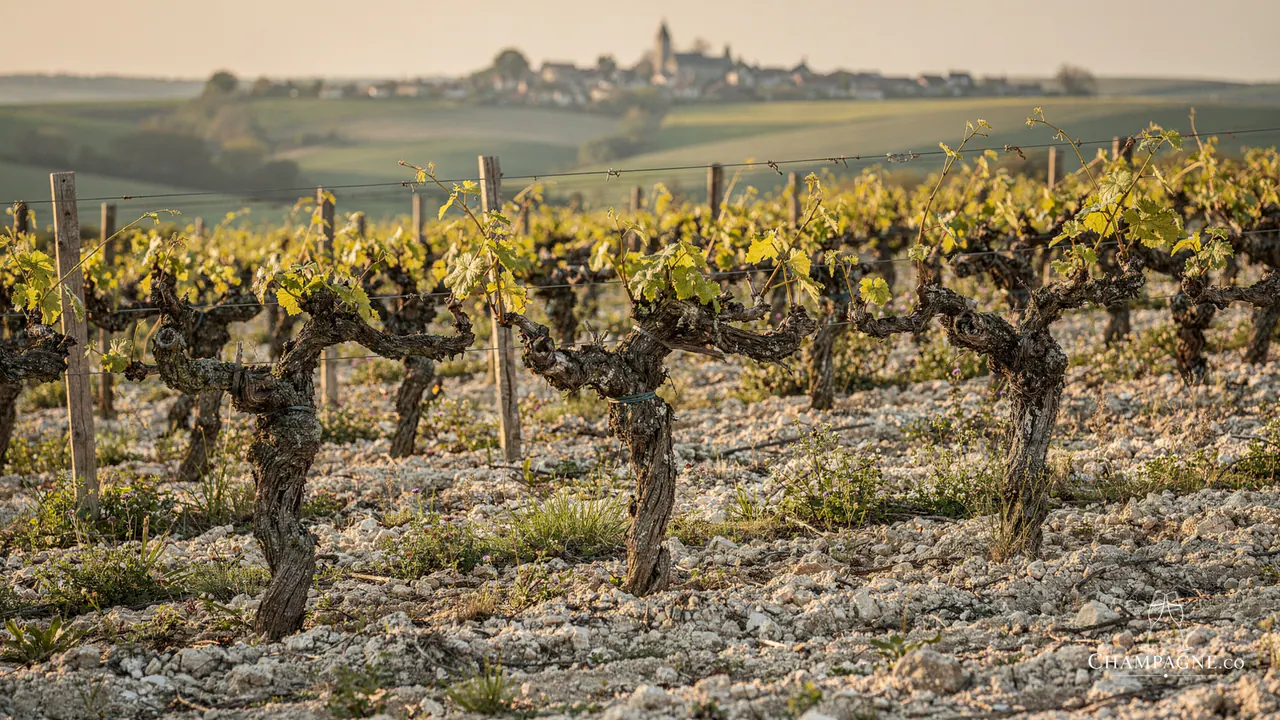
Avize sits at the heart of the Côte des Blancs and is strongly associated with Chardonnay on chalk-rich soils. La Rogerie’s Champagne range is built around this Grand Cru context. Current listings repeatedly identify Champ Bouton as an Avize Grand Cru Chardonnay wine, while Chemin de Chalons is also presented as a site-led Chardonnay bottling connected with Avize and the Cramant boundary.
Bourg/Sud takes a broader geographical approach, drawing its identity from the southern side of Avize toward Oger rather than from a single named parcel. This distinction between a village-sector blend and individual parcel wines is one of the clearest ways to understand the range.
Cellar and winemaking
The wines are commonly encountered as low-dosage or no-dosage Blanc de Blancs, but exact élevage, reserve-wine proportions, disgorgement dates and dosage vary by bottling and release.
This release-sensitive approach matters particularly for a young, evolving domaine. Recent specialist-market information indicates that the presentation of some wines is changing as the producers develop reserve material and multi-vintage expressions.
Champagne.co analysis
La Rogerie is best understood as a producer for drinkers who want to explore Avize at finer resolution. Bourg/Sud provides the broad geographical frame; Champ Bouton and Chemin de Chalons move closer to parcel-level interpretation. That structure is more informative than trying to rank the wines by prestige.
The domaine is also a good example of why grower-Champagne profiles need release discipline. The range is evolving, and seemingly precise facts about reserve wine, dosage, disgorgement or vintage can become misleading when detached from the bottle to which they belong. The durable story is the focus on Chardonnay, Avize and increasingly specific expressions of place.
Buying guidance
For a first bottle, Bourg/Sud is the logical starting point because it introduces the producer’s interpretation of Avize without requiring prior knowledge of individual parcels. Readers already familiar with Côte des Blancs Chardonnay can then compare Champ Bouton and Chemin de Chalons when matching releases are available.
Check the exact label, vintage or base designation and disgorgement information before buying. Older Héroïne bottles and early parcel releases can be useful for following the domaine’s evolution, but they should be evaluated as specific back vintages rather than as interchangeable examples of the current range.
Loading current Champagne range…
Spotted something wrong? Report a correction
Every report goes to a human review queue. Nothing on this page changes automatically.