Lacourte-Godbillon
Lacourte-Godbillon is a family grower in Écueil, a Premier Cru village on the western side of the Montagne de Reims. The domaine’s modern identity was shaped by Géraldine Lacourte and Richard Desvignes, who returned to the family vineyards in 2006 after…
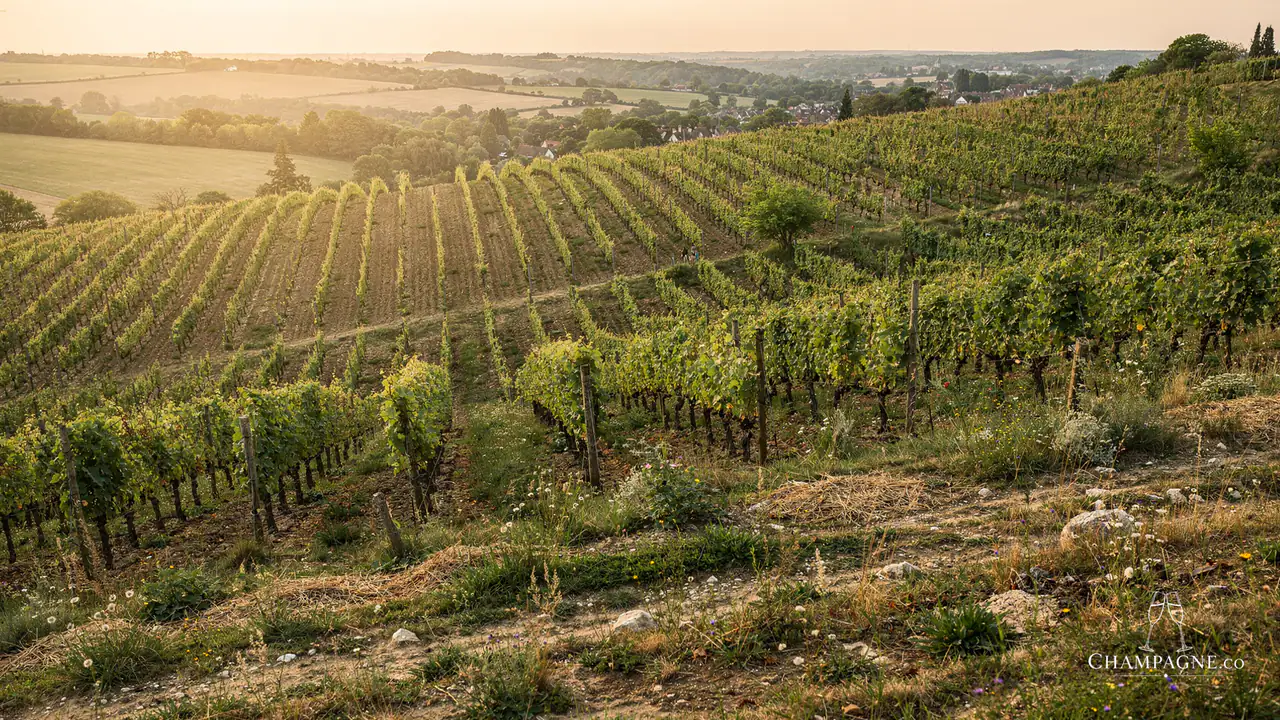
Editorial profile
Lacourte-Godbillon is a family grower in Écueil, a Premier Cru village on the western side of the Montagne de Reims. The domaine’s modern identity was shaped by Géraldine Lacourte and Richard Desvignes, who returned to the family vineyards in 2006 after careers away from Champagne.
The estate currently describes roughly 8 hectares of vines, almost all in Écueil with a small holding in neighbouring Les Mesneux. Pinot Noir dominates at about 85%, with Chardonnay making up the balance. All grapes come from family-owned vineyards, giving the domaine unusually direct control over the raw material behind its range.
Why this producer matters
Écueil is particularly associated with Pinot Noir, but its soils are not uniform. Lacourte-Godbillon’s own account describes sand over deep chalk in some parcels, Sparnacian clay in others and shallower chalk lower on the slopes. The domaine’s range increasingly uses those differences to move from a broad village expression toward more specific mid-slope and parcel wines.
The farming story is equally relevant. The Association des Champagnes Biologiques records certification engagement from January 2017, a first certified-organic harvest in 2020 and 100% of the estate’s 8 hectares within the certified scope. Biodynamic practice has subsequently become part of the domaine’s identity, but certification statements should always be matched to the relevant harvest or current certifier record rather than backdated to older bottles.
Vineyard and terroir
The estate’s vineyards are overwhelmingly in Écueil, with only a small area in Les Mesneux. Current producer material gives an average vine age of around 30 years and confirms the 85% Pinot Noir / 15% Chardonnay split. The family has also moved toward its own massal selection for Pinot Noir, preserving material selected from its existing parcels rather than relying only on nursery clones.
The significance of Écueil here is the combination of Pinot Noir and varied subsoil. That helps explain why Lacourte-Godbillon can produce both a representative village blend and narrower wines from particular slope positions without treating every cuvée as merely a different dosage or cellar treatment.
Cellar and winemaking
The domaine works with both tanks and oak, with the proportion of barrel vinification varying by cuvée and release. Exact reserve-wine percentages, lees ageing, dosage and oak use therefore belong to the specific technical sheet rather than to a permanent house formula.
The current producer pages illustrate that clearly. Terroirs d’Écueil and Mi-Pentes have different blends, reserve components and cellar regimes. Champagne.co keeps those figures attached to the documented release so that an older or newer bottle is not accidentally described with the wrong specification.
Champagne.co analysis
Lacourte-Godbillon offers a particularly coherent way to understand Écueil. Terroirs d’Écueil establishes the village-level frame, while Mi-Pentes narrows the focus to Pinot Noir from a particular slope position. The progression is geographical as much as stylistic.
For readers interested in organic grower Champagne, the domaine also has unusually clear certification evidence: the ACB record dates the certification process and the first certified harvest rather than simply using a generic sustainability claim. That makes it possible to discuss farming accurately without implying that every older bottle on the secondary market was produced under the same certified status.
Buying guidance
Start with Terroirs d’Écueil for the broadest view of the domaine and its Pinot Noir-led village character. Move to Mi-Pentes if you want a more focused Blanc de Noirs and a drier, site-specific expression. For parcel, vintage or older releases, check the exact base/vintage and disgorgement information because cellar details can change materially between editions.
Buyers seeking certified-organic bottles should also pay attention to harvest timing. The estate’s first certified-organic harvest is recorded as 2020, so certification should not be assumed for earlier vintages simply because the domaine is certified today.
Loading current Champagne range…
Spotted something wrong? Report a correction
Every report goes to a human review queue. Nothing on this page changes automatically.