Lancelot Pienne
Champagne Lancelot-Pienne is a family grower based in Cramant Grand Cru in the Côte des Blancs. The family traces five generations of winegrowing, and Gilles Lancelot, an oenologist, has directed the estate since 2005.
Editorial profile
Champagne Lancelot-Pienne is a family grower based in Cramant Grand Cru in the Côte des Blancs. The family traces five generations of winegrowing, and Gilles Lancelot, an oenologist, has directed the estate since 2005.
The current producer site reports 8.5 hectares divided into more than 60 parcels across three broad sectors: Boursault in the Vallée de la Marne; Monthelon and Mancy on the Coteaux Sud d'Épernay; and Cramant, Chouilly, Avize and Cuis in the Côte des Blancs. That spread gives the domaine both a strong Chardonnay core and enough Meunier and Pinot Noir to build a wider set of blended wines.
Why this producer matters
Lancelot-Pienne is particularly useful for understanding how one family can work across several Champagne landscapes while remaining firmly identified with Cramant. The Côte des Blancs parcels provide the Chardonnay basis for Table Ronde, Marie Lancelot and other Blanc de Blancs wines, while Boursault and the Coteaux Sud d'Épernay supply the black grapes used in blends such as Tradition and Perceval.
The current range is therefore organised more by terroir and blend purpose than by a simple quality ladder. Multi-parcel house wines sit alongside pure Chardonnay, vintage Cramant and a vintage Chardonnay–Pinot Noir blend linking the Côte des Blancs with the Vallée de la Marne.
Vineyards and terroir
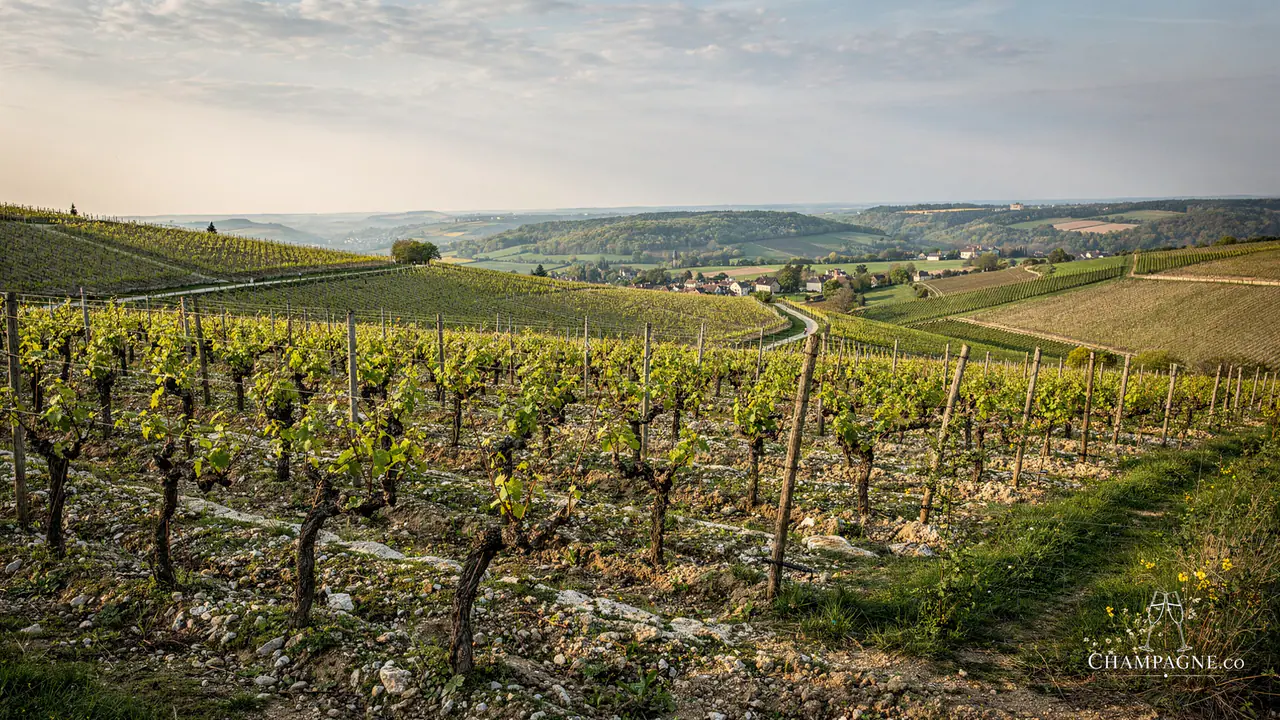
The domaine describes its 8.5 hectares as a mosaic of more than 60 small parcels. In Boursault, the current house profile records Meunier and Pinot Noir on calcareous brown soils over clay. Monthelon and Mancy combine Chardonnay, Meunier and a small amount of Pinot Noir on clay-limestone soils. The Côte des Blancs holdings in Cramant, Chouilly, Avize and Cuis are planted to Chardonnay on chalk-dominant soils.
That diversity makes exact vineyard origin important. A Cramant Grand Cru Blanc de Blancs and a blend containing fruit from Boursault express different parts of the same estate, so village and parcel data should remain attached to the relevant cuvée.
Winemaking and cellar approach
Lancelot-Pienne's current philosophy emphasises parcel-by-parcel vinification in temperature-controlled stainless steel, with malolactic fermentation decided according to the individual wine rather than imposed uniformly. The house then uses extended bottle ageing in its chalk cellars and generally low dosage as tools to preserve differences between wines.
The current Table Ronde release illustrates that precision: it combines Chardonnay from Cramant, Avize and Chouilly, with most of the wine from the 2021 harvest plus a perpetual-reserve component, and only a small fraction raised in demi-muids. Those proportions belong to that release, not to every Table Ronde bottling.
Champagne.co analysis
Lancelot-Pienne's identity comes from controlled contrast. Cramant and the Côte des Blancs provide the Chardonnay centre of gravity, but the domaine's holdings in Boursault, Monthelon and Mancy allow it to build meaningful mixed-grape wines without abandoning its terroir-led philosophy.
The range makes that contrast easy to follow. Tradition gives the widest blended view, Table Ronde focuses the house on Grand Cru Chardonnay, Perceval reconnects Chardonnay with Pinot Noir across two regions, and Marie Lancelot narrows the lens back to vintage Cramant.
Buying guidance
Start with Table Ronde if the main interest is the domaine's Côte des Blancs Chardonnay identity, or Tradition for the broader three-grape view. Perceval is the more useful choice for comparing Cramant Chardonnay with Boursault Pinot Noir in one vintage wine.
Choose Marie Lancelot when vintage Cramant alone is the priority. For all of these wines, keep the exact base year or vintage, reserve proportion, dosage and ageing attached to the current release because Lancelot-Pienne publishes technical detail at cuvée level rather than as permanent house-wide specifications.
Loading current Champagne range…
Spotted something wrong? Report a correction
Every report goes to a human review queue. Nothing on this page changes automatically.