Larmandier-Bernier
Larmandier-Bernier is a family grower based in Vertus on the Côte des Blancs. The Larmandier family has worked vineyards in the area since the nineteenth century, while the Larmandier-Bernier name dates from 1971, when Philippe Larmandier and Elisabeth…
Editorial profile
Larmandier-Bernier is a family grower based in Vertus on the Côte des Blancs. The Larmandier family has worked vineyards in the area since the nineteenth century, while the Larmandier-Bernier name dates from 1971, when Philippe Larmandier and Elisabeth Bernier established the estate in Vertus. Pierre Larmandier returned to the family profession in 1988; today the family team includes Pierre, Sophie, Arthur and Georges Larmandier.
The estate currently reports 19 hectares of its own vines, with no purchased grapes. More than 90% is Chardonnay, concentrated in Vertus Premier Cru and the Grand Cru villages of Cramant, Chouilly, Oger and Avize. Its modern identity is inseparable from a long shift toward soil-led farming: herbicides were abandoned in 1992, the whole estate moved to biodynamic cultivation in 1999, and organic certification followed in 2003.
Why this producer matters
Larmandier-Bernier is a particularly clear example of a Côte des Blancs grower using farming and cellar choices to separate individual places rather than imposing one uniform house style. The estate combines a substantial Chardonnay-dominant vineyard base with both multi-village blends and wines built around individual villages or parcels.
That distinction is structural, not cosmetic. Latitude and Longitude assemble fruit across sites and years, while Terre de Vertus, Vieille Vigne du Levant and Les Chemins d’Avize isolate more specific origins. The result is a range that lets a reader move from a broad estate expression toward increasingly precise interpretations of the Côte des Blancs.
Vineyards and terroir
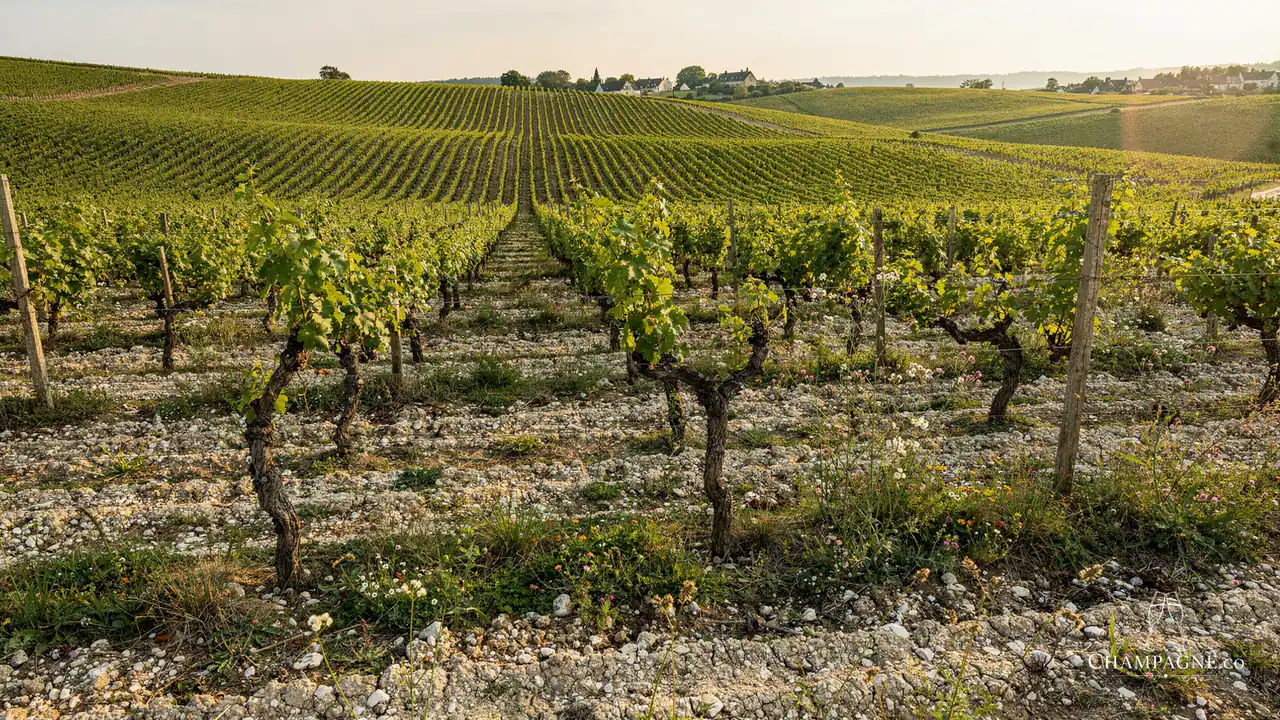
The estate’s vineyards lie on the chalk-dominated Côte des Blancs. Larmandier-Bernier identifies outcropping Campanian chalk as a defining feature and gives an average vine age of about 35 years, with old massal selections retained within the vineyard heritage.
The village spread is important. Vertus provides the Premier Cru home base and both Chardonnay and Pinot Noir. Farther north, Cramant, Chouilly, Oger and Avize extend the estate through Grand Cru Chardonnay territory. For Les Chemins d’Avize, the estate identifies two old-vine parcels, Chemin de Plivot and Chemin de Flavigny, in Avize, where the soils are poor and chalk lies close to the surface.
Winemaking and cellar approach
Grapes are harvested by hand and each cru, variety and parcel is vinified separately before blending decisions are made. Fermentations begin with indigenous yeasts, a practice used across the estate since 1999. The crop is fermented and matured in wooden casks and larger Stockinger vats, with the wines remaining on their lees for roughly eleven months before bottling. The estate says it neither fines nor filters the wines.
A perpetual reserve begun in 2004 contributes to the multi-year blends. By contrast, parcels judged sufficiently distinctive can be bottled as single-origin wines. Bottle ageing is deliberately long, and dosage across the range is generally low; exact figures should be read as attributes of the individual release rather than a permanent rule for every wine.
Champagne.co analysis
The most useful way to understand Larmandier-Bernier is as a progression from estate philosophy to geographical precision. Biodynamic farming, indigenous fermentation, wood maturation and restrained dosage are not separate talking points: together they create a relatively transparent framework in which differences between Vertus, Cramant and Avize can remain legible.
The range also avoids forcing every vineyard into a parcel wine. Latitude and Longitude show the value the family still places on blending, while the single-origin cuvées are reserved for sites they choose to isolate. That balance makes the estate more informative than a simple “grower Champagne” label suggests: it is simultaneously a study of Côte des Blancs blending and of individual terroirs.
Buying guidance
For a first bottle, Longitude is the clearest introduction to the estate’s Chardonnay-focused Côte des Blancs identity. Latitude is useful for comparing how a broader blend changes that expression. Readers interested in more specific origins should move toward Terre de Vertus, Vieille Vigne du Levant or Les Chemins d’Avize, checking the exact vintage and release when buying. Rosé de Saignée offers the most direct contrast to the Chardonnay-led wines, while Vertus Rouge is for readers specifically seeking the estate’s still-wine interpretation rather than Champagne.
Loading current Champagne range…
Spotted something wrong? Report a correction
Every report goes to a human review queue. Nothing on this page changes automatically.