Le Brun de Neuville
Le Brun de Neuville is a winegrowers' cooperative based in Bethon on the Côte de Sézanne. It began in 1963 when 26 growers joined together as La Crayère; the organisation now brings together nearly 170 winegrowers. Its identity is strongly tied to…
Editorial profile
Le Brun de Neuville is a winegrowers' cooperative based in Bethon on the Côte de Sézanne. It began in 1963 when 26 growers joined together as La Crayère; the organisation now brings together nearly 170 winegrowers. Its identity is strongly tied to Chardonnay and to the chalk-rich slopes of the Sézannais rather than to the model of a single family estate.
The producer works across 12 villages, with vines that are predominantly Chardonnay. Its current range is divided into four useful families—Côte, Les Chemins, Autolyse and Millésime—allowing the cooperative to move from broad Côte de Sézanne expression to parcel-led wines and unusually long lees ageing.
Why this producer matters
Le Brun de Neuville gives the Côte de Sézanne a clear collective identity. The producer states that Chardonnay accounts for about 90% of its vineyard base, with Pinot Noir providing the balance, and that much of the vineyard is more than 40 years old. This gives the range a coherent regional centre even though the fruit comes from many growers and villages.
Its other distinguishing feature is time in bottle. The house sets a minimum of four years on lees for its Champagnes, while selected Autolyse wines remain much longer. That long-ageing programme, alongside the Les Chemins parcel approach, makes the range more ambitious than a simple cooperative house blend.
Vineyards and terroir
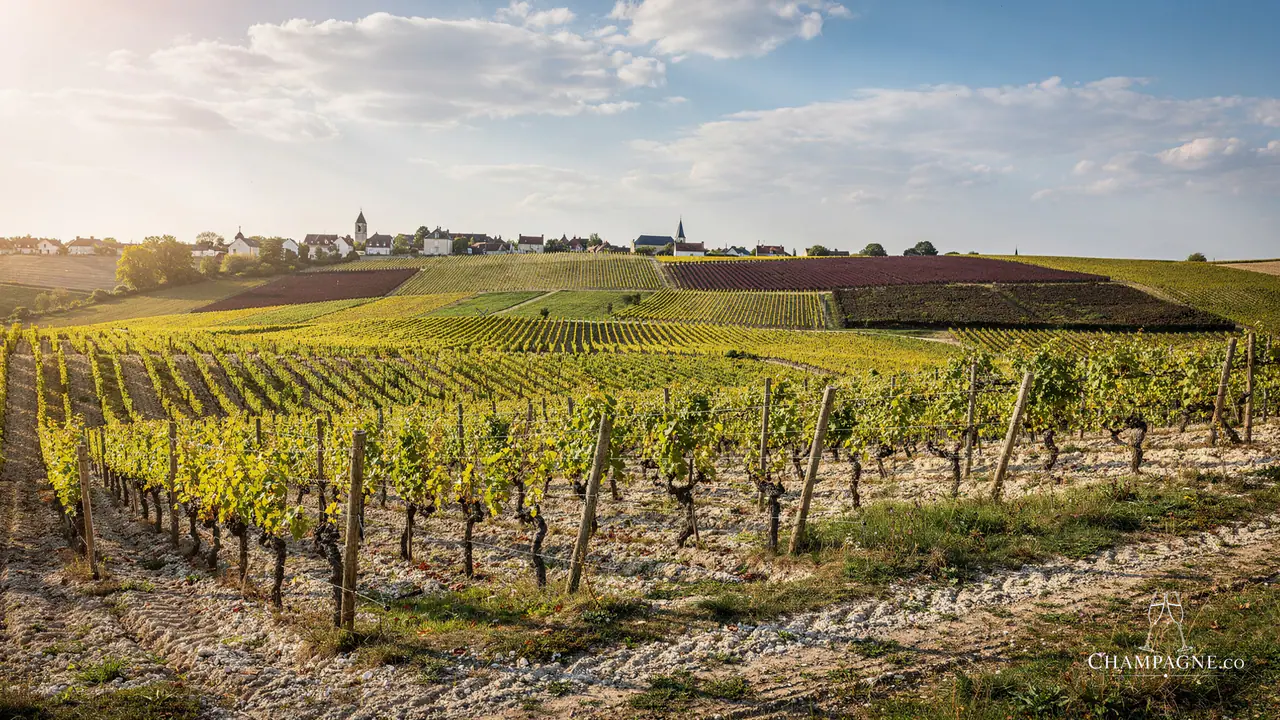
The vineyard base extends across 12 villages in the Côte de Sézanne. The producer describes the sector's chalk as highly porous, helping retain water for vines during dry periods, while the hillside position provides good solar exposure. Chardonnay dominates the plantings at roughly 90%.
Le Brun de Neuville encourages growers towards more environmentally responsible viticulture and identifies fruit from grassed, herbicide-free and mechanically weeded vineyards, as well as HVE- and Viticulture Durable en Champagne-certified holdings, within its sourcing approach.
Because this is a cooperative, these figures describe the collective vineyard base rather than a single contiguous estate owned by one family.
Winemaking and cellar approach
Harvested fruit is separated by grape variety, village and farming practice to expand the palette available for blending. Fermentation can take place in temperature-controlled stainless steel or, for selected wines, in oak vessels; the producer also works both with and without malolactic fermentation depending on the cuvée.
The defining cellar commitment is lees ageing. The producer states a minimum of four years in its underground cellars before release, with longer periods for its most ambitious wines. Some Les Chemins cuvées are bottled under cork for secondary fermentation, while Autolyse is explicitly conceived around extended contact with the lees.
Champagne.co analysis
Le Brun de Neuville is best understood as a regional specialist with enough scale to separate different interpretations of the Côte de Sézanne. The Côte wines establish the collective baseline, while Les Chemins narrows the focus towards individual sites. Autolyse changes the axis again, making extended lees ageing rather than geography the main variable.
That structure is particularly useful because cooperative Champagne can otherwise be difficult to read from the label alone. Here, the hierarchy is not simply based on price or prestige: each family answers a different question about place, time or blend. Chardonnay provides the common thread, but Pinot Noir remains meaningful in both the vineyard base and selected cuvées.
The long minimum ageing also helps explain why the producer's identity is not solely about the relatively sunny Côte de Sézanne landscape. The wines are deliberately given substantial bottle maturation before release, creating a house approach that combines regional fruit with extended cellar development.
Buying guidance
For a first look at the producer, choose a wine from the Côte family; Côte Blanche is the clearest route if the aim is to understand its Chardonnay emphasis. Move to Les Chemins when parcel identity is the priority.
Choose Autolyse when extended lees ageing is the main attraction, but check the exact cuvée because grape composition, base year, dosage and time in cellar differ significantly between releases. For a single-harvest interpretation, buy Millésime by the stated vintage rather than assuming that one technical specification applies across years.
Loading current Champagne range…
Spotted something wrong? Report a correction
Every report goes to a human review queue. Nothing on this page changes automatically.