Leclerc Briant
Leclerc Briant is an Épernay house with roots in Cumières, where Lucien Leclerc founded the domaine in 1872. The family moved the business to Épernay in 1955; around the same period Bertrand Leclerc and Jacqueline Briant developed it into a négociant house…
Editorial profile
Leclerc Briant is an Épernay house with roots in Cumières, where Lucien Leclerc founded the domaine in 1872. The family moved the business to Épernay in 1955; around the same period Bertrand Leclerc and Jacqueline Briant developed it into a négociant house and the Leclerc Briant name took shape. A new chapter began in 2012 when Mark Nunnelly and Denise Dupré acquired the house, with Frédéric Zeimett subsequently leading its revival.
Today Leclerc Briant combines the scale and sourcing flexibility of a house with an unusually strong estate-vineyard identity. Its own 14 hectares are certified organic and biodynamic, while additional grapes are bought from growers who are certified organic or in conversion. Hervé Jestin works with the house on its biodynamic approach to vinification.
Why this producer matters
Leclerc Briant’s importance is not simply that it carries organic and biodynamic certification today. The environmental thread reaches back through the family: Bertrand Leclerc began organic experiments around 1960, and Pascal Leclerc introduced biodynamic trials in 1990. That gives the modern programme historical depth rather than making it a recent repositioning exercise.
The second distinctive feature is the breadth of the wine programme. The range moves from multi-parcel house cuvées through named single-vineyard wines to specialist releases such as Abyss. This creates several ways to understand the producer: through blending, through individual sites, and through more experimental ageing ideas.
Vineyards and terroir
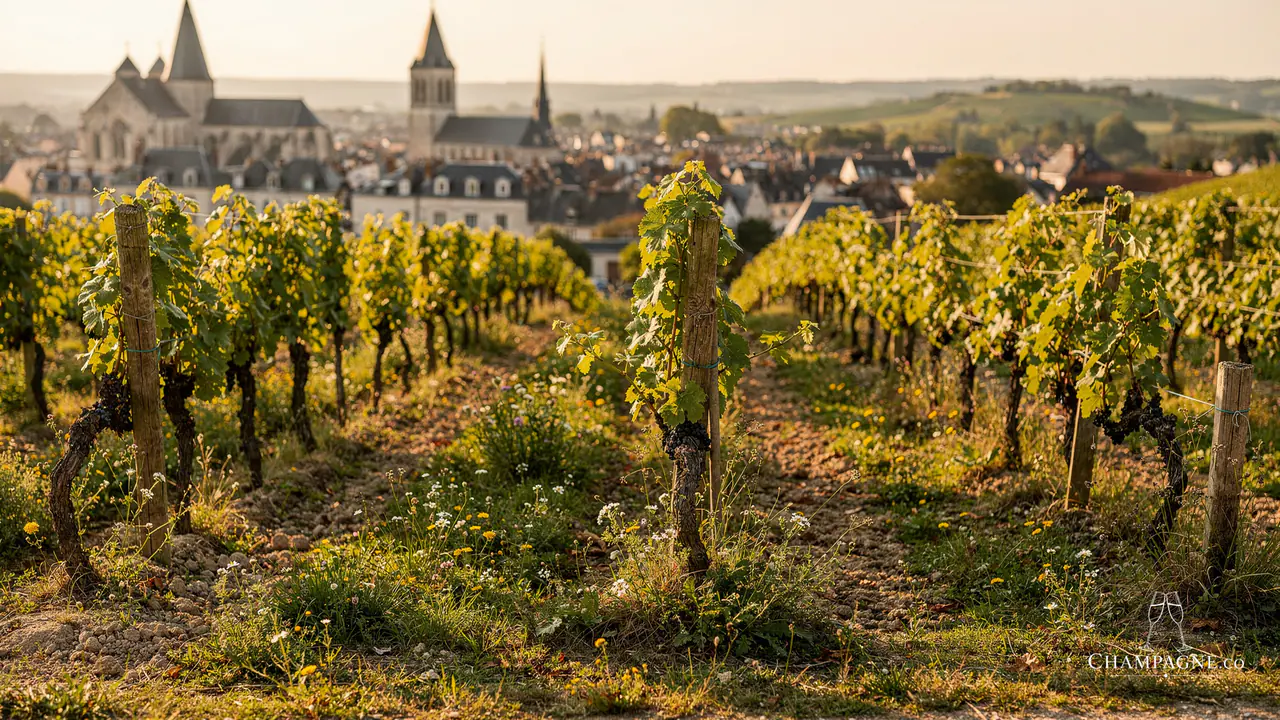
The house farms 14 hectares of its own vines. Its holdings include Grand Cru sites at Mailly and Le Mesnil and Premier Cru vineyards in villages including Hautvillers, Cumières, Bisseuil, Trépail, Rilly-la-Montagne and Villers-Allerand. La Croisette, a small Chardonnay parcel beside the Épernay house, has particular historical importance and supplies a parcel cuvée of the same name.
Estate fruit is supplemented by purchased grapes from organic-certified or converting growers. The distinction matters: Leclerc Briant has a genuine certified estate, but its Champagne production should not be described as exclusively estate-grown.
Winemaking and cellar approach
The cellar programme follows the same environmental philosophy as the vineyards. The house describes a gentle approach from pressing through disgorgement, with Hervé Jestin applying biodynamic principles to vinification as well as viticulture. Wines receive extended élevage before prolonged bottle ageing in the house’s deep Épernay cellars, and dosage is generally restrained, although the exact treatment varies by cuvée.
The cellars themselves extend for more than a kilometre and descend to around 35 metres below ground. Barrel maturation is an important part of the programme, but individual élevage, dosage and disgorgement details should be read wine by wine rather than treated as fixed house formulas.
Champagne.co analysis
Leclerc Briant is most coherent when viewed as a house built around three connected ideas: a long-running environmental philosophy, a meaningful estate-vineyard base, and a willingness to test how different élevage and ageing choices affect Champagne. The 14-hectare certified estate provides the agricultural foundation; the parcel wines make individual sites visible; and the specialties push beyond conventional cellar practice.
For readers encountering the producer for the first time, the most useful point is that the headline-grabbing Abyss wines are not the whole story. The deeper identity lies in the continuity between biodynamic farming, the Épernay cellar programme and a range that can move from blended Champagne to exact parcels without abandoning the same underlying philosophy.
Buying guidance
Start with Réserve Extra Brut for the broadest view of the house. Readers interested in Chardonnay can look to the current Blanc de Blancs or Avize Grand Cru, while Blanc de Meuniers offers a more grape-specific route into the range. The single-vineyard wines are the logical choice when site and vintage matter more than a general house signature.
For collectors interested in Leclerc Briant’s more unconventional work, Abyss and Abyss Rosé are the obvious specialist bottles. They are better treated as an extension of the producer’s experimental culture than as a substitute for understanding its estate and parcel wines.
Loading current Champagne range…
Spotted something wrong? Report a correction
Every report goes to a human review queue. Nothing on this page changes automatically.