Lefébure
Maison M. Lefébure is a small grower project centred on Baye in the Coteaux du Petit Morin. Marie-Laurène and Sébastien Lefébure work on a deliberately small scale, with current specialist records placing the vineyard holding at roughly five to 5.5…
Editorial profile
Maison M. Lefébure is a small grower project centred on Baye in the Coteaux du Petit Morin. Marie-Laurène and Sébastien Lefébure work on a deliberately small scale, with current specialist records placing the vineyard holding at roughly five to 5.5 hectares. The range is correspondingly compact and strongly cuvée-led rather than built around a large house hierarchy.
Public information about Lefébure is less extensive than for many established Champagne houses, so the most reliable way to understand the producer is through the facts that recur across current specialist distribution: Baye and the Petit Morin as the core geography, a small vineyard base, and a group of wines that often isolate a grape, parcel or particular vessel choice.
Why this producer matters
Lefébure represents the small-scale end of contemporary Champagne: a grower identity in a less internationally familiar sector of the appellation, with individual wines carrying much of the story. The Coteaux du Petit Morin location is useful in itself, broadening the map beyond the better-known Côte des Blancs, Montagne de Reims and Vallée de la Marne reference points.
The current range also shows a willingness to separate ideas clearly. Meunier and Chardonnay meet in Nos Esprits Libres & Contents, while Prune Monsieur, Stella Maris and Néolithique take more narrowly defined routes through grape, parcel or élevage.
Vineyard and cellar identity
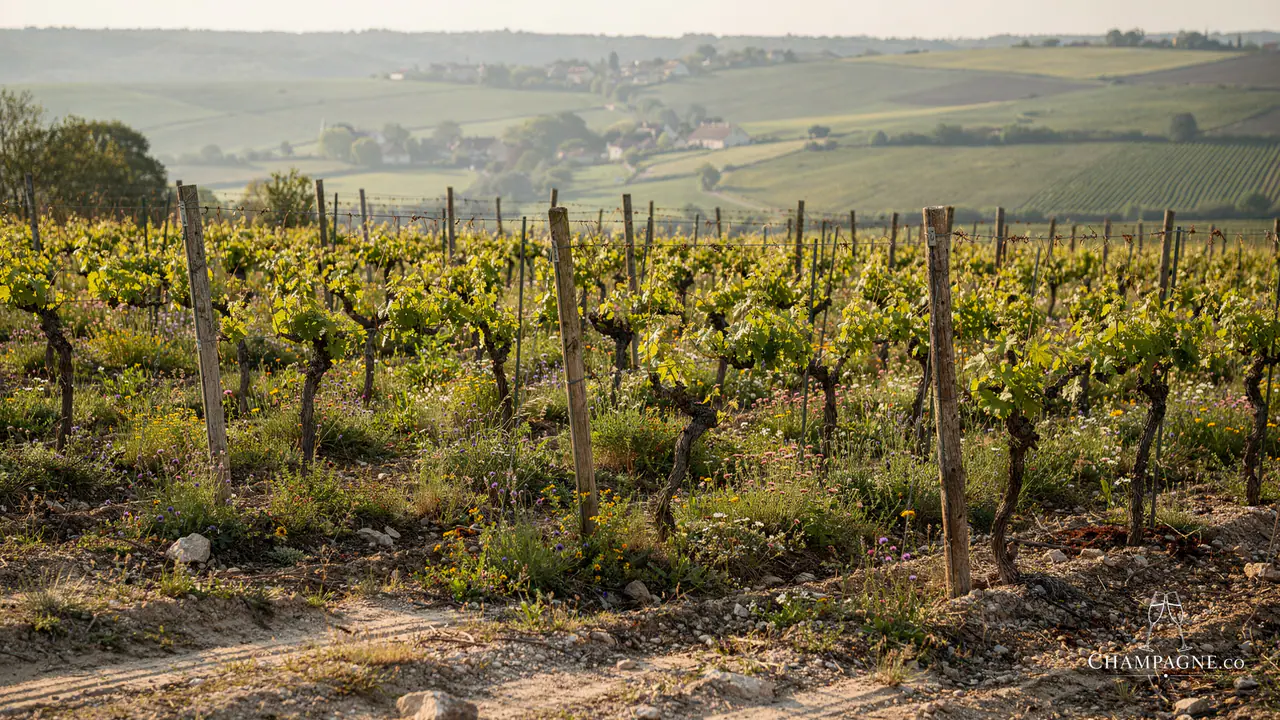
Current specialist material places the domaine at about five to 5.5 hectares, predominantly in the Coteaux du Petit Morin, with an additional small holding in the Côte des Bar reported by some distributors. Because no sufficiently detailed current producer-controlled vineyard register is publicly available, exact estate size and parcel totals are best treated as approximate.
The available technical records repeatedly point to wood fermentation or maturation for several cuvées, manual riddling and disgorgement à la volée. These are useful indicators of an artisanal cellar approach, but they should not be converted into universal rules for every Lefébure release.
Champagne.co analysis
Lefébure is a producer where the individual cuvées are more informative than a conventional house-style shorthand. The common thread is small scale and a willingness to let grape, site and vessel create distinct identities within a short portfolio.
For Champagne.co readers, the useful context is geographic as well as stylistic. Baye and the Coteaux du Petit Morin sit outside the appellation’s most familiar prestige shorthand, so Lefébure offers a route into a part of Champagne that is often underrepresented in general buying guides.
Buying guidance
Nos Esprits Libres & Contents is the clearest starting point because it is the most consistently documented and widely listed wine. Readers wanting a more focused grape expression can look to Prune Monsieur for Pinot Noir or Stella Maris and Néolithique for Chardonnay.
Because Lefébure is small and release details can change, buy by the exact cuvée and bottling in front of you. Check the back label or current merchant technical sheet for vintage/base year, dosage and élevage rather than assuming that an older specification still applies.
Loading current Champagne range…
Spotted something wrong? Report a correction
Every report goes to a human review queue. Nothing on this page changes automatically.