Legrand Latour
Legrand-Latour is a small grower based in Fleury-la-Rivière on the right bank of the Vallée de la Marne. Thibault Legrand’s work is unusually explicit about geology: the family’s Cave aux Coquillages exposes fossil-rich layers beneath the village, and the…
Editorial profile
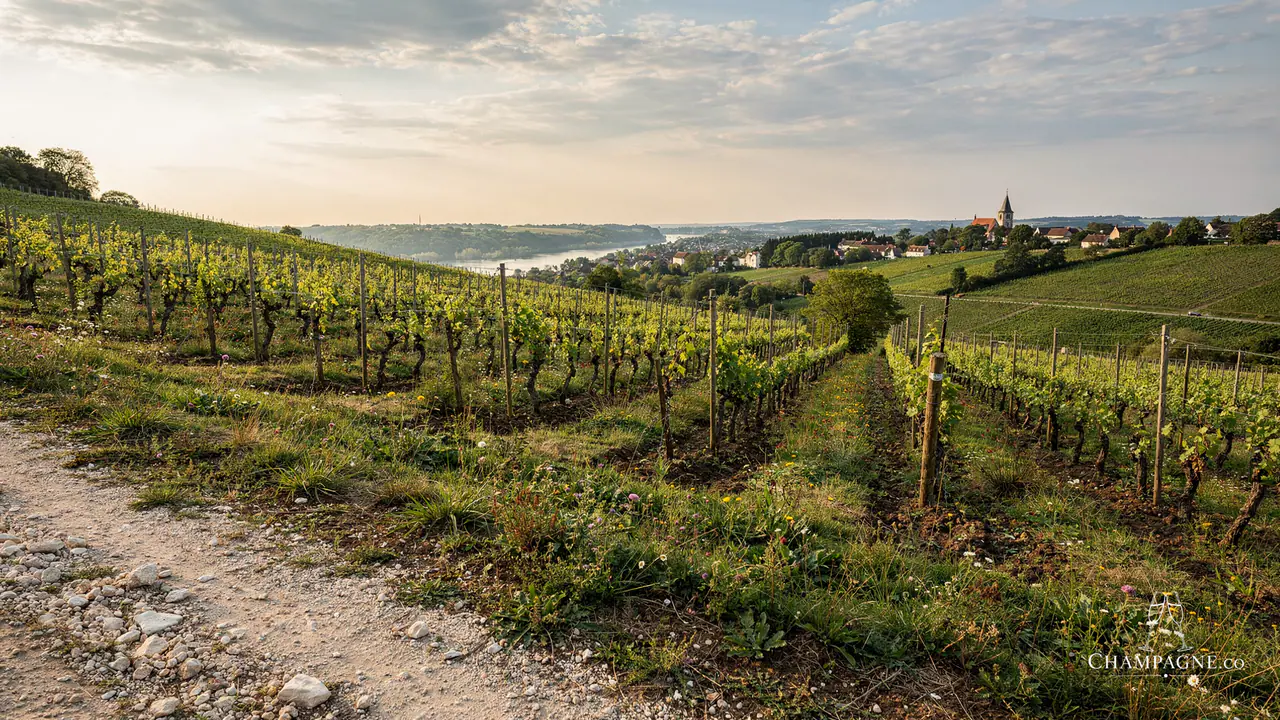
Legrand-Latour is a small grower based in Fleury-la-Rivière on the right bank of the Vallée de la Marne. Thibault Legrand’s work is unusually explicit about geology: the family’s Cave aux Coquillages exposes fossil-rich layers beneath the village, and the domaine uses a “geo-oenological” approach to connect its wines with different geological formations.
The current Association des Champagnes Biologiques record lists 4.2 hectares, all certified organic, planted to 70% Meunier, 20% Pinot Noir and 10% Chardonnay. It records engagement in organic certification from 2016 and the first certified-organic grape production in 2019. Demeter France also currently lists Legrand-Latour and the geology-named wines Yprésien, Eocène, Lutétien and Campanien.
Why this producer matters
Legrand-Latour gives geology a more concrete role than a generic reference to Champagne’s chalk. The family’s fossil site at Fleury-la-Rivière makes the ancient marine history of the area physically visible, while the cuvée names turn different geological periods into a practical way of organising the range.
That idea sits alongside a clearly documented farming identity. The estate is small, entirely organically certified in the current ACB record, and strongly Meunier-led. For readers interested in the less uniform soils and grower culture of the Vallée de la Marne, it is a useful counterpoint to Chardonnay-focused Côte des Blancs estates.
Vineyards and terroir
The domaine is based at Fleury-la-Rivière, where the Cave aux Coquillages exposes fossiliferous calcareous sands associated with the ancient Paris Basin sea. Comité Champagne specifically highlights Legrand-Latour’s fossil research and its use of geo-oenology to interpret the influence of Champagne’s subsoil.
The current certified vineyard surface is 4.2 hectares. Meunier accounts for 70% of the certified plantings, with 20% Pinot Noir and 10% Chardonnay.
Winemaking and cellar approach
The family’s cellar and fossil galleries are part of the same Fleury-la-Rivière site, reinforcing the link between wine production and the geological material exposed underground. Current producer material describes the estate’s move toward biodynamic farming from 2016, while current certification records provide the firmer basis for describing the vineyard as fully organically certified.
Exact fermentation vessels, tirage methods, ageing periods, disgorgement dates and dosage can vary by cuvée and release. They are best treated as bottle-specific information rather than permanent rules for every Legrand-Latour Champagne.
Champagne.co analysis
Legrand-Latour is most compelling when the geology is treated as a working framework rather than a novelty. Fleury-la-Rivière’s fossil-bearing underground gives the producer an unusually tangible way to discuss the origins of its soils, while the small certified-organic vineyard and Meunier majority keep the story anchored in farming rather than tourism.
The range also rewards comparison. Instead of assuming that every bottle expresses one fixed “Legrand-Latour style”, it makes more sense to read Yprésien, Eocène, Lutétien and Campanien as related but distinct interpretations of place. That is the clearest route into what the producer is trying to do.
Buying guidance
For a first encounter, compare Yprésien and Eocène to understand the geological naming idea across two cuvées rather than judging the domaine from a single bottle. Lutétien and Campanien broaden that comparison for readers who want to explore the range more deeply.
Because technical specifications can change between releases, check the exact bottle when dosage, base year, blend or cellar treatment matters to the purchase. Lutétien deserves particular attention because the name is used in both Champagne and Coteaux Champenois contexts.
Loading current Champagne range…
Spotted something wrong? Report a correction
Every report goes to a human review queue. Nothing on this page changes automatically.