Lelarge-Pugeot
Lelarge-Pugeot is a family grower in Vrigny, a Premier Cru village on the Montagne de Reims. The family traces its winegrowing in the village to 1799, and the contemporary estate combines that long local continuity with a notably progressive approach to…
Editorial profile
Lelarge-Pugeot is a family grower in Vrigny, a Premier Cru village on the Montagne de Reims. The family traces its winegrowing in the village to 1799, and the contemporary estate combines that long local continuity with a notably progressive approach to farming. Its 8.7 hectares are organically farmed and planted to 4.4 hectares of Meunier, 2.8 hectares of Pinot Noir and 1.5 hectares of Chardonnay.
That mix makes Lelarge-Pugeot particularly useful for understanding Vrigny beyond a single grape or style. Meunier is the largest component of the vineyard and receives unusual attention in the range, while Pinot Noir and Chardonnay broaden the estate's view of its home village. The result is a grower identity built as much around farming and parcel expression as around a conventional house blend.
Why this producer matters
Lelarge-Pugeot connects deep family roots in Vrigny with one of the clearer organic-and-biodynamic trajectories among growers on this part of the Montagne de Reims. The estate began moving away from conventional inputs over several decades, entered organic certification with Ecocert in 2010, achieved full organic certification from the 2015 harvest and later obtained Demeter biodynamic certification.
Its other point of distinction is Meunier. That gives the range a strong sense of place and makes Lelarge-Pugeot a particularly interesting reference for drinkers exploring Meunier from Premier Cru Vrigny.
Vineyard and terroir
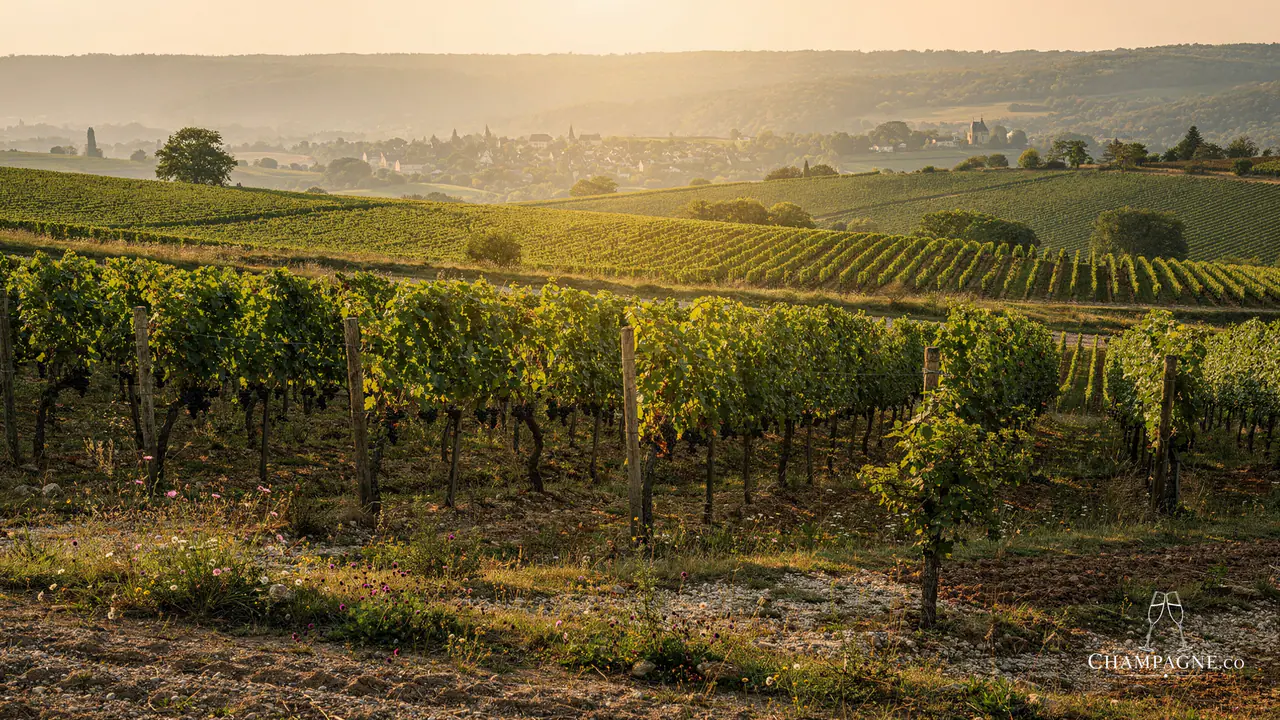
The estate farms 8.7 hectares around Vrigny on a mixture of calcareous-marl, clay-loam and sandy soils. Meunier accounts for just over half the surface, followed by Pinot Noir and Chardonnay. The producer's farming programme includes cover crops, soil cultivation and, on part of the estate, horse ploughing. Fruit trees and beehives have also been introduced as part of a broader effort to encourage biodiversity.
The important point for the wines is not simply the certification label. Lelarge-Pugeot has made soil life and reduced intervention central to how it interprets Vrigny, with biodynamic practice used as an extension of that vineyard-first philosophy.
Cellar and winemaking
The cellar has expanded its range of fermentation vessels in recent years, including amphorae and 500-litre barrels.
Those choices should not be turned into a single recipe for every bottle. Vessel, harvest composition, reserve-wine share, time on lees, disgorgement and dosage vary materially by cuvée and release. Lelarge-Pugeot is best understood as a producer with a consistent low-intervention direction but deliberately varied routes to expressing individual wines.
Champagne.co analysis
Lelarge-Pugeot is most compelling when viewed as a Vrigny grower rather than simply an organic Champagne producer. Certification is important, but it is the combination of mixed soils, a Meunier-led vineyard, multiple wine formats and a willingness to separate particular expressions that gives the estate its identity.
For Champagne drinkers, the range offers a useful progression. The traditional bottlings establish the house language; the Meunier-focused and named wines then show how far the family is prepared to push that language toward grape, parcel and farming expression. That makes Lelarge-Pugeot especially relevant to readers interested in the diversity of the Montagne de Reims beyond its better-known Pinot Noir villages.
Buying guidance
Start with Tradition for context, then move to a Meunier-focused wine such as Les Meuniers de Clémence or Saignée de Meunier if the aim is to understand what distinguishes the estate. The still Coteaux Champenois are particularly relevant for enthusiasts who want to explore the family's work with Meunier and Vrigny outside the framework of sparkling wine.
For vintage, parcel or low-dosage bottlings, check the exact release rather than assuming a historic technical specification still applies. Lelarge-Pugeot's harvest composition, élevage, disgorgement and dosage can change from one bottling to another.
Loading current Champagne range…
Spotted something wrong? Report a correction
Every report goes to a human review queue. Nothing on this page changes automatically.