Loriot-Pagel
Loriot-Pagel is a family grower-producer based in Festigny, in the Vallée de la Marne. The family's winegrowing history in the village dates to 1838 and now spans six generations. Jean-Philippe Loriot joined the estate after his winegrowing studies, took…
Editorial profile
Loriot-Pagel is a family grower-producer based in Festigny, in the Vallée de la Marne. The family's winegrowing history in the village dates to 1838 and now spans six generations. Jean-Philippe Loriot joined the estate after his winegrowing studies, took over in 2013, and is now joined by his sister Alice, who returned to the family business in 2017.
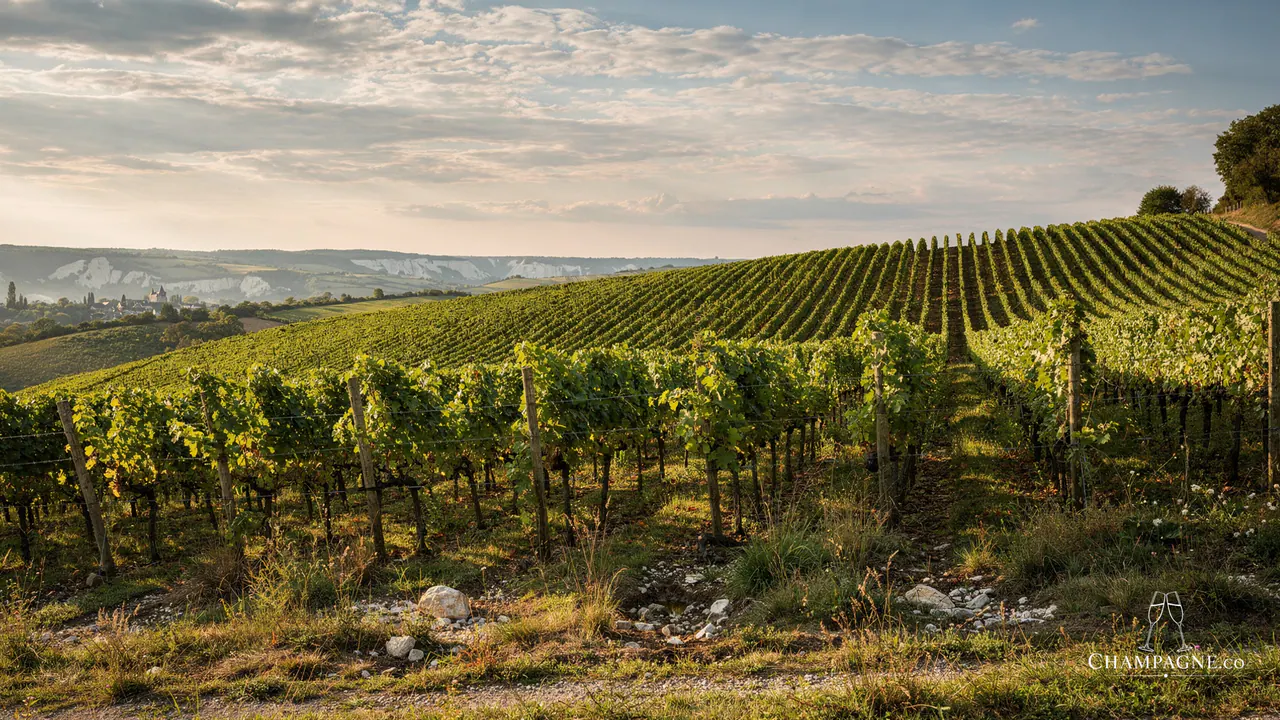
The estate farms about nine hectares across seven crus. Most of the vineyard lies in the Vallée de la Marne, with Festigny at the centre of the family's Meunier identity, while Chardonnay comes from Grand Cru holdings in Cramant, Avize and, to a smaller extent, Oger. The vineyard mix is currently about 66% Meunier, 21% Chardonnay and 13% Pinot Noir; the producer states that around 20% of its vineyard is Grand Cru, spread across roughly 35 individual plots, with vines averaging about 40 years of age.
Loriot-Pagel operates as an independent winegrower and states that it vinifies only fruit from its own estate. That gives the range a clear internal logic: Meunier-led non-vintage cuvées from the Marne Valley sit alongside vintage wines that draw on the estate's Côte des Blancs Chardonnay and, at the top end of the range, a Spécial Club built around Festigny Meunier.
Why this producer matters
The most distinctive feature of Loriot-Pagel is the way it treats Meunier as more than a supporting grape. Festigny is not just the estate's address; it is the historical and stylistic centre of the vineyard, and Meunier accounts for roughly two-thirds of the planted area. That importance shows up in both the everyday wines and the vintage programme.
At the same time, the estate is not one-dimensional. Grand Cru Chardonnay holdings in Cramant, Avize and Oger allow Loriot-Pagel to build a Blanc de Blancs line alongside its Meunier-dominant wines. The contrast between those two parts of the vineyard is one of the most useful ways to understand the producer.
Loriot-Pagel is also a member of the Club Trésors de Champagne, the growers' association behind the Spécial Club designation. Its Spécial Club therefore sits within a collective selection framework rather than being simply a proprietary prestige label.
Vineyards and farming
The estate's nine hectares are divided between four Vallée de la Marne crus, principally Festigny, and three Grand Cru villages in the Côte des Blancs. Loriot-Pagel describes the Festigny sector in terms of green clay and limestone, while its Chardonnay parcels in Cramant, Avize and Oger are rooted in chalkier Côte des Blancs soils.
The domaine is certified HVE Level 3 and Viticulture Durable en Champagne (VDC), with VDC certification dating from 2020. Its current environmental material describes natural grassing and/or ploughing over most of the vineyard, alongside measures aimed at biodiversity, water management, waste reduction and lower-impact vineyard practice.
Winemaking and cellar approach
Most Loriot-Pagel wines are matured in small stainless-steel tanks, which lets different harvests and terroirs remain separate during élevage. Some reserve wines are held in oak, while Cuvée N°6 is the deliberate exception in the range: its named 2014 release was vinified in barrel and aged with lees stirring.
The producer describes a typical cellar horizon of about four years for non-vintage cuvées and an average of about eight years for vintage Champagnes. Those are estate-level reference points rather than fixed specifications for every bottling. Exact malolactic fermentation, ageing, blend and dosage vary by cuvée and should be read from the individual current release.
Champagne.co analysis
Loriot-Pagel makes most sense when viewed as a two-terroir estate. Festigny and the Vallée de la Marne provide the dominant Meunier identity; Cramant, Avize and Oger provide the Chardonnay counterpoint. The range then moves between those poles rather than trying to force every wine into a single uniform style.
That explains why the producer's most informative bottles are not necessarily the most expensive ones. Carte d'Or and Brut Nature reveal how Loriot-Pagel handles Meunier across multi-vintage blending, while Blanc de Blancs Grand Cru shows the Côte des Blancs side of the same estate. Cuvée N°6 and Spécial Club then add vintage-specific cellar choices and longer ageing.
Buying guidance
For a first look at Loriot-Pagel, Carte d'Or is the natural baseline because it shows the producer's Meunier-led house blend with reserve wine. Brut Nature is the better comparison if you want to see the same broad estate identity with zero dosage and a large perpetual-reserve component.
For Chardonnay, choose the Blanc de Blancs Grand Cru and check the vintage and format because current bottle and magnum listings are not identical. For a more cellar-driven vintage style, Cuvée N°6 2014 is the obvious reference because its barrel vinification clearly separates it from the mostly stainless-steel range. For the most direct statement of Festigny Meunier in the current line-up, Spécial Club 2018 is the key bottle.
Loading current Champagne range…
Spotted something wrong? Report a correction
Every report goes to a human review queue. Nothing on this page changes automatically.