Mailly Grand Cru
Mailly Grand Cru is one of Champagne’s longstanding cooperative producers, founded in 1929 by 24 growers whose vineyards were all in Mailly-Champagne. Its defining feature remains unusually simple: the wines are rooted in one Grand Cru village rather than…
Editorial profile
Mailly Grand Cru is one of Champagne’s longstanding cooperative producers, founded in 1929 by 24 growers whose vineyards were all in Mailly-Champagne. Its defining feature remains unusually simple: the wines are rooted in one Grand Cru village rather than assembled from a geographically broad supply base. The estate currently describes more than 70 hectares across all 35 lieux-dits of Mailly-Champagne, planted approximately 75% Pinot Noir and 25% Chardonnay.
That concentration gives Mailly both scale and precision. The village’s vineyards face all four cardinal directions, creating a varied set of exposures within a compact territory on the northern Montagne de Reims. In the cellar, selected parcels are harvested, pressed and vinified separately, while reserve wines from more than ten vintages broaden the blending palette. The cooperative also uses different vessels according to the wine, including oak for selected lots and a perpetual-reserve system for certain cuvées.
Why this producer matters
Mailly demonstrates what a cooperative can achieve when its membership and vineyard base are concentrated in a single highly regarded cru. The model combines the resources of a substantial producer with unusually tight geographic definition: one village, 35 lieux-dits and a large reserve-wine library.
Its history is also inseparable from the growers themselves. After founding the company in 1929, members began digging their own chalk cellars in the winter of 1931–32. The galleries were extended over successive winters to around a kilometre and lie 19 metres underground. Those cellars remain part of the producer’s working infrastructure rather than simply a historical attraction.
Vineyards and terroir
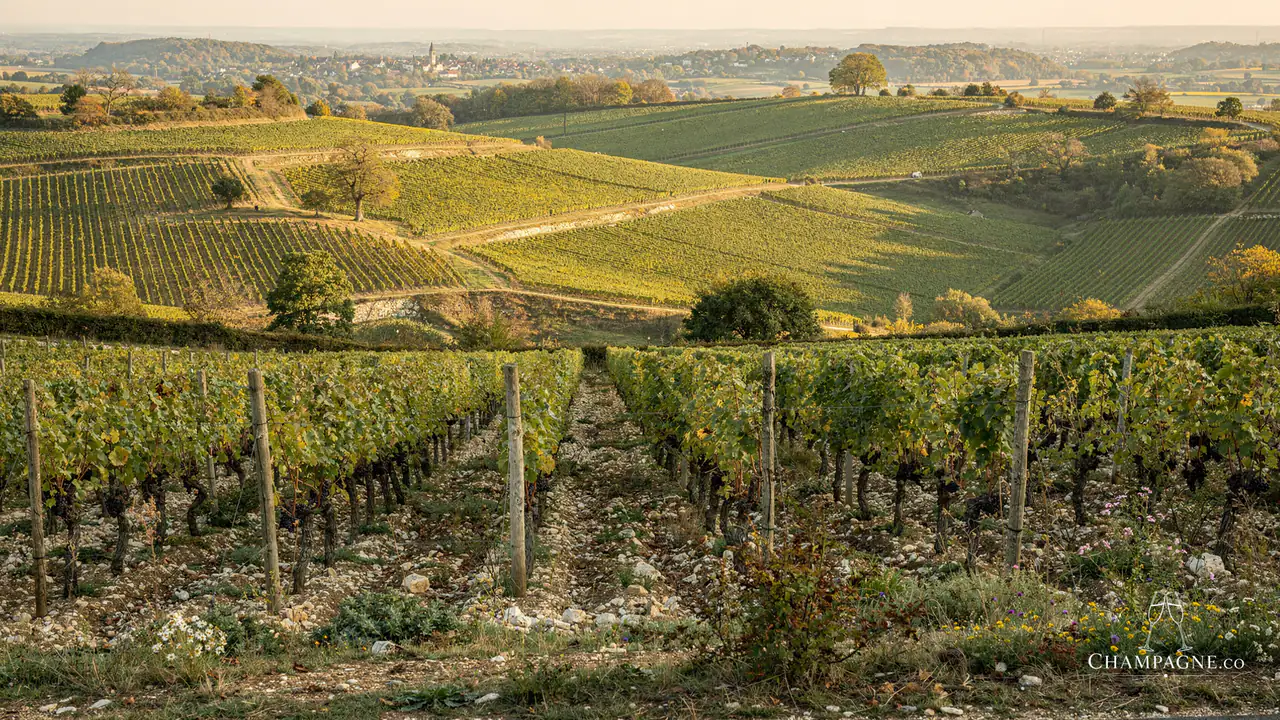
Mailly’s vineyard is a patchwork of 35 named places, with vines on north-, south-, east- and west-facing slopes. The producer’s recent geological work emphasises the diversity created by old landslides, sediments, slope positions and exposures within the village. Many parcels face west or north, while some south- and southeast-facing limestone slopes are notably warmer.
The estate-wide planting is approximately 75% Pinot Noir and 25% Chardonnay. That ratio is useful for understanding the vineyard but should not be confused with the blend of any individual cuvée. Mailly’s significance lies less in a single uniform slope than in the ability to assemble or isolate numerous expressions from one Grand Cru territory.
Winemaking and cellar approach
Selected parcels are pressed and vinified separately in small tanks or casks, preserving options for later blending. The reserve-wine collection spans more than ten harvests and is maintained by vintage and grape variety, providing continuity for the non-vintage wines. Some wines are matured in oak, and a perpetual reserve held in large oak is used selectively rather than as a house-wide formula.
Bottle ageing takes place in the historic chalk cellars 19 metres below ground. The cooperative’s current approach therefore combines parcel-level separation at the front end with a deep reserve programme and long underground maturation at the back end.
Mailly also reports that the entire vineyard has held Viticulture Durable en Champagne and Haute Valeur Environnementale certification since 2021, while a portion of the vineyard has subsequently gained organic certification. These are estate-level farming credentials, not claims that every wine is certified organic.
Champagne.co analysis
Mailly is best understood as a large palette contained inside a small geographic frame. More than 70 hectares is substantial, yet all of that land sits within one Grand Cru village. That creates a different proposition from both a tiny single-parcel grower and a large house blending across the appellation: Mailly can work with meaningful volume, reserves and cellar resources while still making village identity the organising principle.
The 35 lieux-dits matter because they give the cellar team choices. Parcel separation allows individual sites to be isolated when useful, while the reserve library allows those components to be recombined for continuity and complexity. Pinot Noir is the structural centre of the vineyard, but Chardonnay remains important enough that the range should not be reduced to a simple “Pinot house” label.
Buying guidance
Brut Réserve is the logical starting point for understanding Mailly as a blended, single-village Grand Cru producer. Buyers wanting to focus more directly on the village’s dominant grape should look to Blanc de Pinot Noir, while Extra Brut Millésimé offers a vintage-specific comparison rather than a permanent house formula.
The two rosés should not be treated as interchangeable: L’Intemporelle Rosé and Rosé de Mailly occupy different places in the range. For more selective or cellar-oriented buying, Les Échansons is the heritage vintage cuvée to investigate, but vintage, blend, dosage and availability should always be checked against the bottle being offered. Coteaux Champenois belongs in a separate still-wine buying decision rather than being compared directly with the Champagnes.
Loading current Champagne range…
Spotted something wrong? Report a correction
Every report goes to a human review queue. Nothing on this page changes automatically.