Marguet
Champagne Marguet is an Ambonnay grower led by Benoît Marguet, with family Champagne history traced by Comité Champagne to around 1875. The estate's current vineyard is compact but unusually concentrated: 7.30 hectares in Ambonnay and 0.70 hectares in…
Editorial profile
Champagne Marguet is an Ambonnay grower led by Benoît Marguet, with family Champagne history traced by Comité Champagne to around 1875. The estate's current vineyard is compact but unusually concentrated: 7.30 hectares in Ambonnay and 0.70 hectares in Bouzy, with vines averaging about 40 years of age according to the producer.
The defining feature is not scale but intent. Marguet combines Grand Cru Pinot Noir territory with an explicitly ecological approach to farming and a range that moves from broad estate blends to village wines, individual lieux-dits and the separate Sapience project. The producer describes the use of biodynamic preparations, phytotherapy and aromatherapy in the vines; Comité Champagne records draft-horse soil cultivation since 2010 and currently lists the estate for organic agriculture and Demeter biodynamic farming.
That agricultural philosophy continues into the cellar, where the estate describes gravity handling, ageing on lees and deliberately gentle production methods. Yet Marguet is most useful to understand through its hierarchy of origin. Shaman expresses the Ambonnay/Bouzy estate as a whole; Yuman shifts the focus to Chardonnay; the current range then extends through vintage village wines from several celebrated crus and into named parcels such as Les Crayères, Le Parc, Les Bermonts and Les Saints Remys. Sapience operates alongside that structure as a separate prestige programme.
Why this producer matters
- Family Champagne history reaches back to around 1875.
- The current estate totals 8 hectares, overwhelmingly in Ambonnay with a smaller holding in Bouzy.
- Average vine age is about 40 years according to the estate.
- Biodynamic preparations, medicinal-plant treatments and aromatherapy are part of the producer's stated vineyard practice.
- Draft horses have been used for soil work since 2010.
- The current portfolio is unusually granular, moving from estate blend to village wine, lieu-dit and prestige/library release.
- Marguet's own range now reaches well beyond Ambonnay and Bouzy through wines identified with Avize, Chouilly, Le Mesnil-sur-Oger, Oger, Vertus and other crus, making origin an essential part of reading the label.
Vineyard and farming
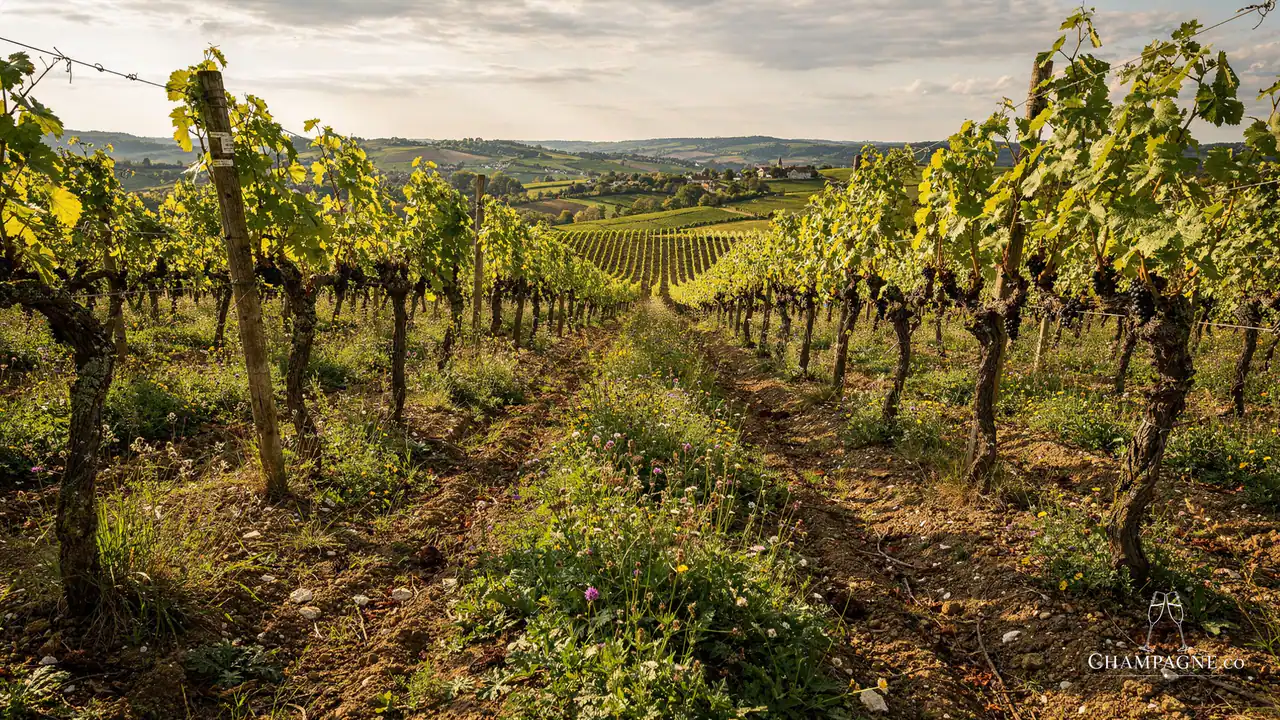
Marguet's own vines are concentrated in Ambonnay and Bouzy, two Grand Cru villages strongly associated with Pinot Noir. The estate names Ambonnay lieux-dits including Les Saints Remys, Les Beurys, Les Crayères, La Grande Ruelle, Les Bermonts and Le Parc, while its Bouzy holdings include Les Loges and Les Hannepés.
Benoît Marguet's farming is one of the clearest parts of the house identity. The estate describes biodynamic preparations alongside phytotherapy—macerations, infusions and decoctions of medicinal plants—and aromatherapy using essential oils. Comité Champagne independently records the use of draft horses for cultivation since 2010 and identifies the domaine with both organic and Demeter practices.
For readers, the important point is that these methods are not attached to one showcase wine. They form the agricultural background to an estate whose flagship vineyard holdings are in Ambonnay and Bouzy. That makes the increasingly fine-grained parcel bottlings a logical extension of the farming rather than a separate marketing layer.
Cellar approach
Marguet's current cellar presentation emphasises gravity, lees ageing and gentle handling. The house's public language is philosophical, but the practical consequence is straightforward: the wines are conceived around preserving the distinction between their origins rather than forcing every cuvée into one standardised recipe.
The portfolio confirms that approach. Some wines are broad assemblages, some are village-specific, others are tied to one named site, and Sapience follows its own multi-origin logic. Because blends and production details can move from one vintage to another, Marguet is a producer where the year on the label is part of the wine's identity rather than a minor catalogue detail.
Champagne.co analysis
Marguet is one of the clearest examples of a grower whose portfolio is organised as a progressive narrowing of origin. Shaman tells you what the estate wants Ambonnay and Bouzy to mean together. The village wines then isolate individual crus. The lieux-dits go further, asking the reader to pay attention to specific parcels within Ambonnay. Sapience moves laterally rather than simply upward, using a separate multi-terroir concept with its own blend and release history.
That structure makes the range more interesting than a simple “entry wine to prestige wine” ladder. A bottle of Ambonnay 2021 is not merely a more expensive Shaman; Les Crayères is not simply a more expensive Ambonnay. Each step changes the geographic question being asked. For Champagne.co, that is the most useful way to frame Marguet.
The ecological farming also matters most when read alongside this hierarchy. If the estate is devoting unusually intensive attention to soil work and plant treatments, the village and parcel wines are where readers can most directly explore whether that attention translates into differentiated origin. The philosophy is therefore most convincing when it leads back to place.
Buying guidance
- Best introduction: Shaman, because it gives the broadest view of the estate's Ambonnay/Bouzy identity.
- For Chardonnay: Yuman Blanc de Blancs is the simplest route into the white-grape side of the range.
- For Ambonnay itself: choose the current Ambonnay Grand Cru before moving into the named parcels.
- For a parcel comparison: taste Les Crayères, Les Bermonts, Le Parc or Les Saints Remys with the exact vintage retained; these wines are about site, so year and parcel both matter.
- For a broader village comparison: the current 2021 releases from Avize, Bouzy, Chouilly, Le Mesnil-sur-Oger, Oger and Vertus offer a way to explore how Marguet handles fruit beyond its own Ambonnay/Bouzy estate base.
- For the separate prestige project: Sapience 2018; for mature/library context, Sapience Oenothèque 2013.
- For still wine: the Ambonnay Blanc Coteaux Champenois is a different appellation and should be bought on that basis, not as a substitute for a sparkling cuvée.
Loading current Champagne range…
Spotted something wrong? Report a correction
Every report goes to a human review queue. Nothing on this page changes automatically.