Marie Copinet
Champagne Marie Copinet is a family grower whose modern identity is built around geographic diversity, organic farming and increasingly precise expressions of soil. The estate was founded in 1975 by Jacques Copinet. Today it is led by his daughter…
Editorial profile
Champagne Marie Copinet is a family grower whose modern identity is built around geographic diversity, organic farming and increasingly precise expressions of soil. The estate was founded in 1975 by Jacques Copinet. Today it is led by his daughter Marie-Laure Kowal-Copinet with Alexandre Kowal-Copinet, with the working cellar in Villenauxe-la-Grande and the family registered address in Montgenost.
Unlike a domaine concentrated around one village, Marie Copinet works across three distinct parts of Champagne. The Association des Champagnes Biologiques identifies the estate with Chardonnay in the southern Sézannais, Pinot Noir in the southern Côte des Bar and Meunier in the Vallée de la Marne. That spread is not incidental to the range: the current generation has increasingly organised its wines around the differences between grape, soil and origin rather than blending those differences away.
Organic conversion began in 2018, and the Association des Champagnes Biologiques records 2021 as the first certified-organic harvest. Its current member record lists 10.5 hectares of certified-organic surface, representing 85% of the total vineyard, with Chardonnay, Pinot Noir and Meunier all included in the certified area. The estate's own website now presents the vineyard explicitly as organic.
The most distinctive cellar idea is Argilla Villonissa. Villenauxe-la-Grande has white-clay soils and a history of art pottery; Marie Copinet commissioned clay eggs made from local material so Chardonnay grown there could complete its élevage in a vessel derived from the same place. It is a literal interpretation of terroir, but it is only one element of a broader approach that also uses stainless steel, large-format wood and barrels according to the wine.
Why this producer matters
- Family estate founded in 1975, now led by Marie-Laure and Alexandre Kowal-Copinet.
- Vineyard holdings span three Champagne sectors rather than one continuous block.
- The Association des Champagnes Biologiques records 2021 as the first certified-organic harvest.
- Its current organic-member profile records 10.5 ha certified, covering Chardonnay, Pinot Noir and Meunier.
- The estate works its own fruit as an independent grower and uses the three principal Champagne grapes to interpret contrasting soils and regions.
- Current cellar practice includes indigenous alcoholic fermentation and a deliberately low-intervention approach to ripeness and malolactic fermentation.
- Argilla Villonissa links Villenauxe Chardonnay with locally made clay vessels, giving the estate one of the region's more literal experiments in connecting soil and élevage.
Vineyard and terroir
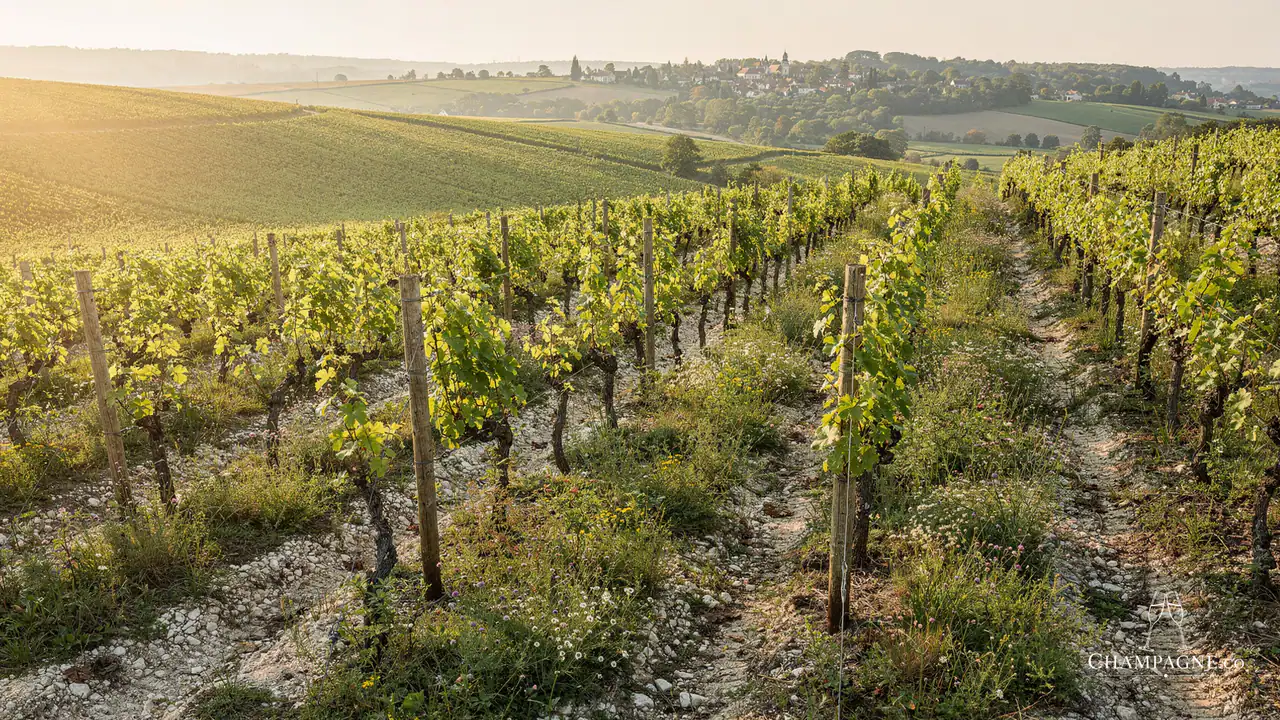
Marie Copinet's vineyard is best understood as a network rather than a single terroir. Chardonnay anchors the estate in the southern Coteaux du Sézannais, where Villenauxe-la-Grande and the surrounding chalk-and-clay landscape give the house its historical Blanc de Blancs identity. Pinot Noir comes from the southern Côte des Bar, while Meunier reaches into the Vallée de la Marne.
That distribution could have encouraged a broad blended style. Instead, the modern range often isolates the differences. The Nos Pas… wines, for example, are conceived around contrasting soil and grape combinations, while Argilla Villonissa goes further by linking a Villenauxe Chardonnay to a vessel made from Villenauxe clay.
The organic programme gives this terroir focus more substance. The Association des Champagnes Biologiques records an organic-certification commitment beginning in July 2018, first certified harvest in 2021, and all three principal grapes within the certified surface. Its current description also identifies indigenous yeasts, no chaptalisation and harvesting decisions driven by natural ripeness rather than a fixed recipe.
Cellar and winemaking
Marie Copinet's cellar is intentionally varied because the wines are not all trying to make the same point. Current association material describes indigenous alcoholic fermentation, no chaptalisation and malolactic fermentation sought naturally rather than blocked as a house-wide rule. The producer's own technical material documents stainless-steel vinification for classical cuvées, with reserve wines historically matured in foudres and 300-litre barrels.
The clay programme is more specific. Argilla Villonissa is 100% Chardonnay from Villenauxe-la-Grande, with the producer explicitly tying its élevage to locally derived clay eggs. This should not be reduced to novelty: the significant point is that vessel choice becomes another way of distinguishing one origin from another.
Across the range, the common thread is therefore not one material—steel, wood or clay—but a willingness to choose élevage according to the wine. That makes Marie Copinet's portfolio more coherent when read as a set of terroir studies than as a conventional prestige ladder.
Champagne.co analysis
Marie Copinet is most compelling when viewed as a three-region estate trying to make dispersion legible. Many growers derive identity from concentration: one village, one slope, one dominant grape. Copinet has the opposite raw material. Chardonnay, Pinot Noir and Meunier arrive from materially different parts of Champagne, so the challenge is to turn variety into coherence.
The answer has been to make the differences themselves the organising principle. The classical range establishes a house baseline; the Nos Pas… wines isolate soil and grape; Argilla Villonissa connects soil to vessel; and Alexandrine shows that multi-harvest Chardonnay can still be a serious expression rather than simply an entry-level blend.
Argilla Villonissa is the most immediately memorable idea, but it should not overshadow the larger achievement. The estate's real strength is the ability to let Sézannais Chardonnay, Côte des Bar Pinot Noir and Vallée de la Marne Meunier remain recognisably different while still belonging to one producer. That makes Marie Copinet especially rewarding for comparative tasting.
Buying guidance
- Best introduction: the current Blanc de Blancs if you want the estate's historical Chardonnay centre of gravity in its clearest form.
- For zero dosage: Blanc de Blancs Brut Nature, which also shows the three-harvest blending approach.
- For the most distinctive cellar concept: Argilla Villonissa.
- their point is the contrast between origin and grape.
- For Meunier: look to Nos Pas Dans l'Argile or La Ruelle des Loups.
- For Pinot Noir: Nos Pas Dans la Pierre is the most direct route into the darker-grape side of the range.
- For a mature multi-vintage Chardonnay concept: Alexandrine.
- When buying older bottles: check the specific release. Marie Copinet's blends and élevage choices have evolved, and historical technical sheets should not be assumed to describe current stock.
Loading current Champagne range…
Spotted something wrong? Report a correction
Every report goes to a human review queue. Nothing on this page changes automatically.