Marie-Courtin
Marie Courtin is the tiny Polisot estate of Dominique Moreau, named in honour of her grandmother and built around a sharply focused Côte des Bar idea: make Champagne from a very small vineyard with the grape, vintage and place kept as legible as possible.…
Editorial profile
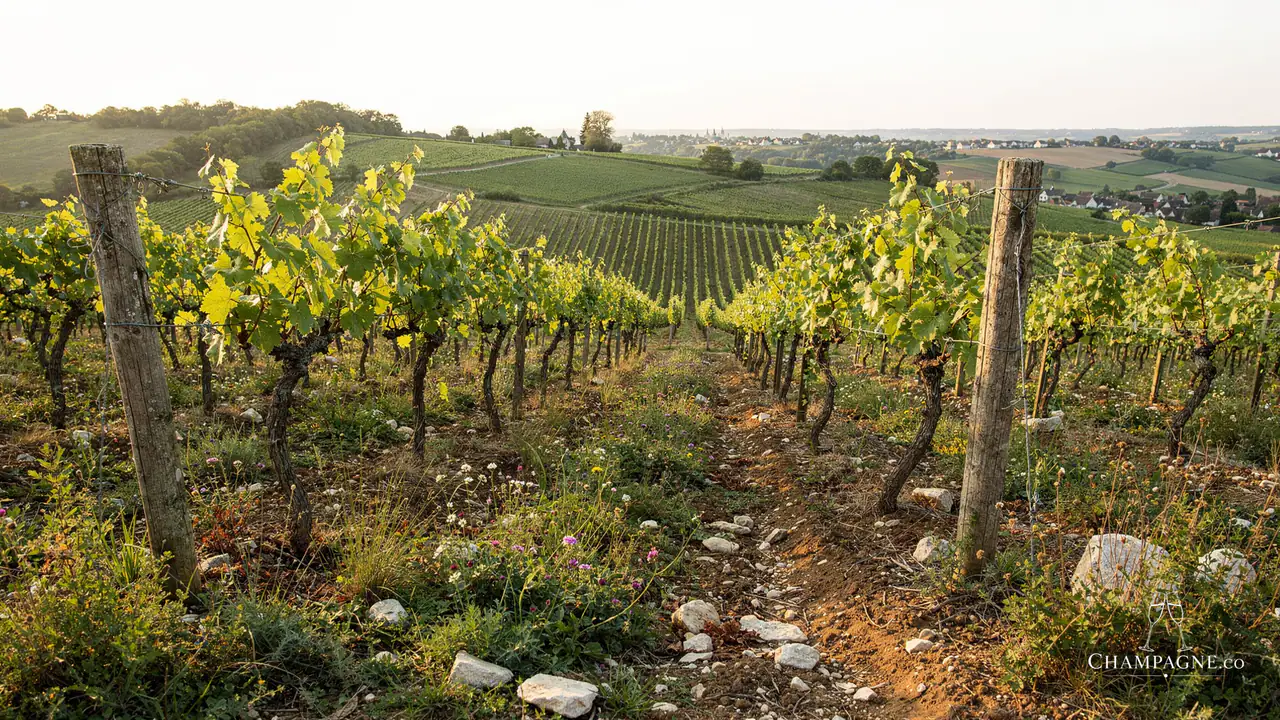
Marie Courtin is the tiny Polisot estate of Dominique Moreau, named in honour of her grandmother and built around a sharply focused Côte des Bar idea: make Champagne from a very small vineyard with the grape, vintage and place kept as legible as possible. Current specialist producer records consistently place the estate at about 2.5 hectares, centred on an east-facing hillside and planted predominantly to Pinot Noir, with smaller amounts of Chardonnay and Pinot Blanc.
Moreau began the Marie Courtin project with the 2005 vintage. From the outset, the wines have been associated with organic and biodynamic farming, indigenous yeasts and low or zero dosage.
The range is especially interesting because the vineyard context is tight while the cellar treatments differ. Résonance is the most direct Pinot Noir reference; Efflorescence brings barrel élevage into the comparison; Concordance explores Pinot Noir with no added sulphur in documented releases; Eloquence shifts to Chardonnay; Présence moves into the white-grape side of the estate; Indulgence is rosé. The result is a portfolio where differences in vessel, grape and handling can be explored without losing sight of one small place.
Why this producer matters
- Marie Courtin is a 2.5-ha grower estate in Polisot in the Côte des Bar.
- Dominique Moreau has produced under the Marie Courtin name since the 2005 vintage.
- The vineyard is overwhelmingly Pinot Noir, with smaller Chardonnay and Pinot Blanc plantings.
- Farming is certified organic and biodynamic according to current specialist producer records.
- The wines are built around a single-vineyard/single-variety/single-vintage philosophy rather than conventional multi-year house blending.
- The range gives unusually clear comparisons between direct tank-raised Pinot Noir, barrel-raised Pinot Noir, Chardonnay-led wines and low-intervention variants.
Vineyard and farming
Marie Courtin's scale is part of its identity. The estate occupies roughly 2.5 hectares in a concentrated Polisot setting rather than drawing on parcels scattered across Champagne. The principal hillside is east-facing and was planted by massal selection; Pinot Noir is the dominant variety, with much smaller quantities of Chardonnay and Pinot Blanc.
Polisot sits in the Barséquannais sector of the Côte des Bar, where Kimmeridgian limestone and clay-limestone soils create a markedly different geological context from the chalk-dominated Côte des Blancs or Montagne de Reims. For Marie Courtin, that matters because the wines are designed to minimise the number of variables between vineyard and bottle.
The farming follows organic and biodynamic principles. Current specialist material describes the estate as certified organic and biodynamic rather than simply “inspired by” those methods. That distinction is important: the viticulture is structural to the domaine, not a claim attached to one cuvée.
Cellar and winemaking
Marie Courtin's cellar approach is deliberately spare. Current specialist sources consistently describe indigenous-yeast fermentation and very low or zero dosage. Moreau's original concept was to work with one vineyard, one grape and one vintage at a time, allowing the cuvées to differ through variety and cellar treatment rather than through broad blending.
The most useful comparison is between Résonance and Efflorescence. Both are Pinot Noir Blanc de Noirs, but Résonance is the more direct reference while Efflorescence introduces barrel élevage. Concordance adds another variable through no-added-sulphur handling in documented releases. Eloquence then moves to Chardonnay, providing a white-grape counterpoint to the Pinot Noir core.
Recent market releases underline why bottle-specific detail still matters. Current 2026 lists include Résonance 2020 and 2022, Efflorescence 2017–2019, Eloquence 2018–2019, Concordance 2016 and 2018, and Présence 2016–2022. Marie Courtin's wines may sometimes be presented commercially without a conventional front-label vintage declaration even when they come from a single harvest, so the harvest year and disgorgement information on the actual bottle remain important buying details.
Champagne.co analysis
Marie Courtin is compelling because the range behaves almost like a controlled experiment. The vineyard is tiny, the philosophy is narrow and the number of variables is limited. Change the vessel and Résonance becomes meaningfully different from Efflorescence. Change the grape and the estate moves from Pinot Noir to Eloquence. Change the sulphur regime and Concordance asks another question again.
That makes Marie Courtin less about hierarchy than about comparison. Efflorescence is not simply a more prestigious Résonance; it is Pinot Noir viewed through a different élevage. Eloquence is not an alternative entry wine; it is the Chardonnay counterpoint. Présence matters because it brings the rare Pinot Blanc component into the conversation.
For readers exploring the Côte des Bar, this clarity is valuable. Many small growers produce several cuvées, but few make it quite so easy to see how grape and cellar choice change the expression of one concentrated vineyard context.
Buying guidance
- Best introduction: Résonance for the most direct Pinot Noir expression.
- For a side-by-side cellar comparison: taste Résonance against Efflorescence from comparable harvests if possible.
- For Chardonnay: Eloquence.
- For the rare white-grape angle: Présence, with the exact blend checked on the release in hand.
- For the low-intervention extreme: Concordance, particularly where the bottle explicitly identifies the no-added-sulphur handling.
- For rosé: Indulgence.
- For still wine: Le Blanc du Tremble is Coteaux Champenois and should be approached as a separate wine, not a non-sparkling version of another cuvée.
- When buying older bottles: prioritise harvest/disgorgement information. Marie Courtin's single-harvest philosophy makes the year materially important even when the commercial presentation is not conventionally vintage-labelled.
Loading current Champagne range…
Spotted something wrong? Report a correction
Every report goes to a human review queue. Nothing on this page changes automatically.