Matthieu Godmé-Guillaume
Matthieu Godmé-Guillaume is a grower based in Verzenay on the Montagne de Reims, building a distinct producer identity from vineyards rooted in the Godmé-Guillaume family domaine. Current specialist material places the project at 5.35 hectares, with 3.50…
Editorial profile
Matthieu Godmé-Guillaume is a grower based in Verzenay on the Montagne de Reims, building a distinct producer identity from vineyards rooted in the Godmé-Guillaume family domaine. Current specialist material places the project at 5.35 hectares, with 3.50 ha of Chardonnay and 1.85 ha of Pinot Noir, principally across Verzenay, Verzy and Villers-Marmery.
His independent project began in 2017, when he started taking responsibility for selected family parcels and vinifying them under his own direction. The transition from the wider family operation has been gradual rather than a single clean break, which is important to understanding the domaine today: this is a new label and cellar perspective drawing on established family vineyard holdings rather than a newly assembled vineyard estate.
The geography gives the range its clearest organising principle. Verzenay and Verzy are Grand Cru villages on the Montagne de Reims, while Villers-Marmery is Premier Cru and particularly associated with Chardonnay. Godmé-Guillaume uses those three origins both together and separately, so the portfolio can be read as a progression from a three-village blend toward more focused village expressions.
Why this producer matters
- The project represents a new generation within an established Verzenay winegrowing family, with its own producer identity and range.
- The current working vineyard is compact enough for the three principal villages to remain legible in the wines: Verzenay, Verzy and Villers-Marmery.
- Chardonnay is unusually important for a producer centred on the northern Montagne, accounting for the majority of the current 5.35-ha holding.
- Vineyard work emphasises permanent or selected cover crops, cultivation beneath the row, organic fertilisers and the avoidance of herbicides and insecticides.
- The range is structured around origin rather than a large hierarchy of prestige labels, with V.V.V as the broad introduction and Terre de Verzy and Terre de Villers-Marmery narrowing the focus.
- Current cellar information points to indigenous fermentations, substantial use of French oak, village-specific reserve wines and restrained dosage.
Vineyards and terroir
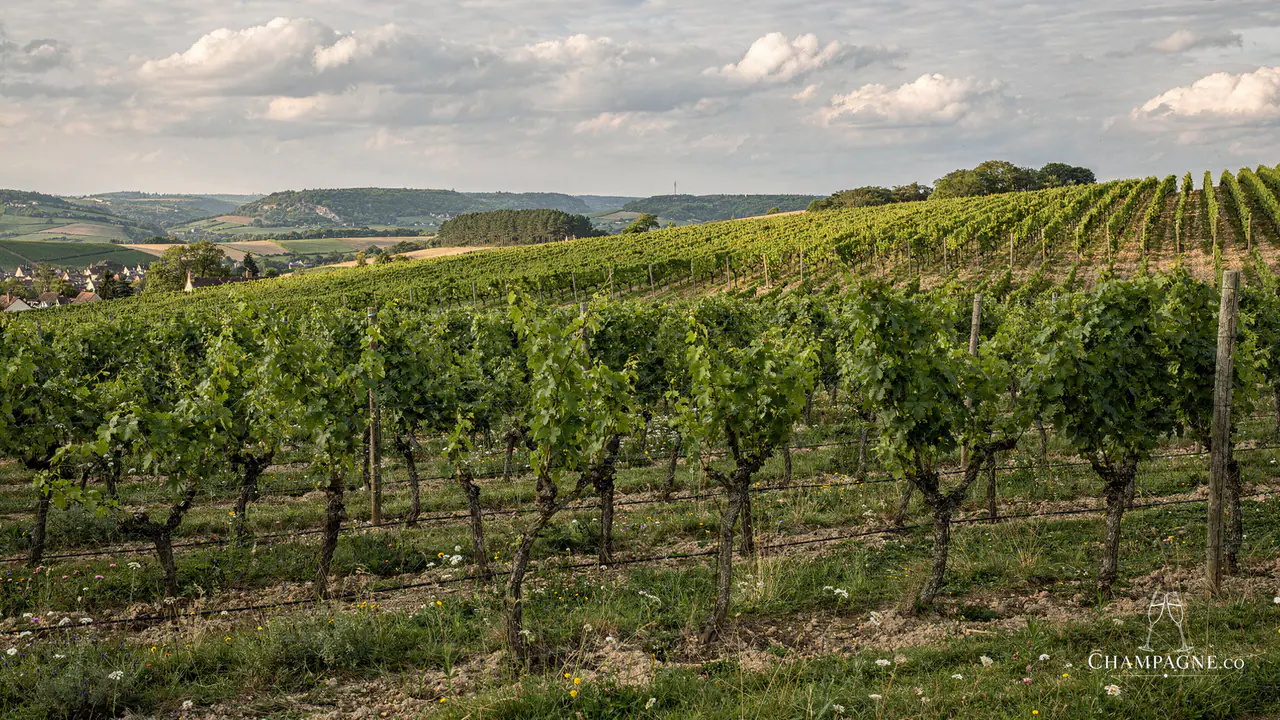
The domaine's 5.35 ha are currently described as 3.50 ha Chardonnay and 1.85 ha Pinot Noir. The vineyards are concentrated in three neighbouring but meaningfully different villages. Verzenay and Verzy bring Grand Cru sites from the northern Montagne de Reims, an area strongly associated with Pinot Noir but also capable of fine Chardonnay. Villers-Marmery, to the east, is a Premier Cru village with a much stronger Chardonnay identity.
That mix matters because Godmé-Guillaume is not simply making a Pinot-led Verzenay range. Chardonnay is the larger part of the estate, and Villers-Marmery gives the producer a credible second axis beside the darker-grape identity of the northern Grand Cru slopes. The contrast is explicit in the cuvée architecture rather than buried inside one house blend.
Current accounts describe vines averaging roughly 30 to 40 years in age. Vineyard management includes planted or maintained vegetation between the rows, soil cultivation beneath the vines, organic fertilisers and no herbicides or insecticides. The farming is therefore best described through those verified practices rather than by assuming a formal certification status for every parcel.
Winemaking and cellar approach
Godmé-Guillaume's cellar work is geared toward texture and site expression rather than a highly reductive, tank-only style. Current technical descriptions point to indigenous-yeast fermentation, with a significant proportion of the wines fermented or raised in French oak from several coopers. Some neutral vessels are also used, depending on the wine.
Reserve wines are kept by cru, allowing the producer to maintain village-specific reserves rather than one undifferentiated house reserve. Current specialist information also describes bottling around mid-June after extended élevage, with wines generally handled without fining or filtration. Low dosage is common in the releases currently on the market, but exact figures belong to the individual bottling rather than to a permanent domaine rule.
Champagne.co analysis
Godmé-Guillaume is most coherent when the range is read as a three-village study. V.V.V sets out the shared vocabulary; Terre de Verzy and Terre de Villers-Marmery then separate two contrasting sides of the estate. The first points back toward the northern Grand Cru slopes, while the second makes the domaine's unusually important Chardonnay component impossible to overlook.
That structure also explains why the producer is more interesting than a simple story of generational succession. The inherited vineyard base is being reorganised into a deliberately legible range. Family continuity supplies the land; the new identity comes from how those parcels are grouped, vinified and presented.
The cellar choices reinforce that idea. Indigenous fermentations, oak and village-specific reserves can all add breadth, but the range is not built around wood as an end in itself. The more useful distinction for buyers is between the blended three-village framework and the narrower village bottlings. That makes the producer particularly well suited to side-by-side drinking rather than to a conventional ladder from entry wine to prestige cuvée.
Buying guidance
- Start with V.V.V if you want the broadest view of the domaine and the relationship between its three principal villages.
- Choose Terre de Verzy for a more focused northern Montagne Grand Cru expression.
- Choose Terre de Villers-Marmery if your interest is Chardonnay and the Premier Cru identity of Villers-Marmery.
- V.V.V Rosé is the logical rosé entry, but check the disgorgement or release because its blend and dosage are not permanent specifications.
- Sous La Ville and Les Pucelles are for buyers interested in the still-wine side of the estate; they are Coteaux Champenois rather than Champagne.
- With this young, evolving range, base year and disgorgement matter. Compare the technical information on the bottle in front of you rather than assuming an earlier release's blend or dosage still applies.
Loading current Champagne range…
Spotted something wrong? Report a correction
Every report goes to a human review queue. Nothing on this page changes automatically.