Michel Arnould & Fils
Michel Arnould & Fils is a family grower-producer rooted in Verzenay, one of the Montagne de Reims villages most closely associated with Pinot Noir. The family traces its vineyard activity in the village back through many generations, while the modern…
Editorial profile
Michel Arnould & Fils is a family grower-producer rooted in Verzenay, one of the Montagne de Reims villages most closely associated with Pinot Noir. The family traces its vineyard activity in the village back through many generations, while the modern domaine took shape after Michel Arnould acquired the current site at 28 rue de Mailly in 1961. His son Patrick joined in 1986, son-in-law Thierry in 1995, and Thierry's son Thomas became part of the domaine in 2022.
The estate now works around 12 hectares, planted approximately 80% Pinot Noir and 20% Chardonnay. Pinot Noir is therefore the structural centre of the range, but the present portfolio deliberately explores both a Pinot Noir-led track and a second strand in which Chardonnay has greater influence.
Why this producer matters
Michel Arnould & Fils is useful for understanding how a long-established Verzenay grower can evolve without abandoning its village identity. The estate's current generation has moved beyond a simple house-cuvée hierarchy into a range organised around grape variety, reserve systems, individual vintages and selected plots, while keeping Pinot Noir at the core.
That combination gives the producer more range than its modest scale might suggest. The current wines move from direct Pinot Noir expressions such as Genèse to perpetual-reserve Atemporelle, vintage bottlings such as Mémoire 2019 and Saignée 2020, and cuvées including Acuité and Observation that introduce a stronger Chardonnay dimension.
Vineyard and terroir
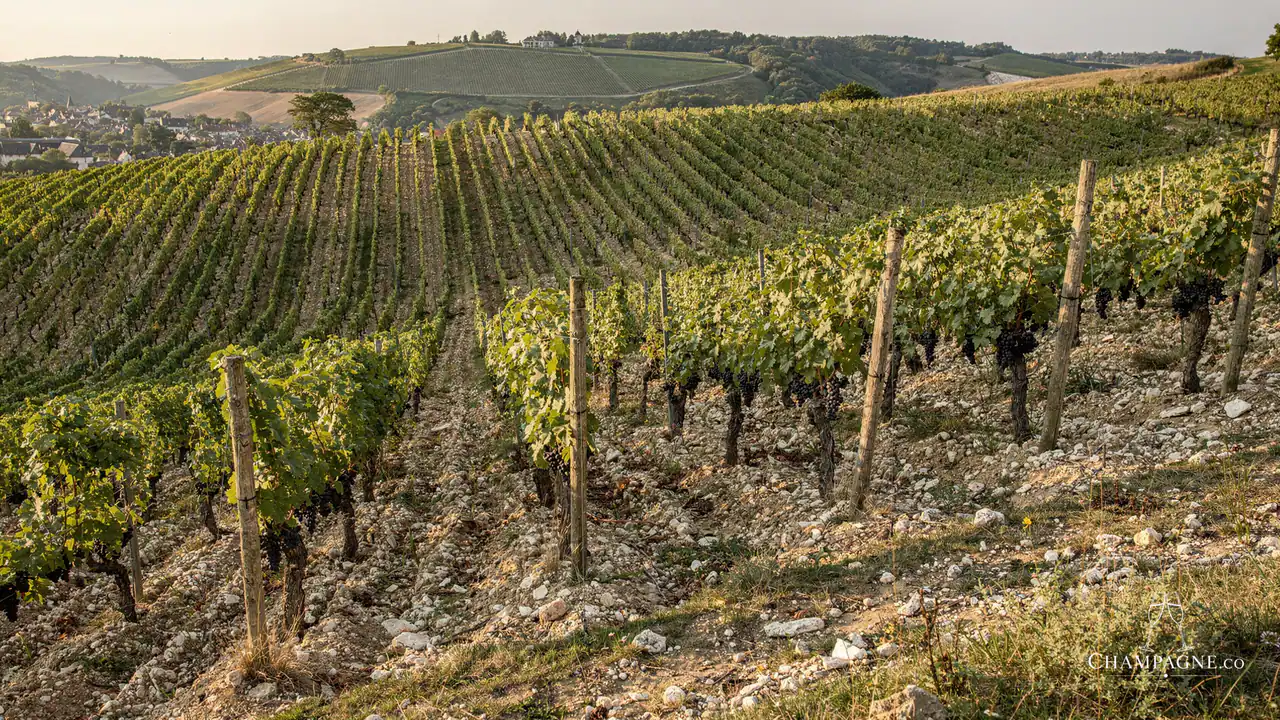
The domaine's vineyards are centred on Verzenay Grand Cru. Current estate information gives a vineyard surface of around 12 hectares, with an 80/20 split between Pinot Noir and Chardonnay.
The family works the vineyards itself with its team and uses parcel identity as an important part of decision-making. The two presses allow grapes to be separated by location, sector and parcel, giving the cellar the option to keep distinct origins apart before deciding how they will be used in the final wines.
Cellar and winemaking
Pinot Noir remains the stylistic reference point, with Chardonnay used differently according to the cuvée. The domaine uses both stainless steel and oak, and wood appears in varying proportions across the range rather than as a single fixed recipe.
Current technical sheets show how deliberately the cellar approach changes from wine to wine. Genèse, for example, is the present 100% Pinot Noir release, while Observation is currently 70% Pinot Noir and 30% Chardonnay. Atemporelle is based on 100% Pinot Noir and uses a perpetual reserve system established in 2018. These details describe the current releases checked in August 2026 and should not be projected automatically onto future bottlings.
Champagne.co analysis
Michel Arnould & Fils is most coherent when read as a Verzenay Pinot Noir estate that is deliberately testing how far it can stretch that identity. The vineyard mix makes Pinot Noir dominant by necessity, yet the present range does not simply repeat one black-grape formula. Reserve systems, vintage bottlings, rosé maceration, old-vine material, Chardonnay from outside the immediate estate core and varying oak regimes create several distinct routes through the portfolio.
For readers, the useful distinction is between the wines that state the Pinot Noir identity most directly and those that use Chardonnay or extended cellar work to broaden it. That makes the range easier to navigate than the number of cuvées might initially suggest.
Buying guidance
For the clearest introduction to the domaine's core identity, start with Genèse. Atemporelle is the more distinctive next step if you want to see how the same Pinot Noir focus changes through a perpetual-reserve approach.
Choose Observation or Acuité if you want a broader blend in which Chardonnay has a meaningful role. The dated wines — Saignée 2020, Mémoire 2019, Heuristique 2020, Anastrophe 2020 and Causalité 2012 — should be bought with the specific vintage and release in mind rather than treated as interchangeable permanent expressions. Availability is limited across the range, so exact bottling and release details are worth checking when buying.
Loading current Champagne range…
Spotted something wrong? Report a correction
Every report goes to a human review queue. Nothing on this page changes automatically.