Michel Loriot
Apollonis – Champagne Michel Loriot is a family grower in Festigny, on the western side of the Vallée de la Marne. The family story extends across 12 generations, and the current team includes oenologist Marie Petit Loriot, her husband Alban, who oversees…
Editorial profile
Apollonis – Champagne Michel Loriot is a family grower in Festigny, on the western side of the Vallée de la Marne. The family story extends across 12 generations, and the current team includes oenologist Marie Petit Loriot, her husband Alban, who oversees production, and Marie's parents Martine and Michel Loriot.
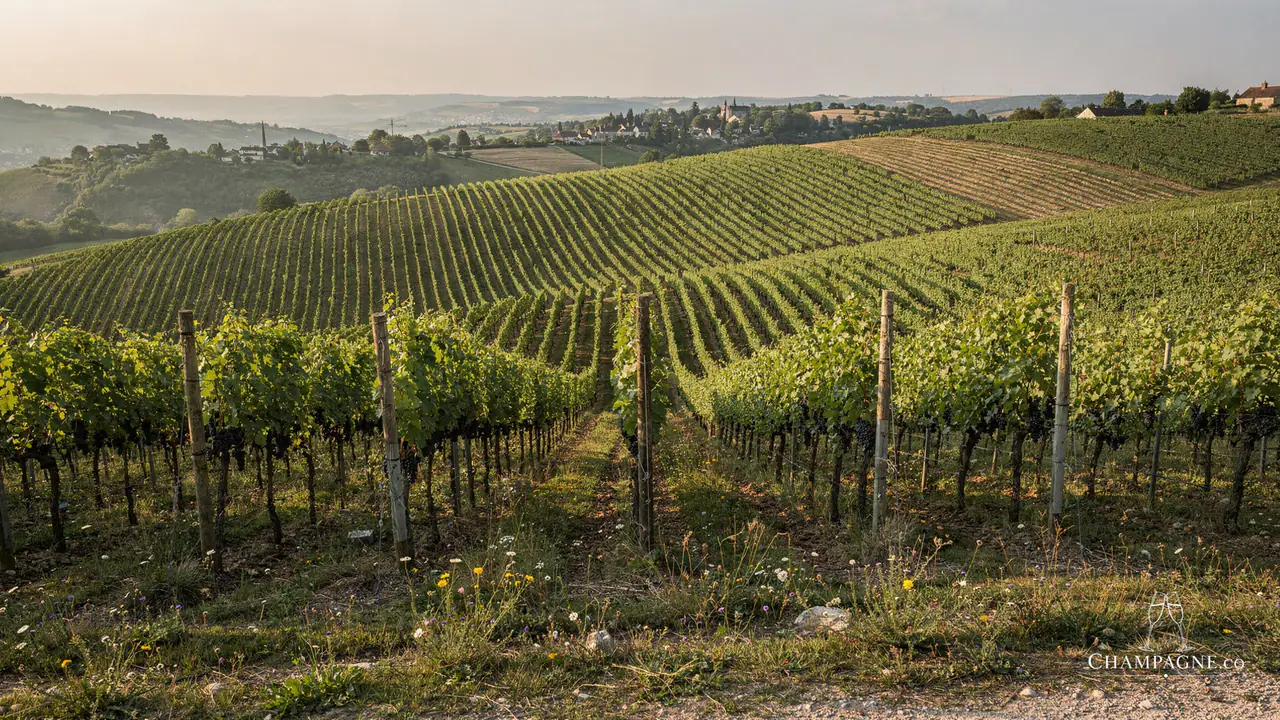
The vineyard is small—roughly 7 hectares—and decisively Meunier-led. Current independent records put Meunier at around four-fifths or more of the plantings, with Chardonnay and a smaller amount of Pinot Noir completing the mix. The estate is both Haute Valeur Environnementale and a Vigneron Indépendant.
Apollonis is also one of Champagne's more unusual family projects because music is woven deliberately into the way the domaine presents and ages its wines. Classical music is played during cellar ageing, and the family has also experimented with music or vibration programmes in selected vineyard parcels. That is a documented estate practice; it is best understood as part of the producer's working philosophy rather than as proof of a scientifically established effect on wine quality.
Why this producer matters
The central theme here is Meunier. Festigny is a natural setting for the variety, and Apollonis makes it possible to compare Meunier in several different forms: as the sole grape in a straight Brut, in an old-vine vintage wine, in zero-dosage blends and alongside Chardonnay or Pinot Noir.
The range is also unusually personal. Several cuvées refer to members of the Loriot family, while the music theme runs through the cellar and the naming of the portfolio. The most convincing way to approach the domaine, however, is through the wines themselves: Meunier is the anchor, and the other cuvées show how dosage, age, grape mix and vintage change the expression.
Vineyard and terroir
The domaine is based at 13 rue de Bel Air in Festigny. Current records differ slightly on exact surface area and planting percentages, but they agree on the essential picture: approximately 7 hectares, with Meunier overwhelmingly dominant and Chardonnay and Pinot Noir occupying much smaller shares.
That makes the estate's pure-Meunier wines especially relevant to its identity. Chardonnay provides a contrasting line within the range, while Pinot Noir appears in selected blends and rosé production rather than defining the vineyard as a whole.
Cellar and winemaking
Music is used during the ageing of the wines and is presented by the family as part of the Apollonis approach. The domaine also varies dosage and blending substantially across the range: the portfolio runs from Brut and Sec to zero dosage and Extra-Brut, while both single-variety and multi-variety wines are made.
Some of the most distinctive bottles are vintage-specific. Sources du Flagot is currently listed as a 2013 Chardonnay; Saison Cépages à l'unisson as a 2012 Meunier-Chardonnay blend; Monodie as a 2013 old-vine Meunier from vines planted in 1942; and Terra 15 as a 2015 Festigny blend of all three principal Champagne grapes. Those dates and technical details belong to those named releases rather than to future editions automatically.
Champagne.co analysis
Apollonis is most persuasive when the music theme is treated as context rather than as the reason to buy the wines. The deeper story is a compact, Meunier-dominant Festigny estate with enough range to show the grape in several different settings.
The pure-Meunier bottlings give the clearest view of the domaine's centre of gravity. From there, Palmyre changes the dosage equation, Sources du Flagot moves entirely into Chardonnay, and Terra 15 brings all three principal varieties together. The dated wines also give the portfolio a more mature, cellar-led dimension than a simple entry-level grower range.
Buying guidance
Start with Meunier for the clearest introduction to the estate.
Choose Sources du Flagot 2013 if Chardonnay is the priority, or Terra 15 2015 if you want a Festigny wine incorporating Meunier, Chardonnay and Pinot Noir. Marie Léopold is deliberately Sec, so it is the bottle to seek when a softer, sweeter style is wanted rather than a Brut or Extra-Brut profile.
Loading current Champagne range…
Spotted something wrong? Report a correction
Every report goes to a human review queue. Nothing on this page changes automatically.