Minière F&R
Minière F&R is a fourth-generation family estate in Hermonville, a village north of Reims at the edge of the Montagne de Reims. The domaine traces its modern history to 1919, when Alfred Minière installed his own press and began selling wine to négociants…
Editorial profile
Minière F&R is a fourth-generation family estate in Hermonville, a village north of Reims at the edge of the Montagne de Reims. The domaine traces its modern history to 1919, when Alfred Minière installed his own press and began selling wine to négociants in Reims. Brothers Frédéric and Rodolphe Minière took over the family estate in 2005 after oenology studies and practical experience.
The vineyard covers nearly 8 hectares, mostly in Hermonville. Around 2 hectares are Chardonnay, 1.5 hectares Pinot Noir and the balance Meunier. The vines range from young plantings to parcels approaching 80 years old, with an average age of about 50 years, and the estate retains some ungrafted vines alongside older massal-selection material.
Why this producer matters
Minière F&R has a particularly coherent identity because vineyard age, oak vinification and long ageing are all central rather than peripheral to the estate. The wines are organised not simply by colour or grape but by increasing focus: bruts, single-vineyard cuvées and vintages, followed separately by Coteaux Champenois still wines.
That structure makes Hermonville itself the key reference point. The estate's most interesting bottles progressively narrow the lens from multi-parcel blends to individual lieux-dits and old-vine material, while extended ageing gives the range a more deliberate cellar dimension than many estates of similar size.
Vineyard and terroir
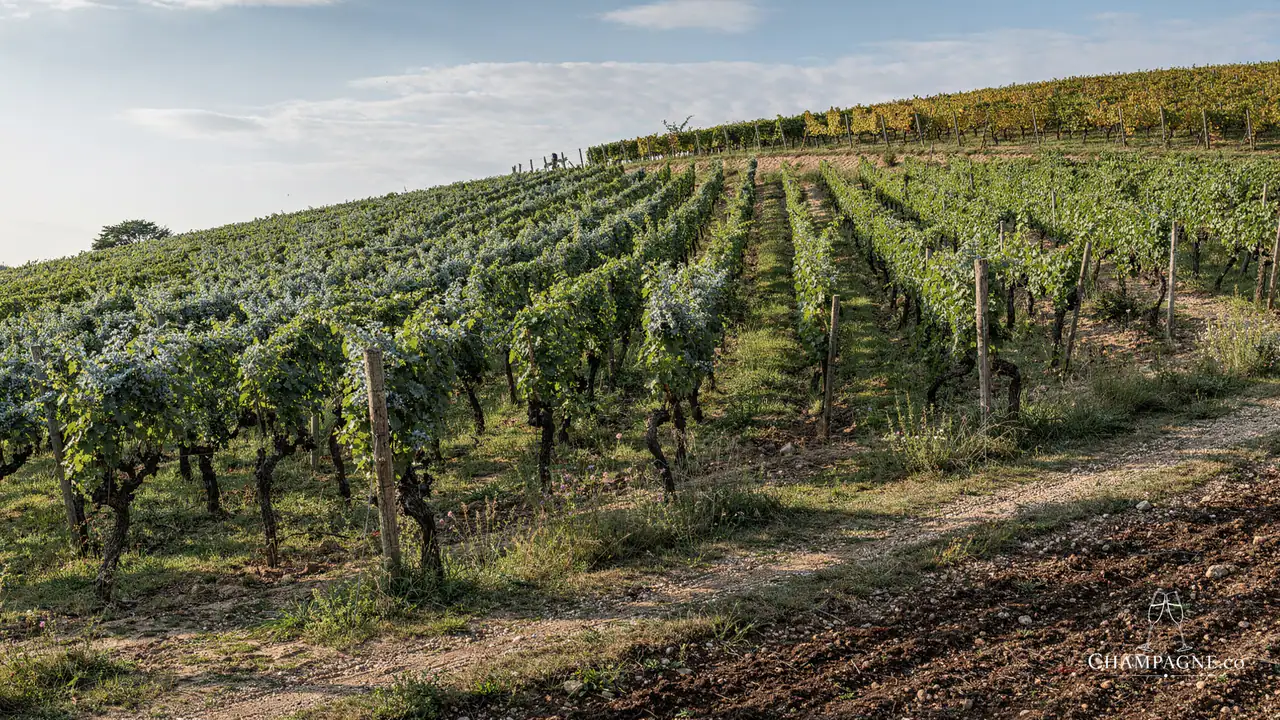
Most of the vineyard sits on a south-to-south-east-facing hillside in Hermonville. The estate describes lighter loam-sandy soils higher on the slope and more loam-clay-sandy material lower down, with lacustrine limestone appearing beneath several of the parcels used for named cuvées.
Vine age is an important part of the domaine's identity. The current estate record gives an age range of roughly 2 to 78 years and an average of around 50 years. Massal selection remains part of the replacement strategy, and some parcels contain ungrafted, own-rooted vines.
Cellar and winemaking
Oak is a defining part of Minière F&R's cellar approach. The winery contains around 250 barrels, mostly 228 litres with some larger formats, and the estate vinifies its wines in wood. Fermentation uses indigenous yeasts, with wines generally spending several months on fine lees in barrel before bottling.
Malolactic fermentation is handled wine by wine rather than through a single house rule. Some current cuvées explicitly avoid it; others allow it to occur naturally depending on vintage. Bottle ageing is equally deliberate: the current range is organised around about three years for the bruts, a minimum of five years for the single-vineyard wines and roughly eight to ten years for the vintages.
Champagne.co analysis
Minière F&R is best understood as an Hermonville estate where time is as important as grape variety. The vineyard gives the brothers mature vine material and several distinct parcels; oak then becomes the common cellar language, while bottle ageing creates a clear progression from bruts to parcels and vintages.
The range therefore rewards moving in stages. The bruts show the broader house framework, the single-vineyard wines isolate site and vine age, and the vintage wines push ageing and selection further. That structure gives Minière F&R a strong internal logic without needing an inflated hierarchy of prestige labels.
Buying guidance
Start with Influence for the broadest introduction to the estate's Meunier-led Hermonville style, or Brut Zéro if you prefer to see the three principal grapes without dosage. Blanc Absolu is the natural entry point for Chardonnay.
The single-vineyard wines are the more revealing next step. Les Voirmissa gives a Pinot Noir-Meunier view of a single parcel, Les Moineaux focuses on old-vine Chardonnay, and La Vigne à Alfred is the clearest choice for mature-vine Meunier. Symbiose 2016 is the bottle to seek when long ageing and a vintage-specific Pinot Noir-Chardonnay blend are the priority. Check the exact vintage and release when buying the parcel and vintage wines, because their technical specifications are deliberately release-specific.
Loading current Champagne range…
Spotted something wrong? Report a correction
Every report goes to a human review queue. Nothing on this page changes automatically.