Montaudon
Champagne Montaudon is a Reims house founded in 1891. Its first four generations were tied to the Montaudon family, beginning with Auguste-Louis Montaudon, before the company joined Alliance Champagne in 2010. The modern house is therefore best understood…
Editorial profile
Champagne Montaudon is a Reims house founded in 1891. Its first four generations were tied to the Montaudon family, beginning with Auguste-Louis Montaudon, before the company joined Alliance Champagne in 2010. The modern house is therefore best understood as a branded Champagne operation built around a wide partner-grower network rather than as a single family estate.
Montaudon currently describes its sourcing base as roughly 350 hectares of vineyard sites across Champagne, worked by families of partner growers. Pinot Noir and Meunier are central to the house's present identity, and black grapes dominate several of its most important cuvées.
The current range is broad without being confusing: it spans a core Brut, a reserve cuvée, rosé, Blanc de Noirs, a founder's cuvée, prestige and vintage bottlings, Demi-Sec and a separate organic-sourcing expression.
Why this producer matters
Montaudon is a good example of a historic brand whose modern identity is different from its original family-estate structure. Since joining Alliance Champagne, the house has relied on a large collective vineyard base and a shared winemaking organisation, while keeping a clear stylistic emphasis on Pinot Noir and Meunier.
That black-grape direction gives the range an intelligible centre. Brut Tradition and Réserve Première are both dominated by Pinot Noir and Meunier, Blanc de Noirs removes Chardonnay entirely, while Classe M and Cuvée Millésimée 2018 move toward an even 50/50 split between black grapes and Chardonnay.
Vineyard and sourcing
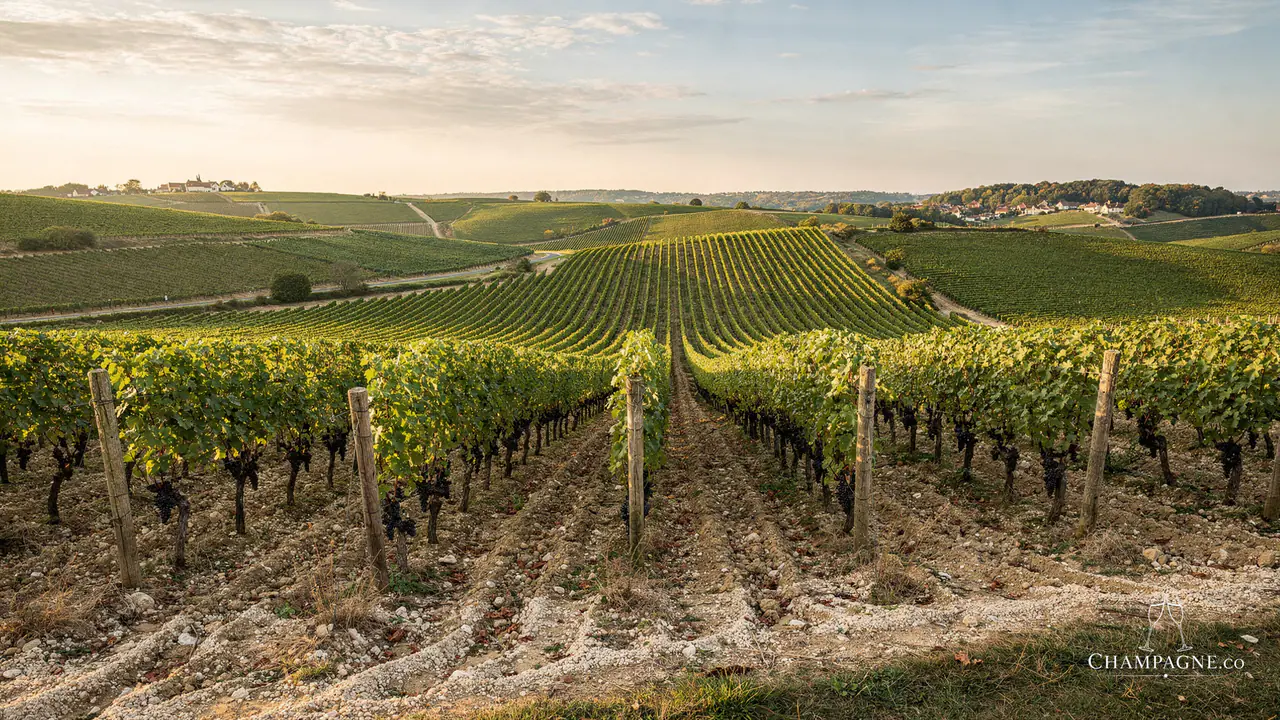
The house currently works from a sourcing footprint of about 350 hectares spread across Champagne through partner winegrower families. That figure describes the vineyard sites contributing to Montaudon's wines, not a 350-hectare estate owned by the brand itself.
This broad supply base allows the house to blend across many origins rather than build its identity around a single village. Réserve Première, for example, is drawn from a wide selection of villages that includes Premier Cru fruit. The current house style instead places the emphasis on the proportion of black grapes and the use of reserve wines.
Cellar and blending
Montaudon's core wines rely on straightforward, repeatable blending structures. The present Brut Tradition is 80% Pinot Noir and Meunier combined with 20% Chardonnay, including 35% reserve wines, at 11 g/L dosage and with at least 18 months in the cellar. Réserve Première Brut shifts to 75% black grapes and 25% Chardonnay, again with 35% reserve wines and 11 g/L dosage.
Other cuvées deliberately change that architecture. Blanc de Noirs is currently 60% Pinot Noir and 40% Meunier, while Classe M uses equal proportions of black grapes and Chardonnay. The current 2018 vintage follows the same 50/50 broad split but is a declared-vintage wine rather than a permanent non-vintage formula.
Champagne.co analysis
Montaudon's strongest modern identity is blending rather than terroir singularity. The partner-grower network gives the house access to a wide spread of Champagne fruit, but the range maintains a recognisable black-grape bias that is easy to follow from one cuvée to the next.
The most useful comparison is therefore not between villages but between proportions and purpose. Brut Tradition gives the broadest house reference point, Réserve Première refines the blend across a wider village base, Blanc de Noirs concentrates completely on Pinot Noir and Meunier, and Classe M or the 2018 vintage bring Chardonnay up to half of the blend. Organic Brut sits alongside those wines as a separate sourcing proposition rather than evidence that the entire Montaudon supply network is organic.
Buying guidance
Start with Brut Tradition for the clearest introduction to the modern Montaudon style. Réserve Première Brut is the next step if you want a broader reserve-driven blend, while Blanc de Noirs is the obvious choice when the house's black-grape identity is the priority.
Choose La Grande Rose for rosé, Classe M for the prestige tier and Cuvée Millésimée 2018 when a declared vintage matters. Organic Brut makes sense specifically for buyers seeking a cuvée from organically grown grapes. Demi-Sec is the deliberate sweeter option and should not be substituted for the house's Brut styles.
Loading current Champagne range…
Spotted something wrong? Report a correction
Every report goes to a human review queue. Nothing on this page changes automatically.