Morel
Champagne Morel Père & Fils is a family grower in Les Riceys, the Côte des Bar village whose unusual combination of Champagne, Coteaux Champenois and Rosé des Riceys appellations makes Pinot Noir especially important. The Morel family has worked vines here…
Editorial profile
Champagne Morel Père & Fils is a family grower in Les Riceys, the Côte des Bar village whose unusual combination of Champagne, Coteaux Champenois and Rosé des Riceys appellations makes Pinot Noir especially important. The Morel family has worked vines here for more than five generations. Its history was initially tied to still Pinot wines and Rosé des Riceys before Pascal Morel began commercialising Champagne under the family name in 1987.
Today the domaine is run by Pascal, Émilie and Simon Morel. Simon manages the vineyard, Pascal remains involved in management and winemaking, and Émilie works on the wines while leading sales and export. Émilie and Simon joined the business in 2016, the same year the estate obtained Haute Valeur Environnementale certification.
The vineyard covers 8 hectares, planted about 90% Pinot Noir and 10% Chardonnay. All grapes come from the family's own vineyards around Les Riceys; the domaine states that it does not buy fruit from outside growers.
Why this producer matters
Morel is one of the clearest producers for understanding how Les Riceys and Pinot Noir can support several different wine styles within one estate. The same village and dominant grape feed a classic sparkling Brut, pure Pinot Blanc de Noirs, maceration rosé, a single-parcel Champagne, a multi-year rosé reserve and the still Rosé des Riceys for which the village is famous.
That breadth is not just a matter of product variety. It reflects the history of the family, whose work with still rosé predates its modern Champagne business. Morel's current range therefore makes more sense when Pur Rosé, Histoire de Rosé and Rosé des Riceys are viewed as related expressions of long familiarity with Pinot Noir maceration rather than as isolated novelties.
Vineyard and terroir
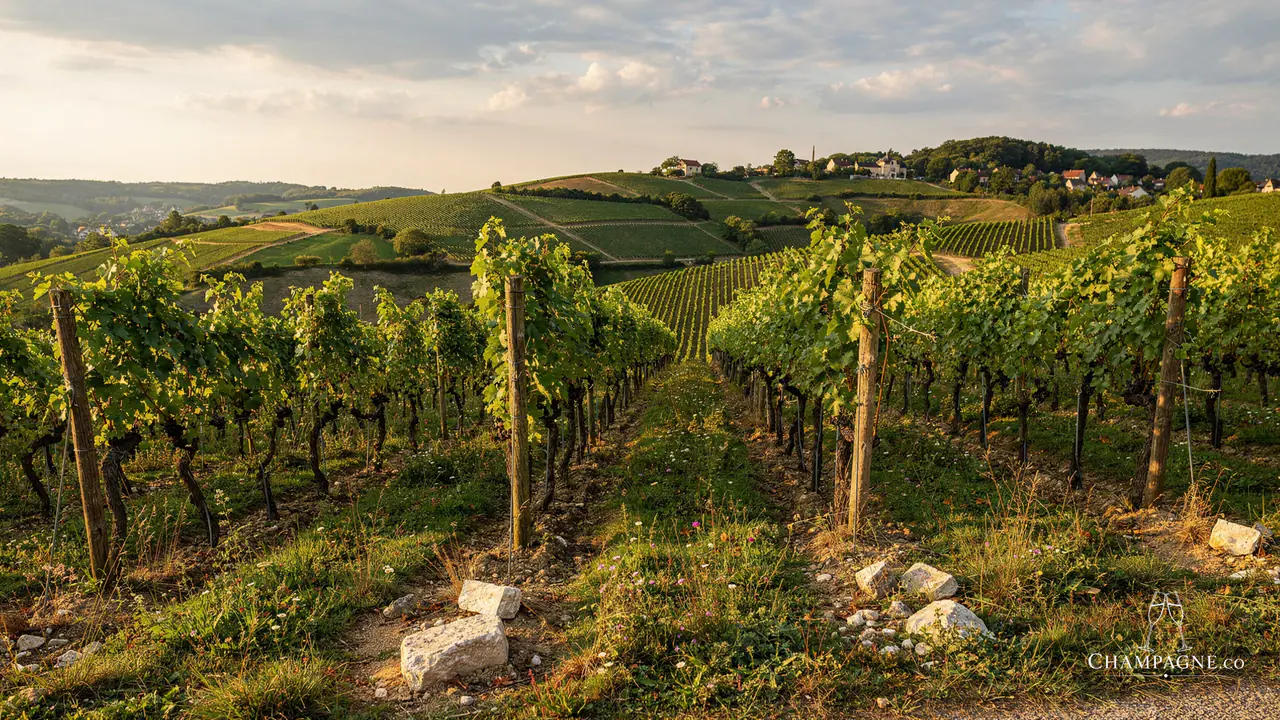
The estate's 8 hectares lie on slopes around Les Riceys, generally with south or south-east exposures. The vineyards sit on the Kimmeridgian clay-limestone geology characteristic of this part of the Côte des Bar, and Pinot Noir dominates the plantings.
The vineyard is fully grassed and the domaine favours mechanical work, organic composts and other methods intended to reduce chemical inputs. HVE certification dates from 2016. Because all grapes are estate-grown, the wines provide a relatively direct view of the Morel family's own Les Riceys holdings rather than a blend of purchased fruit from across Champagne.
Cellar and winemaking
The range shows several different ways of working Pinot Noir. Brut Réserve blends Pinot Noir with a small Chardonnay component, while L'Extra and L'Exquis are pure Pinot Noir Blanc de Noirs. Pur Rosé is made by whole-bunch maceration rather than by blending white Champagne with red wine.
The estate also works at smaller scale with individual sites and reserve systems. Vemoy Le Chêne comes from a single Pinot Noir parcel on the higher slopes of Les Riceys, while Histoire de Rosé is assembled from a long-running reserve of macerated rosé wines rather than a single harvest.
Chardonnay has a more limited role in the vineyard but receives its own expression in Cuvée Gabriel, a 100% Chardonnay Blanc de Blancs partly raised in oak and aged for a minimum of 36 months on lees in the current release.
Beyond Champagne: Rosé des Riceys
Rosé des Riceys deserves a prominent place in the Morel story even though it is not Champagne AOC. The current estate release is a 2022 still wine from 100% Pinot Noir, made by whole-bunch maceration. It belongs to the separate Rosé des Riceys appellation and should be understood as part of the family's historical and technical background rather than as a sparkling cuvée.
The estate also sells Ratafia Champenois and Marc de Champagne, which likewise sit outside the Champagne sparkling-wine range.
Champagne.co analysis
Morel's range is unusually coherent because almost every important wine can be traced back to the same two ideas: Les Riceys and Pinot Noir. What changes is the method. Brut Réserve uses Chardonnay as a small balancing component; L'Extra and L'Exquis strip the blend back to pure Pinot Noir; Pur Rosé moves into maceration; Vemoy Le Chêne narrows the focus to one parcel; Histoire de Rosé uses time and a perpetual reserve; Rosé des Riceys removes the second fermentation entirely.
That makes Morel more interesting than a simple catalogue of styles. The estate effectively uses one local grape to explain several dimensions of the village. Chardonnay, through Cuvée Gabriel, provides a useful contrast but remains secondary to the Pinot Noir story.
Buying guidance
Start with Brut Réserve for the broadest introduction to the house. Move to L'Extra if you want a drier, pure-Pinot expression, or L'Exquis for a softer take on the same grape.
Pur Rosé is the most useful sparkling bottle for understanding the estate's connection to maceration and the wider Rosé des Riceys tradition. Vemoy Le Chêne is the more site-specific choice, while Histoire de Rosé is the most unusual cellar-driven wine in the range and is likely to appeal most to experienced drinkers looking beyond the core cuvées.
Choose Cuvée Gabriel when Chardonnay is the priority. For a fuller understanding of the estate, add a bottle of Rosé des Riceys alongside the Champagnes; it is a separate still-wine appellation, but historically it is central to why this family approaches Pinot Noir the way it does.
Loading current Champagne range…
Spotted something wrong? Report a correction
Every report goes to a human review queue. Nothing on this page changes automatically.