Moutard
Champagne Moutard is a Côte des Bar house based in Buxeuil, with its modern Champagne activity dating to 1927. The family business remains closely associated with François Moutard, who is currently identified by the Union des Maisons de Champagne as…
Editorial profile
Champagne Moutard is a Côte des Bar house based in Buxeuil, with its modern Champagne activity dating to 1927. The family business remains closely associated with François Moutard, who is currently identified by the Union des Maisons de Champagne as chairman, vineyard lead, cellar master and oenologist.
The Champagne vineyard covers roughly 22–23 hectares in current house and trade records, while the wider business also buys grapes under contract from additional Côte des Bar growers. Pinot Noir is the largest single planting, but Moutard is particularly distinctive for preserving several of Champagne's less common authorised varieties alongside Chardonnay and Meunier: Arbane, Petit Meslier and Pinot Blanc all remain part of the estate's current vineyard and wine programme.
That six-variety breadth gives Moutard a different identity from many Côte des Bar producers whose ranges are built almost entirely around Pinot Noir. The present catalogue includes classic bruts, parcel wines, Brut Nature cuvées and wines specifically devoted to the rarer grapes.
Why this producer matters
Moutard matters because it combines a recognisable Côte des Bar Pinot Noir base with one of Champagne's most visible commitments to historic grape diversity. Current vineyard records show more than a hectare each of Arbane and Petit Meslier, plus Pinot Blanc, making those varieties significant enough to shape named cuvées rather than survive only as tiny experimental plantings.
The current range makes that diversity tangible. Arbane Vieilles Vignes isolates one rare variety, while Cuvée des 6 Cépages brings all six of the family's Champagne grapes together. At the same time, parcel wines such as Richardot Pinot Noir Vieilles Vignes, Les Troncs, Les Perrières and Vignes Chiennes Chardonnay keep the range grounded in individual Côte des Bar sites.
Vineyard and terroir
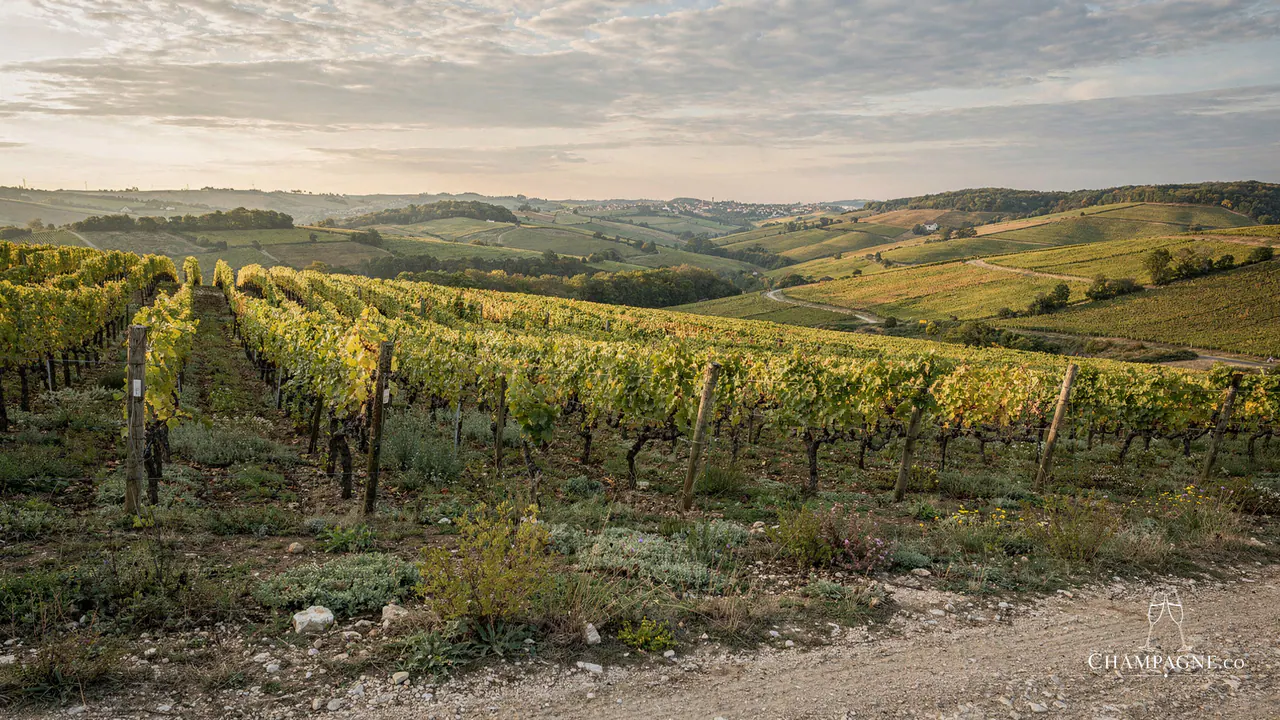
Moutard's Champagne vineyards lie in the Côte des Bar, where Kimmeridgian marls and clay-limestone form a major part of the geological background. Current estate material gives a vineyard surface of about 23 hectares, while the UMC record rounds the estate to 22 hectares.
The present planting breakdown is led by roughly 13.9 hectares of Pinot Noir and 5.7 hectares of Chardonnay. The remainder includes approximately 1.1 hectares of Petit Meslier, 1.3 hectares of Arbane across younger and older plantings, 0.55 hectares of Pinot Blanc and 0.57 hectares of Meunier. Those figures explain why the rare varieties are more than a marketing footnote here.
The Champagne business also has a trading activity based on contracted grape purchases in the Côte des Bar, so the family vineyard figure should not be confused with the total sourcing footprint of the house.
Cellar and winemaking
Moutard's current range is organised into several distinct families rather than one fixed cellar formula. The house offers conventional Brut styles, zero-dosage wines, parcel Champagnes, rare-variety cuvées and a no-added-sulphur Pinot Noir bottling.
This makes release identity particularly important. A parcel Pinot Noir, a six-grape blend and an Arbane cuvée are intended to show different raw materials and methods, so technical details such as dosage, vintage and élevage should be read from the exact bottle rather than generalised across the estate.
Champagne.co analysis
Moutard is easiest to understand through contrast. On one side sits the Côte des Bar's familiar Pinot Noir strength. on the other is a serious commitment to grape varieties that most Champagne drinkers rarely encounter.
That gives the portfolio several useful entry points. The classic Brut establishes the house baseline, the parcel wines narrow the focus to individual sites and Pinot Noir or Chardonnay, and the rare-variety wines reveal the more unusual part of the estate's identity. The six-grape cuvées are especially relevant because they show how Moutard connects the historic varieties to the familiar three-grape Champagne framework.
Buying guidance
Start with Brut Grande Cuvée if you want a straightforward introduction to the house before exploring its more specialised wines. For a clearer Côte des Bar Pinot Noir focus, move to one of the parcel bottlings such as Richardot Pinot Noir Vieilles Vignes, Les Troncs or Les Perrières.
Choose Arbane Vieilles Vignes if the goal is to taste one of Champagne's rare authorised varieties on its own. Cuvée des 6 Cépages is the broader choice for understanding how Moutard combines the historic varieties with Chardonnay, Pinot Noir and Meunier. Vignes Chiennes Chardonnay offers the most direct contrast to the Pinot Noir-led side of the range, while Cuvée Pinot Noir Sans Soufre is the bottle to seek specifically for the no-added-sulphur approach.
Loading current Champagne range…
Spotted something wrong? Report a correction
Every report goes to a human review queue. Nothing on this page changes automatically.