Nowack
Champagne Nowack is a grower-producer in Vandières, in the Vallée de la Marne, where the Nowack family has farmed vines for more than two centuries. The modern estate is shaped by Flavien Nowack, who returned to the family business in 2012 and…
Editorial profile
Champagne Nowack is a grower-producer in Vandières, in the Vallée de la Marne, where the Nowack family has farmed vines for more than two centuries. The modern estate is shaped by Flavien Nowack, who returned to the family business in 2012 and progressively brought vineyard work and vinification back into a more parcel-focused domaine model.
The estate now works about 10 hectares, with Meunier accounting for roughly 70% of the vineyard and Chardonnay and Pinot Noir making up the balance. Flavien has expanded the domaine through ownership and tenancy while also using a limited amount of fruit from growers whose farming approach he knows; current reporting places that purchased component at up to around 15% of the total volume vinified.
Why this producer matters
Nowack is particularly useful for understanding Vandières because the range is organised less around a single house style than around differences within the village slope. Flavien has studied individual parcels through soil pits and treats altitude, exposure and geology as practical variables in both farming and wine identity.
That approach gives the portfolio a clear logic. Broad blends establish the domaine's frame of reference, named parcels isolate specific sites and varieties, and the L.V. wines explore what happens when selected parcels spend much longer on lees. The result is a producer whose range can be read as a study of place, variety and time rather than simply a collection of labels.
Vineyards and terroir
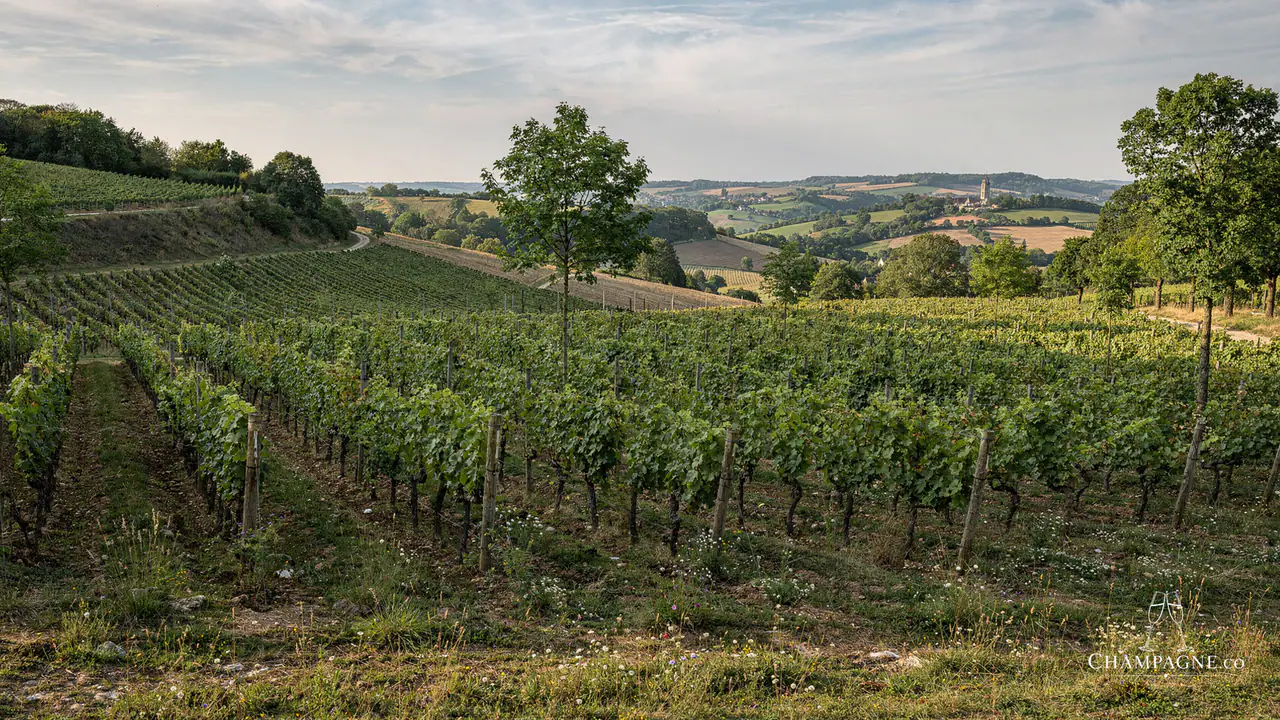
Vandières supplies markedly different conditions over a relatively short change in elevation. Terres Bleues sits higher on the slope, where fossil-bearing limestone is an important feature. La Fontinette, Les Bauchets and La Tuilerie occupy mid-slope positions with combinations of marl, clay, sand and limestone, while Arpent Rouge lies lower on a warmer, south-facing sector.
Organic farming is central to the current estate. Flavien stopped using herbicides when he returned, began organic conversion in 2016 and has subsequently developed an agroforestry programme, planting multiple tree species across roughly four hectares. He also uses selected biodynamic practices, but that should not be confused with a claim that the domaine is currently certified biodynamic.
Winemaking and cellar approach
The cellar approach is deliberately restrained. Grapes are picked in small cases at full maturity, fermentations are spontaneous, settling is light and malolactic fermentation is generally allowed to proceed. Sulphur and dosage are kept low, with dosage varying by wine and release, while new oak represents only a small part of élevage.
Some bottlings also use grape must in the secondary fermentation. This, together with the domaine's ageing choices, contributes to a style that places wine texture and site character ahead of a strongly standardised house signature.
Champagne.co analysis
Nowack makes most sense when approached as a vertical map of Vandières. The important distinction is not simply between blends and single vineyards, but between different positions on the slope and the way those positions interact with Meunier, Chardonnay and Pinot Noir.
That makes the range unusually coherent for comparative drinking. S.A. gives the broad frame; Fontinette, Bauchets, Tuilerie, Terres Bleues and Arpent Rouge narrow the focus to individual sites; L.V. then adds extended ageing as another variable. Flavien's farming and cellar choices support that structure rather than obscuring it with a rigid recipe.
The estate is also still evolving. Vineyard area has grown, a limited amount of purchased fruit can enter the programme, and blends and base years change.
Buying guidance
For a first look at the domaine, start with S.A. and note the base year. La Fontinette is the clearest route into parcel-specific Meunier, while Les Bauchets shifts the focus to Pinot Noir and La Tuilerie to Chardonnay. Les Terres Bleues is the natural comparison for a higher-slope site, whereas Arpent Rouge explores the warmer lower slope and may vary in its blend from release to release.
The L.V. wines are the more mature end of the range and are best bought with the exact vintage and disgorgement understood. They are distinct long-aged releases, not alternative names for the standard Fontinette or Tuilerie bottlings.
Loading current Champagne range…
Spotted something wrong? Report a correction
Every report goes to a human review queue. Nothing on this page changes automatically.