Oudiette
Champagne Oudiette is a small family grower in Beaunay, in the Coteaux du Petit Morin, run by Maxime, Pascal and Sylvie Oudiette. The family says it has been established in Beaunay for almost a century. Maxime joined his parents in 2012 and, from 2015,…
Editorial profile
Champagne Oudiette is a small family grower in Beaunay, in the Coteaux du Petit Morin, run by Maxime, Pascal and Sylvie Oudiette. The family says it has been established in Beaunay for almost a century. Maxime joined his parents in 2012 and, from 2015, began developing the parcel-focused approach that now defines the domaine.
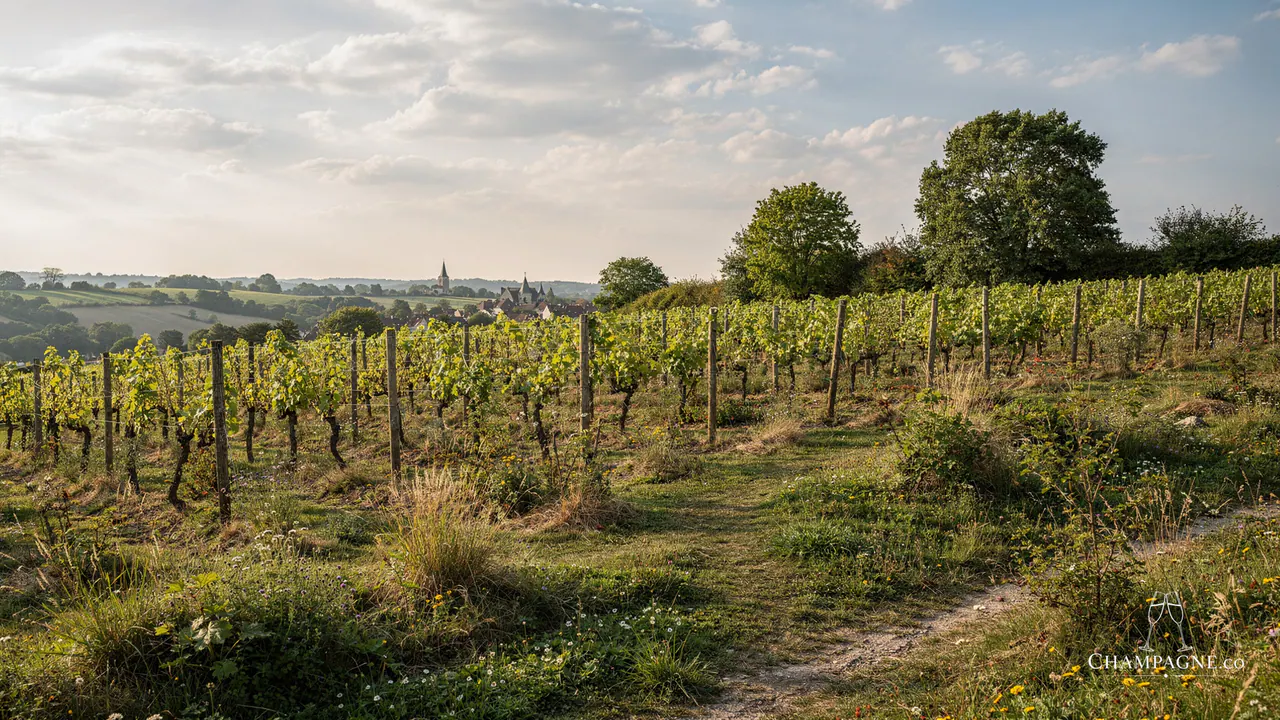
The estate's own current vineyard register totals four hectares, principally in Beaunay with additional vines in Celles-lès-Condé and Étoges. It records an average vine age of 39 years and 26,115 vines across Chardonnay, Meunier, Pinot Noir and a small planting of Pinot Gris. Oudiette uses the 1821 Napoleonic cadastre to identify and name its parcels, making place of origin central to the way the wines are organised and presented.
Why this producer matters
Oudiette is a particularly clear example of a contemporary Champagne grower structuring a range around individual sites rather than around a conventional hierarchy of non-vintage, vintage and prestige cuvées. The wines are identified by parcel, and reserve-wine histories are managed at parcel level. That makes the range useful for understanding how differences within one small sector of Champagne can be carried through from vineyard to bottle.
The farming is equally site-conscious. Oudiette describes ten plots worked without synthetic pesticides, with cultivation concentrated beneath the vines and spontaneous vegetation retained between rows. Copper, sulphur and plant preparations are used for protection. Since 2024, all of the domaine's Chardonnay is certified organic; the wider vineyard programme also incorporates biodynamic practices, vitiforestry and permaculture, but the estate does not present the whole holding as biodynamically certified.
Vineyards and terroir
The four-hectare estate is centred on Beaunay and extends into Celles-lès-Condé and Étoges. Chardonnay is the largest component of the planting, followed by Meunier, with smaller amounts of Pinot Noir and Pinot Gris. The producer's current register lists 16,799 Chardonnay vines, 7,199 Meunier, 1,636 Pinot Noir and 481 Pinot Gris.
Several named parcels form the backbone of the range. Les Gras d'Huile is a Chardonnay site in Beaunay. Les Hautes Sources Souris includes the Pinot Noir used for the cuvée of the same name, while Les Caourdets and Les Bas Vigny provide further Chardonnay expressions. The domaine also farms Meunier in parcels including Les Barabannes and maintains Chardonnay in Les Chênes at Étoges.
The parcel register shows that these sites differ materially in age, exposure and soil. Les Bas Vigny, for example, is a small Chardonnay parcel planted in 2007 on shallow soils over soft chalk. Oudiette's decision to keep such sites separate gives the range a geographical logic that is more precise than a single generic description of the estate's terroir.
Winemaking and cellar approach
Cellar work is designed to remain responsive to the wine rather than to impose one fixed recipe. Juice goes directly from the press to 228-litre barrels, where alcoholic fermentation proceeds spontaneously with indigenous yeasts. The producer sometimes prepares a native-yeast pied de cuve before harvest. Sulphur is not added at pressing and is used lightly after fermentation.
Malolactic fermentation is allowed to occur according to the wine rather than being treated as an automatic house rule. The wines remain on their lees in barrel for at least 11 months, are generally not stirred, and are bottled without fining, filtration or tartaric stabilisation. Oudiette says dosage is adjusted to each wine and can therefore change from one release to another.
Perpetual reserves are also parcel-specific. Rather than maintaining one undifferentiated house reserve, the domaine builds reserve material tied to individual sites. This is an important part of the producer's identity because successive releases of the same cuvée can contain meaningfully different proportions of reserve wine.
Champagne.co analysis
Oudiette's significance lies less in scale than in the precision of its internal map. Four hectares might normally suggest a compact, easily summarised domaine, but the producer does the opposite: it breaks that small holding into named sites, tracks the vineyard parcel by parcel and keeps reserve histories attached to those sites. The result is a range in which origin and release matter more than a permanent ladder of prestige.
That makes release detail unusually important. Les Gras d'Huile is a good example: the proportion of perpetual reserve changes materially between releases, so the wine cannot be reduced to one timeless blend specification. The same principle applies more broadly to dosage, malolactic conversion and other cellar choices. Oudiette is best understood as a site-responsive grower whose methods are adjusted to the conditions of each parcel and year.
The vineyard programme reinforces that interpretation. Organic certification for the Chardonnay, spontaneous ground cover, reduced inputs, vitiforestry and other biodiversity-oriented practices all point toward a farming model designed around resilience and observation. The wines then carry that same logic into the cellar through separate parcel vinification and limited intervention.
Buying guidance
For a first bottle, Les Gras d'Huile is the most direct introduction to Oudiette because it combines a principal Beaunay Chardonnay parcel with the domaine's parcel-specific perpetual-reserve system. Check the base year and reserve proportion when buying, as those details change from release to release.
Choose Les Hautes Sources Souris to see the estate through Pinot Noir rather than Chardonnay. Les Caourdets offers another Beaunay Chardonnay site, while Les Bas Vigny is chiefly for collectors comfortable with extremely small production and release-specific availability.
Rosé d'Infusion is the more unconventional option, using a distinct infusion method and appearing only when the fruit allows the producer to make it as intended. Readers interested in the still-wine side of the domaine should look separately for Beaunay Rouge, remembering that it is Coteaux Champenois rather than Champagne.
Loading current Champagne range…
Spotted something wrong? Report a correction
Every report goes to a human review queue. Nothing on this page changes automatically.