Palmer & Co
Palmer & Co is a Reims Champagne house with cooperative roots, founded in 1947 when seven winegrowers from the Montagne de Reims combined their vineyards and winemaking expertise. The house moved to Reims in 1959 and today operates from rue Jacquart, with…
Editorial profile
Palmer & Co is a Reims Champagne house with cooperative roots, founded in 1947 when seven winegrowers from the Montagne de Reims combined their vineyards and winemaking expertise. The house moved to Reims in 1959 and today operates from rue Jacquart, with Xavier Berdin as Cellar Master.
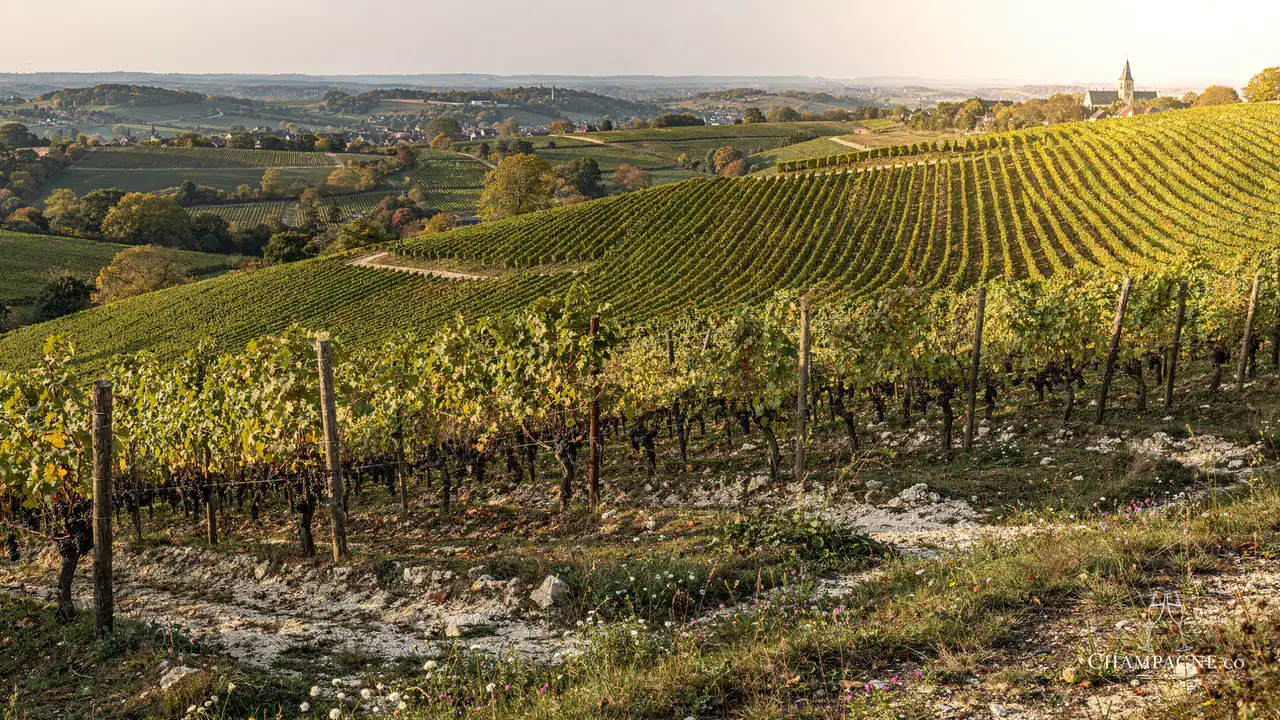
Its modern identity rests on three linked ideas: a strong base of Premier and Grand Cru vineyards in the Montagne de Reims, extensive use of reserve wines, and long cellar ageing. Palmer & Co says it is established across more than 220 hectares of Premier and Grand Cru vineyards in its historic Montagne de Reims heartland, complemented by fruit from the Côte de Sézanne, Côte des Bar and Vallée de la Marne.
Why this producer matters
Palmer & Co is an instructive example of how a collectively owned Champagne house can build a recognisable style through blending rather than through a single estate vineyard. Its founders pooled high-quality Montagne de Reims holdings; the current house still treats blending across crus, varieties, years and reserve wines as the centre of its identity.
The reserve-wine system is particularly important. Palmer maintains perpetual reserves linked to its principal non-vintage cuvées and also works with three soleras: a red-wine solera used in Rosé Solera, a Chardonnay solera used in dosage, and Chardonnay and Pinot Noir soleras that can form part of Amazone. That gives the range a stronger continuity of reserve-wine character than the simple phrase "non-vintage blend" suggests.
Vineyards and sourcing
The Montagne de Reims remains Palmer & Co's historic core. The house's current vineyard material describes more than 220 hectares of Premier and Grand Cru vineyards there, including Pinot Noir sites as well as important Chardonnay on east- and south-east-facing slopes. Other sources of fruit include the Côte de Sézanne, Côte des Bar and Vallée de la Marne.
This broad sourcing matters because the wines are built through assemblage. La Réserve draws from more than 50 crus, while the vintage and prestige wines narrow the focus toward selected Premier and Grand Cru sites. Palmer is therefore better understood as a house that uses a wide vineyard network selectively rather than as a producer whose identity depends on one contiguous estate.
Cellar and blending approach
Xavier Berdin and the oenology team oversee a cellar programme built around reserve wines, soleras and extended maturation. For the non-vintage range, reserve wines from previous blends are incorporated into later releases, creating continuity from one bottling to the next.
Palmer also uses time as a structural part of the range. The house states a minimum of three years on lees for its non-vintage cuvées, while vintage wines are generally aged for substantially longer periods. Some large formats are given extended cellar ageing, and the house continues the uncommon practice of carrying out the second fermentation directly in large bottles for selected formats rather than transferring wine into them later.
The important point for readers is that ageing and reserve composition vary by cuvée.
Champagne.co analysis
Palmer & Co makes most sense when viewed as a house of layered reserves rather than simply as a large blended Champagne producer. The broad vineyard network supplies diversity, but the cellar system is what turns that diversity into continuity. Reserve wines from previous blends maintain a house thread across successive non-vintage releases, while the separate soleras add older material with distinct roles in the rosé, dosage and prestige programmes.
That creates an unusually coherent range architecture. La Réserve establishes the house's Chardonnay-led baseline; La Réserve Nature removes dosage without abandoning that core structure; Blanc de Noirs shifts the emphasis to black grapes; Rosé Solera shows the effect of a long-lived red-wine reserve; and the vintage wines narrow the focus toward selected crus and years. Amazone then pushes the reserve-and-ageing model furthest by combining multiple harvests with solera material and very long maturation.
The common thread is not one grape or one village but the controlled use of blending and time. For readers comparing bottles, the most revealing details are therefore the proportion and type of reserve wine, the years represented in the blend and the length of lees ageing.
Buying guidance
For a first bottle, La Réserve is the clearest introduction because it sets out the house's Chardonnay-led blend and reserve-wine method without the additional variables of zero dosage, rosé production or vintage selection.
Choose La Réserve Nature if you want to see the same broad house architecture without dosage, and Blanc de Noirs if black-grape structure is the priority. Rosé Solera is the most distinctive route into Palmer's reserve programme because its red-wine solera has a specific role that is easy to understand within the blend.
For vintage Champagne, Blanc de Blancs 2018 is the Chardonnay-focused option, while Grands Terroirs 2018 gives a broader Montagne de Reims blend. Amazone de Palmer & Co is the bottle to seek when the attraction is long ageing, multiple harvests and solera material brought together in one cuvée. La Réserve Demi-Sec serves a different purpose altogether and is best chosen when a noticeably sweeter Champagne style is specifically wanted.
Loading current Champagne range…
Spotted something wrong? Report a correction
Every report goes to a human review queue. Nothing on this page changes automatically.