Philippe Gonet
Champagne Philippe Gonet is a family house based in Le Mesnil-sur-Oger, with roots traced by the family to 1830. The current generation is led by siblings Pierre Gonet and Chantal Brégeon-Gonet.
Editorial profile
Champagne Philippe Gonet is a family house based in Le Mesnil-sur-Oger, with roots traced by the family to 1830. The current generation is led by siblings Pierre Gonet and Chantal Brégeon-Gonet.
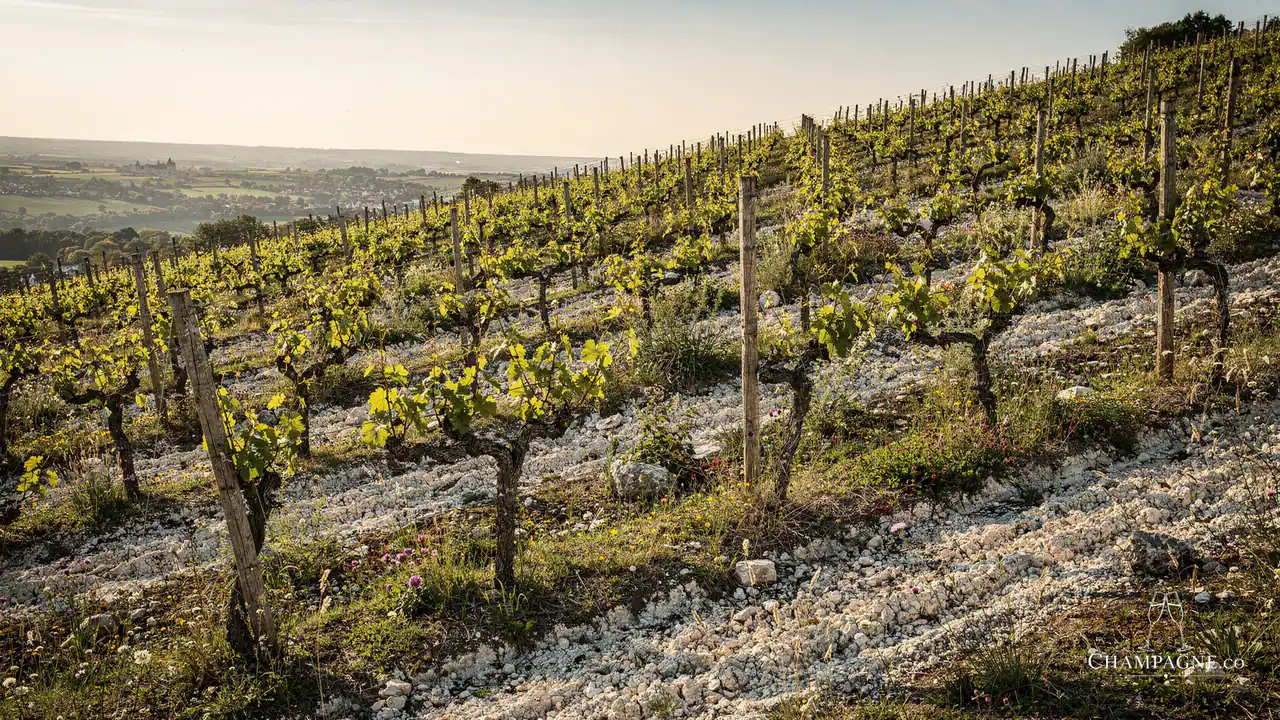
Le Mesnil is the centre of gravity, but the vineyard is broader. Recent first-party technical material gives approximately 20 hectares across 35 parcels in eight villages, including about 4.5 hectares in Le Mesnil-sur-Oger itself. Other holdings extend through Oger and Vertus in the Côte des Blancs, Vindey in the Sézannais, Fontaine-sur-Aÿ, Le Breuil, La Chapelle-Monthodon and Montgueux.
The producer also buys selected Pinot Noir and, occasionally, Chardonnay from trusted growers.
Chardonnay as the centre of the range
Chardonnay dominates the current portfolio, but the house uses its regional spread at several levels of geographical precision. Some wines combine Chardonnay from different sectors of Champagne; others narrow the focus to Le Mesnil Grand Cru or to explicitly named terroirs.
Current first-party technical material records HVE3 and Viticulture Durable en Champagne (VDC) certification and states that the vineyards are worked without insecticides or herbicides and with organic fertilisers. Those credentials are reported as such rather than converted into an organic-certification claim.
TER: three terroirs, deliberately separated
The TER collection is one of the clearest expressions of the house's present approach. Both TER wines are made in 60-hectolitre oak foudres, and the producer states that malolactic fermentation is not carried out for these cuvées.
TER Blanc is 100% Chardonnay from three parcels: Les Hautes Mottes in Le Mesnil-sur-Oger Grand Cru, Vozémieux in Oger Grand Cru and Les Corrigniers in Ludes Premier Cru.
TER Noir uses Chardonnay, Pinot Noir and Meunier from three different places, including Le Mesnil-sur-Oger and Montgueux. Exact proportions belong to the current release rather than to a generic house formula.
Le Mesnil and the prestige wines
Roy Soleil and Belemnita move the range back towards Le Mesnil-sur-Oger. Roy Soleil is a Le Mesnil Grand Cru Chardonnay wine with an oak component in the élevage. Belemnita is the most tightly selected old-vine Le Mesnil expression and includes Chardonnay from vines planted in 1929.
The Millésime line is inherently vintage-specific: the harvest year is part of the wine's identity and must never be replaced by data from a different vintage.
Why this producer matters
Philippe Gonet is more complex than the shorthand “Le Mesnil Blanc de Blancs house.” The range moves from cross-region Chardonnay through zero-dosage 3210 and the three-terroir TER wines to old-vine Grand Cru selections. Oak, malolactic fermentation and dosage are varied by cuvée, so technical distinctions matter as much as prestige.
That breadth makes the house useful for comparing several ways of handling Chardonnay while still retaining Le Mesnil as the historic anchor.
Champagne.co analysis
The current range is best read by asking how narrowly origin is defined. Signature and 3210 use broader Chardonnay sourcing; TER deliberately combines three named terroirs; Roy Soleil and Belemnita narrow the lens towards Le Mesnil; Millésime adds the additional constraint of one harvest.
This explains why Philippe Gonet cannot be reduced to one technical recipe. The producer uses stainless steel, oak, malolactic choices, dosage and geographic scale differently depending on the wine. The range is therefore a study in controlled variation rather than a single ladder of prestige.
Buying guidance
Start with Signature for the broadest introduction to the Chardonnay-led house style. Choose 3210 if zero dosage is the priority, or compare TER Blanc and TER Noir to explore the producer's three-terroir concept.
Move to Roy Soleil for a more focused Le Mesnil Grand Cru expression and to Belemnita for the old-vine end of the range. For Millésime, always buy by the exact vintage. With Rosé Brut and Réserve Brut, check the current release sheet because blend and reserve composition can change between editions.
Loading current Champagne range…
Spotted something wrong? Report a correction
Every report goes to a human review queue. Nothing on this page changes automatically.