Pierre Gimonnet et Fils
Champagne Pierre Gimonnet & Fils is one of the substantial family-grower estates of the Côte des Blancs, based in the Premier Cru village of Cuis. The Gimonnet family has been present in Cuis since at least the middle of the seventeenth century, with its…
Editorial profile
Champagne Pierre Gimonnet & Fils is one of the substantial family-grower estates of the Côte des Blancs, based in the Premier Cru village of Cuis. The Gimonnet family has been present in Cuis since at least the middle of the seventeenth century, with its winegrowing history firmly established by the eighteenth century.
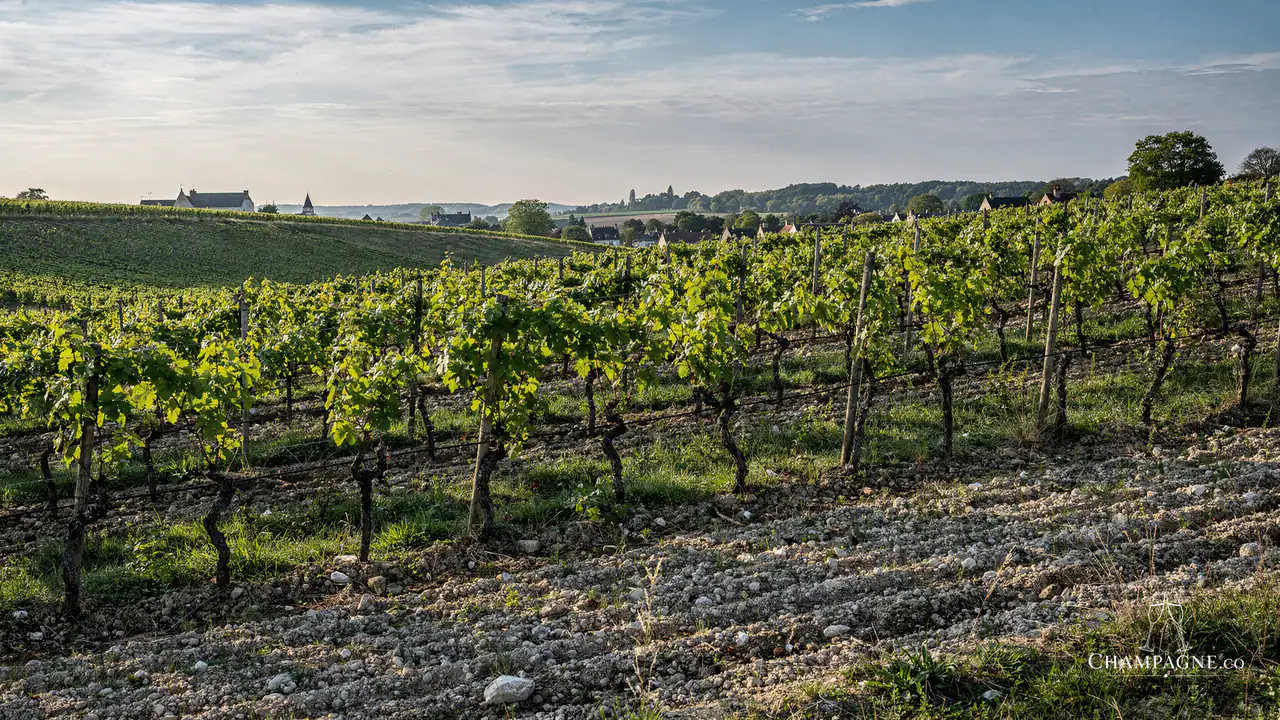
The modern domaine has grown from a Cuis-centred estate in the 1950s to a current vineyard of 29.40 hectares, still concentrated entirely in the Côte des Blancs. Chardonnay defines the producer: the vineyard spans Cramant, Chouilly and Oger Grand Cru, together with Cuis and Vertus Premier Cru.
The family today spans several generations. Didier and Olivier Gimonnet remain central to the domaine, with Arnaud and Pierre-Guillaume representing the younger generation within the family operation.
Why this producer matters
Pierre Gimonnet is important not simply because it owns a large amount of Chardonnay vineyard for a grower, but because it uses that vineyard in two apparently opposite ways.
On one side, the domaine is a committed blender. Cuvées such as Cuis 1er Cru, Fleuron and the principal Spécial Club combine different years, parcels or villages to build balance. On the other side, the range now includes increasingly precise village expressions from Cramant, Chouilly, Oger and Cuis.
The producer therefore gives Champagne.co an unusually clear way to explain the tension between assemblage and terroir-specific bottling in modern Champagne. The domaine does not treat those approaches as contradictory; both are used to interpret Chardonnay.
Vineyard and terroir
The current first-party vineyard census is 29.40 hectares. Current independent producer records place roughly 13 hectares in Grand Cru villages and about 16 hectares in Premier Cru sites, all within the Côte des Blancs.
The principal villages are:
- Cramant Grand Cru
- Chouilly Grand Cru
- Oger Grand Cru
- Cuis Premier Cru
- Vertus Premier Cru
The estate remains overwhelmingly identified with Chardonnay. Its strength is not just the scale of its holdings but the ability to blend across a large mosaic of Côte des Blancs parcels and, where desired, to isolate individual village identities.
Vineyard practice
The producer describes a pragmatic form of reasoned viticulture rather than an ideological farming system. Current estate material records soil work on the majority of parcels where appropriate, selective grass cover, very limited fertilisation, reduced herbicide use and sexual-confusion techniques to avoid insecticides.
Those practices are best reported as specific vineyard methods rather than converted into an organic or biodynamic certification claim.
Blending and reserve wines
The domaine regards blending as fundamental to Champagne. Cuis 1er Cru, the core non-vintage wine, is built from at least five harvest years rather than one base wine alone.
A distinctive part of the reserve programme is the preservation of reserve wines in bottle on fine lees, a method the estate has used for decades. The exact reserve mix remains release-specific, but the principle explains why the main non-vintage cuvée is designed around continuity across several years rather than around one dominant harvest.
Champagne.co analysis
Pierre Gimonnet & Fils is best understood through the question: when does blending reveal terroir better than isolation? The domaine's answer is deliberately flexible.
Cuis 1er Cru and Fleuron argue for assemblage. They combine years or origins to create balance. The principal Spécial Club does the same at a higher level, using old-vine Chardonnay from several strong sites. The village-specific Cramant, Chouilly, Oger and Cuis wines then reverse the experiment and ask what happens when one origin is allowed to stand alone.
Œnophile adds a third axis by removing dosage. Rosé de Blancs adds a fourth by introducing a small amount of Pinot Noir into an otherwise Chardonnay-defined estate. The range is therefore more intellectually coherent than a simple hierarchy from inexpensive to expensive.
Buying guidance
For a first bottle, Cuis 1er Cru Brut is the right starting point because it explains the domaine's multi-year blending philosophy and its home village. Brut Extra is the obvious comparison for readers interested in lower dosage within the same broad framework.
Move to Fleuron for a vintage blend and to Œnophile for a no-dosage vintage expression. Spécial Club – Grands Terroirs de Chardonnay is the best introduction to the estate's old-vine prestige blending philosophy.
Readers interested in terroir comparison should then explore the village-specific Special Clubs from Cramant, Chouilly, Oger and Cuis. Always show the exact vintage: these wines are not interchangeable permanent formulas, and the year is integral to understanding the bottle.
vintage and format are essential purchase information.
Loading current Champagne range…
Spotted something wrong? Report a correction
Every report goes to a human review queue. Nothing on this page changes automatically.