Pierre Legras
Champagne Pierre Legras is a family estate based in Chouilly Grand Cru, on the Côte des Blancs. The family traces its local winegrowing line back through eleven generations to Pierre Legras, born in Chouilly in 1662. The modern Champagne marque was created…
Editorial profile
Champagne Pierre Legras is a family estate based in Chouilly Grand Cru, on the Côte des Blancs. The family traces its local winegrowing line back through eleven generations to Pierre Legras, born in Chouilly in 1662. The modern Champagne marque was created in 2002 by Vincent Legras, a trained oenologist, with Marcelline joining the business in 2011.
The estate today covers 10.5 hectares. Chardonnay is the defining grape: 7 hectares in Chouilly are planted exclusively to Chardonnay, while the remainder of the vineyard includes Chardonnay, Pinot Noir and Meunier. That gives Pierre Legras both a strong Chouilly Blanc de Blancs identity and enough broader material for blends, rosé and Blanc de Noirs wines.
Why this producer matters
Pierre Legras is interesting because its range is organised around two complementary ideas. One is Chouilly itself: Coste Beert, Déa Matra and the Monographie wines are built around Grand Cru fruit from the village. The other is assemblage across a wider family vineyard, represented most clearly by Orior and the Blanc de Noirs programme.
The estate also makes cellar choices unusually easy to read. Stainless steel is the default vessel, but Monographie and Idée de Voyage receive a partial barrel component. Malolactic fermentation, by contrast, is a consistent current house practice across the wines. Those decisions give readers concrete technical differences to follow rather than relying on generic style language.
Vineyard and Chouilly
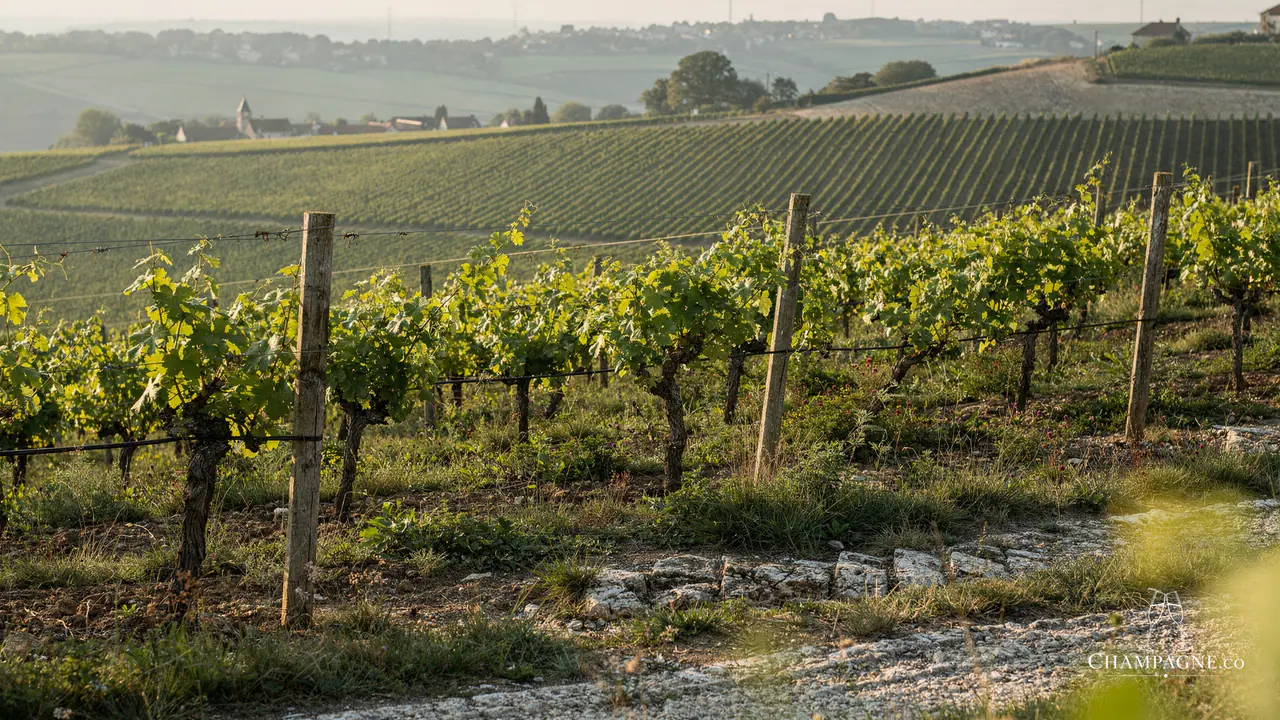
Chouilly is the centre of the estate. Of the current 10.5 hectares, 7 hectares are devoted solely to Chardonnay in Chouilly Grand Cru. The producer describes chalk as the defining subsoil there. The rest of the vineyard carries Chardonnay, Pinot Noir and Meunier on denser soils beyond the core Chouilly Chardonnay holdings.
The estate has followed an environmental programme for decades and obtained Haute Valeur Environnementale (HVE) certification in 2020. Current vineyard practice includes substantial grass cover to limit erosion and protect water resources. HVE is the appropriate certification claim; it should not be converted into organic or biodynamic status.
Cellar and winemaking
The current winery contains 27 temperature-controlled stainless-steel tanks and around twelve barrels. That equipment allows the estate to keep parcels or lots separate before blending and to use oak selectively rather than as a universal house signature.
Vincent Legras currently carries out malolactic fermentation on all wines. For most cuvées, stainless steel remains central. Monographie and Idée de Voyage are different: part of their wines is vinified in barrel before being combined with tank-raised components.
That distinction should remain cuvée-specific. It would be misleading to describe Pierre Legras either as an all-stainless estate or as a broadly barrel-driven producer.
Champagne.co analysis
Pierre Legras is best understood through the contrast between pure Chouilly and deliberate blending. Coste Beert and Monographie narrow the focus to Chardonnay from one Grand Cru village. Orior does the opposite, using assemblage to connect different family vineyard origins. Déa Matra introduces Pinot Noir to the Chouilly framework, while Black Jackets leaves the Côte des Blancs emphasis altogether for a black-grape blend from Épernay and Moussy.
The cellar reinforces that structure. Full malolactic fermentation is stable across the range, but oak is used selectively. That makes Monographie and Idée de Voyage technical counterpoints to the more stainless-steel-led wines rather than evidence of one universal oak style.
The estate therefore offers more than a standard Côte des Blancs Blanc de Blancs story. Its strongest identity is the ability to move between Chouilly purity, broader assemblage and selective barrel work while keeping the cuvées clearly differentiated.
Buying guidance
For a first bottle focused on the estate's core terroir, Coste Beert is the most direct choice: Chouilly Grand Cru Chardonnay without the complications of a broader blend. Orior Brut is the better starting point for understanding Vincent Legras as an assembler rather than only as a Chouilly specialist.
Choose Monographie Brut to see how a partial barrel component changes the Chouilly framework, or Monographie Brut Nature for the same broad idea without dosage. Déa Matra is the current rosé route, while Black Jackets is the black-grape contrast and should always be purchased with its exact vintage confirmed because current first-party pages conflict.
Idée de Voyage belongs to the vintage, barrel-influenced end of the range. As with all vintage wines, the year is intrinsic to the bottle and should never be carried forward automatically to later releases.
Loading current Champagne range…
Spotted something wrong? Report a correction
Every report goes to a human review queue. Nothing on this page changes automatically.