Pierre Mignon
Champagne Pierre Mignon is a family house based in Le Breuil, in the Vallée de la Marne. The family presents its Champagne tradition as dating to 1892, and the current generation is led by Jean-Charles and Céline Mignon. Jean-Charles directs the technical…
Editorial profile
Champagne Pierre Mignon is a family house based in Le Breuil, in the Vallée de la Marne. The family presents its Champagne tradition as dating to 1892, and the current generation is led by Jean-Charles and Céline Mignon. Jean-Charles directs the technical and oenological side of the house, while Céline represents the family and wines internationally.
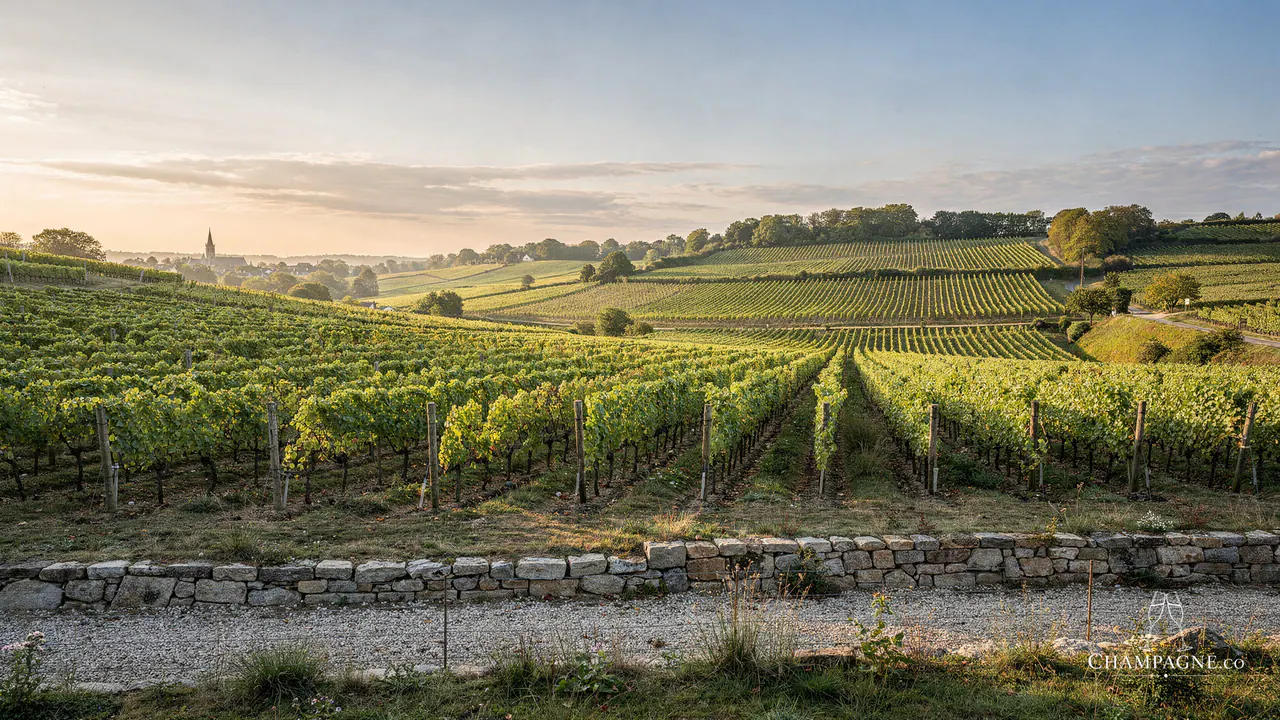
The estate currently works 20 hectares spread between the Vallée de la Marne and the Côte des Blancs. That geography explains the range: the core wines are strongly shaped by Meunier, while the Blanc de Blancs and Harmonie wines draw on Grand Cru Chardonnay from Chouilly, Cramant and Avize.
Why this producer matters
Pierre Mignon is useful to understand because it combines three quite different Champagne identities within one house. The first is a Meunier-led Vallée de la Marne core, visible in Grande Réserve and Blanc de Noirs. The second is a Grand Cru Chardonnay programme from the Côte des Blancs. The third is the family's own Clos des Graviers, a walled parcel planted in the 1950s and made as a separate long-aged wine.
The range also allows dosage to be compared directly. Cuvée Pure and Blanc de Blancs Non Dosé remove dosage entirely, while the vintage and core blends retain measured dosage.
Vineyard and environmental programme
The current vineyard covers 20 hectares between the Vallée de la Marne and Côte des Blancs. The house obtained Haute Valeur Environnementale level 3 certification in 2019. A portion of the vineyard received organic certification in 2024.
Those claims need to remain properly scoped. The organic status currently applies to part of the vineyard, not automatically to all 20 hectares or every bottle produced by the house.
Clos des Graviers
Clos des Graviers is the most distinctive single vineyard in the Pierre Mignon story. The family planted the parcel in the 1950s. According to the house, the ground was so stony that the stones removed during planting were reused to construct the low walls that still mark the Clos.
The vineyard contains Chardonnay, Meunier and Pinot Noir. The current Clos des Graviers Champagne is vinified in wood, aged for around 11 years on lees and currently dosed at 6 g/L. Those figures belong to the present release framework and should remain attached to the exact bottling.
Cellar approach
Pierre Mignon describes a relatively low-intervention handling of the base wines: slow natural settling, with filtration, fining and other treatments avoided where the cellar team judges they are unnecessary.
Reserve wines are maintained through a solera-style system. The house states that around 30–35% of wines from previous years can be incorporated into a current blend. That reserve structure is particularly important for the non-vintage house wines and helps explain why their identity is not tied to one harvest alone.
Champagne.co analysis
Pierre Mignon's range is most coherent when read as a dialogue between Meunier, Chardonnay and time. The core blends start from a strong Meunier base. The Blanc de Blancs wines move east to Grand Cru Chardonnay. Clos des Graviers then brings the story back to a specific family parcel and adds extended ageing and wood.
The reserve-wine system is another important thread. A house that can incorporate roughly a third of previous-year wines into a current blend is deliberately building continuity rather than asking the latest harvest to carry the whole identity of the non-vintage range.
The zero-dosage wines add a useful technical comparison without pretending that lower dosage automatically means higher quality. Cuvée Pure and Blanc de Blancs Non Dosé are different wines with different grape structures; the point is to compare how dosage interacts with those structures, not to rank them.
Buying guidance
Grande Réserve is the best introduction to the house because it shows the Meunier-led Vallée de la Marne side of Pierre Mignon and the role of reserve wines. Prestige Brut is the next step for a blend with more Chardonnay.
For Grand Cru Chardonnay, choose Blanc de Blancs Grand Cru; for the same regional Chardonnay idea without dosage, choose Blanc de Blancs Non Dosé. Cuvée Pure is the more useful zero-dosage bottle if the objective is to stay closer to the house's three-grape, Meunier-led structure.
For mature vintage Champagne, Grand Vintage 2016 is the current French-catalogue release. Harmonie de Blancs 2013 is the long-aged Grand Cru Chardonnay alternative. Clos des Graviers is the bottle to choose for the family's single-parcel story and its most extended current ageing programme.
Loading current Champagne range…
Spotted something wrong? Report a correction
Every report goes to a human review queue. Nothing on this page changes automatically.