Pierre Moncuit
Champagne Pierre Moncuit is a family grower based in Le Mesnil-sur-Oger, one of the great Chardonnay villages of the Côte des Blancs. The family's vineyard story begins in 1889, when Alex Moncuit acquired vines in Le Mesnil. His son Pierre began vinifying…
Editorial profile
Champagne Pierre Moncuit is a family grower based in Le Mesnil-sur-Oger, one of the great Chardonnay villages of the Côte des Blancs. The family's vineyard story begins in 1889, when Alex Moncuit acquired vines in Le Mesnil. His son Pierre began vinifying and selling wine under his own name in 1928, establishing the producer identity that continues today.
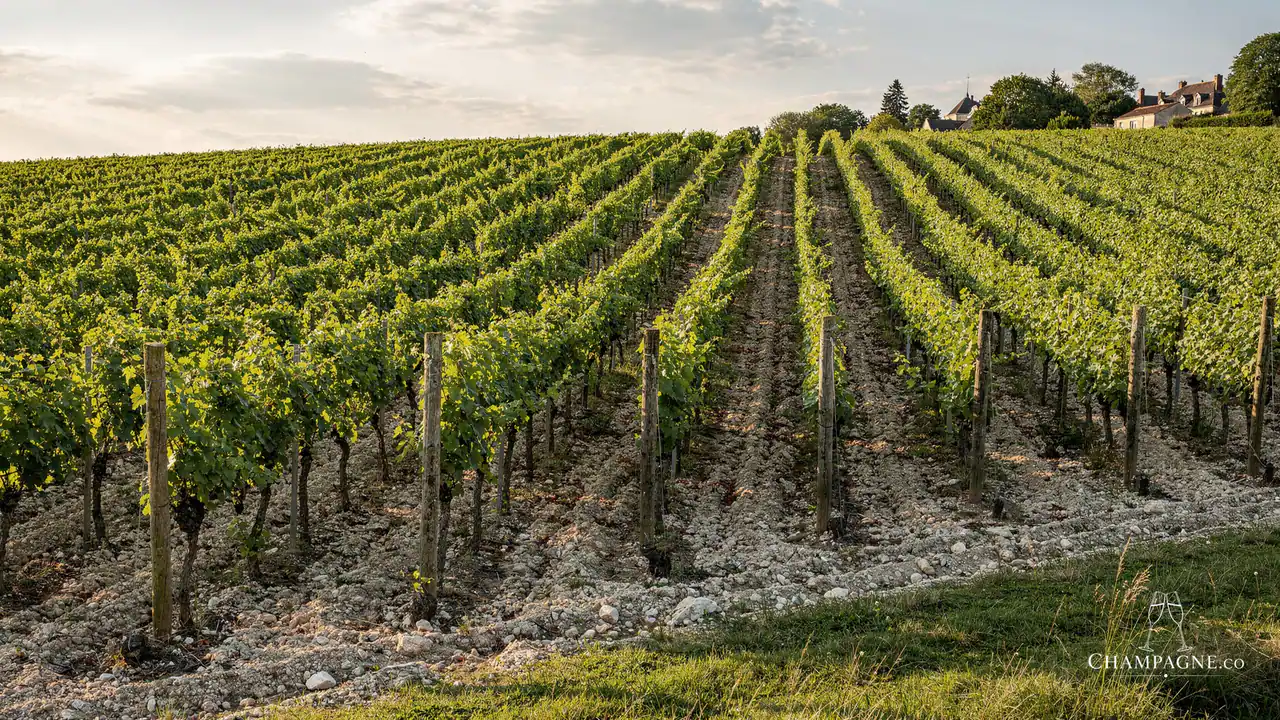
The domaine now works around 20 hectares, planted entirely to Chardonnay. Approximately 15 hectares are Grand Cru, centred on Le Mesnil-sur-Oger, while most of the remainder lies in the Sézannais. That two-area structure is fundamental to the range: Pierre Moncuit-Delos represents the Grand Cru side of the estate, while Hugues de Coulmet is built from Sézanne Chardonnay.
Why this producer matters
Pierre Moncuit is a particularly clear Chardonnay estate because it does not need different grape varieties to create variety in the range. Instead, the distinctions come from place, dosage, vine age and vintage.
Le Mesnil Grand Cru provides the central reference. Sézanne gives a geographically separate Chardonnay comparison. The Pierre Moncuit-Delos Brut and Extra-Brut show dosage differences within the Grand Cru framework, while the vintage wines and Nicole Moncuit Vieille Vigne move toward older vines and longer cellar time.
That makes the domaine useful for readers who want to understand how much diversity can be created within 100% Chardonnay Champagne.
Family and succession
The producer's own chronology records several important stages. Alex Moncuit began the vineyard in 1889. Pierre Moncuit started making and commercialising the family's own wines in 1928, assisted by his wife Odile Moncuit-Delos.
Their daughter Nicole joined the domaine in 1977 and took full responsibility for the technical side in 1982. Her brother Yves joined in 1980 to handle the commercial side. Current grower records identify Nicole, Valérie and Yves Moncuit, with the younger generation represented particularly by Valérie, who now continues the family operation.
Vineyard and Chardonnay
Current independent-grower records give a vineyard of 20 hectares, 100% Chardonnay. Champagne de Vignerons places about 15 hectares in Grand Cru vineyards, with the rest principally in the Sézannais.
The producer's current vineyard material describes vines averaging around 50 years of age. The old-vine reference point is the parcel behind Nicole Moncuit Vieille Vigne, associated with Les Chétillons in Le Mesnil-sur-Oger and very old Chardonnay vines.
Current sector records list the estate as Haute Valeur Environnementale (HVE). This is the appropriate current environmental credential; no stronger organic or biodynamic certification should be inferred from it.
Two Chardonnay landscapes
The most useful geographic contrast in the range is between Grand Cru Côte des Blancs Chardonnay and Chardonnay from Sézanne.
Pierre Moncuit-Delos is the Grand Cru family: current producer pages describe both Brut and Extra-Brut versions made from 100% Chardonnay from the estate's Grand Cru terroir. Hugues de Coulmet, by contrast, is 100% Chardonnay from the producer's Sézanne vineyards and is currently made in both Brut and Demi-Sec forms.
That makes Hugues de Coulmet more than an entry-level wine. It is the estate's clearest way of showing another Chardonnay landscape alongside Le Mesnil.
Champagne.co analysis
Pierre Moncuit demonstrates that a Chardonnay-only vineyard does not produce a one-dimensional range. The estate creates contrast first through geography: Le Mesnil and the Grand Cru Côte des Blancs versus Sézanne. It then uses dosage to create direct comparisons within both families.
The vintage and Vieille Vigne wines add another dimension: time. Nicole Moncuit Vieille Vigne connects the producer to old Chardonnay vines and a specific Le Mesnil parcel, while the vintage programme lets individual harvests stand apart from the regular blends.
The rosé is deliberately the outlier. Its Bouzy Pinot Noir component should be read as a carefully introduced counterpoint to an estate whose own vineyard remains 100% Chardonnay.
Buying guidance
For the clearest introduction to Pierre Moncuit's Grand Cru identity, begin with Pierre Moncuit-Delos Brut. Compare it with the Extra-Brut to understand the effect of lower dosage without changing the core grape and Grand Cru framework.
For the estate's second geographic identity, choose Hugues de Coulmet Brut. The Demi-Sec is valuable for readers specifically interested in how a much higher dosage changes the same Sézanne Chardonnay context.
The Grand Cru vintage wines should always be selected by exact year. Nicole Moncuit Vieille Vigne is the more focused choice for old-vine Le Mesnil Chardonnay, again with exact vintage and disgorgement checked on the bottle rather than inherited from the producer's older web archive.
Loading current Champagne range…
Spotted something wrong? Report a correction
Every report goes to a human review queue. Nothing on this page changes automatically.