Pierre Paillard
Champagne Pierre Paillard is an eight-generation family grower based in Bouzy Grand Cru on the Montagne de Reims. The family dates its winegrowing tradition in the village to 1768, when an ancestor, Antoine Paillard, acquired vineyard parcels in Bouzy.
Editorial profile
Champagne Pierre Paillard is an eight-generation family grower based in Bouzy Grand Cru on the Montagne de Reims. The family dates its winegrowing tradition in the village to 1768, when an ancestor, Antoine Paillard, acquired vineyard parcels in Bouzy.
The domaine today is run by brothers Antoine and Quentin Paillard. Its historic family vineyard covers about 11 hectares entirely in Bouzy Grand Cru; the producer's detailed map gives 10.70 hectares. Since 2018, the brothers have also expanded their work beyond Bouzy by harvesting and vinifying selected parcels from other villages, creating a second strand to the range without changing the fact that Bouzy remains the family's estate centre.
Why this producer matters
Pierre Paillard is a strong example of how a long-established Grand Cru grower can become more terroir-specific without abandoning blending. The Bouzy range begins with a village assemblage, then moves through rosé, single-parcel Pinot Noir, single-parcel Chardonnay and a long-aged prestige blend.
The newer village programme extends the same idea outward. Ambonnay, Verzenay, Ludes and Taissy are vinified as distinct origins, allowing the reader to compare different Montagne de Reims sites within a broadly consistent cellar framework.
That makes Pierre Paillard less a simple Bouzy house than a terroir platform whose centre of gravity remains Bouzy.
Bouzy vineyard and farming
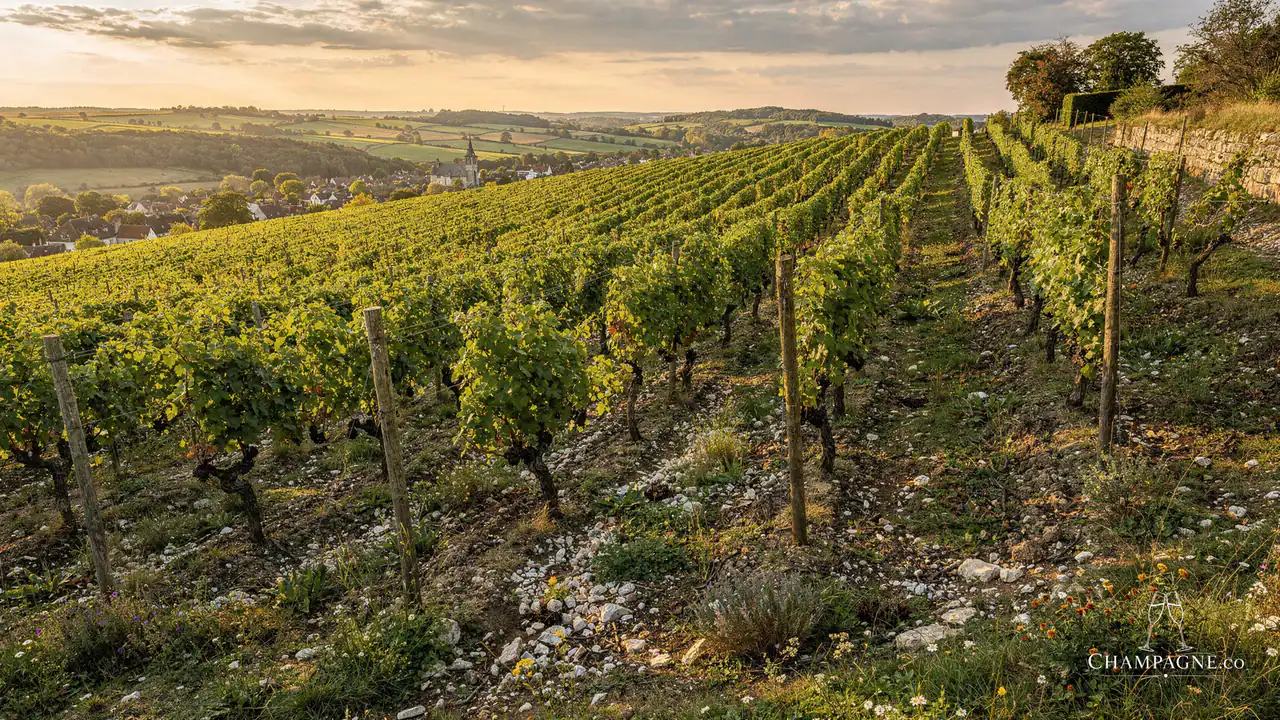
The family's historic vineyard is approximately 11 hectares of Bouzy Grand Cru. The detailed current map records 10.70 hectares and identifies old parcels including Les Maillerettes, Les Mignottes and Les Mottelettes.
The Bouzy land is farmed organically. Since 2016, Antoine and Quentin have explicitly oriented the domaine around organic farming, soil work, controlled yields and high grape maturity. The estate also uses massal selection to maintain genetic diversity in its old Pinot Noir and Chardonnay material.
Bouzy's south-facing slope and chalk-rich subsoil provide the common physical setting, but the parcel wines show that the brothers do not treat the village as one uniform terroir.
Cellar approach
The current cellar method is unusually consistent across the range. Wines are fermented and aged for around ten months in barrel on fine lees. Alcoholic fermentation uses indigenous yeasts, followed by malolactic fermentation. Sulphur is used sparingly, and the wines clarify naturally without filtration or fining.
After bottling, Champagnes spend roughly three to ten years in chalk cellars around sixteen metres underground. The length of ageing depends on the cuvée: the village blends are shorter-aged, parcel wines longer, and La Grande Récolte sits at the extended end of the programme.
Champagne.co analysis
Pierre Paillard's range works at three levels of resolution. Les Parcelles shows Bouzy as a blended village. Les Maillerettes and Les Mottelettes isolate single sites and single grapes within Bouzy. The post-2018 programme then moves outward to other villages while keeping a broadly similar cellar language.
That consistency is what makes comparison useful. Barrel élevage, indigenous fermentation, malolactic fermentation and long cellar ageing provide a common frame; the changing variable is increasingly the origin of the grapes.
The domaine also challenges a simple equation of Bouzy with Pinot Noir. Pinot Noir is central, but Les Mottelettes gives Chardonnay a serious single-parcel role, while Les Terres Roses and La Grande Récolte deliberately combine the two grapes in different ways.
Buying guidance
Les Parcelles is the correct first bottle because it introduces Bouzy as the brothers interpret it through assemblage. Always note the Roman numeral, because XXI is not merely a relabelled XIX or XX.
For a direct grape-and-parcel comparison within Bouzy, pair Les Maillerettes with Les Mottelettes: Pinot Noir versus Chardonnay from two old family sites. La Grande Récolte 2012 is the choice for the long-aged prestige end of the Bouzy programme.
Readers interested in village comparison should then move to Ambonnay, Verzenay, Ludes or Taissy, keeping the exact vintage attached to each bottle. Les Mignottes is the still-wine route and should be approached as Bouzy Rouge Coteaux Champenois rather than as another Champagne cuvée.
Loading current Champagne range…
Spotted something wrong? Report a correction
Every report goes to a human review queue. Nothing on this page changes automatically.