Ployez-Jacquemart
Ployez-Jacquemart is a small family Champagne house based in Ludes Premier Cru, in the Montagne de Reims. It was founded in 1930 by Marcel Ployez and Yvonne Jacquemart and is now led in the cellar by their granddaughter Laurence Ployez, who returned for…
Editorial profile
Ployez-Jacquemart is a small family Champagne house based in Ludes Premier Cru, in the Montagne de Reims. It was founded in 1930 by Marcel Ployez and Yvonne Jacquemart and is now led in the cellar by their granddaughter Laurence Ployez, who returned for the 1988 harvest and today directs both vinification and commercialisation alongside Christophe Prieux.
The house combines a very small estate vineyard with long-standing grower partnerships. Its own vineyard covers 3 hectares across Ludes, Ville-Dommange, Mailly-Champagne and Vertus, while additional Chardonnay and Pinot Noir come from selected partner growers in the Montagne de Reims and Côte des Blancs.
Why this producer matters
Ployez-Jacquemart is distinctive because its identity is based less on scale than on how the wines are aged and finished. Low dosage is a consistent theme. Barrel fermentation is used selectively. Malolactic fermentation may be blocked for part or all of a wine when the house wants to preserve more acidity. Many bottles are aged sur pointe, reducing prolonged contact with settled yeast while still allowing long bottle maturation before disgorgement.
That technical discipline becomes particularly interesting in a house that works with both estate fruit and partner sourcing. The result is a range that can move from broadly blended Champagne to a very specific estate-owned Meunier parcel without pretending that every wine has the same provenance.
Vineyard and sourcing
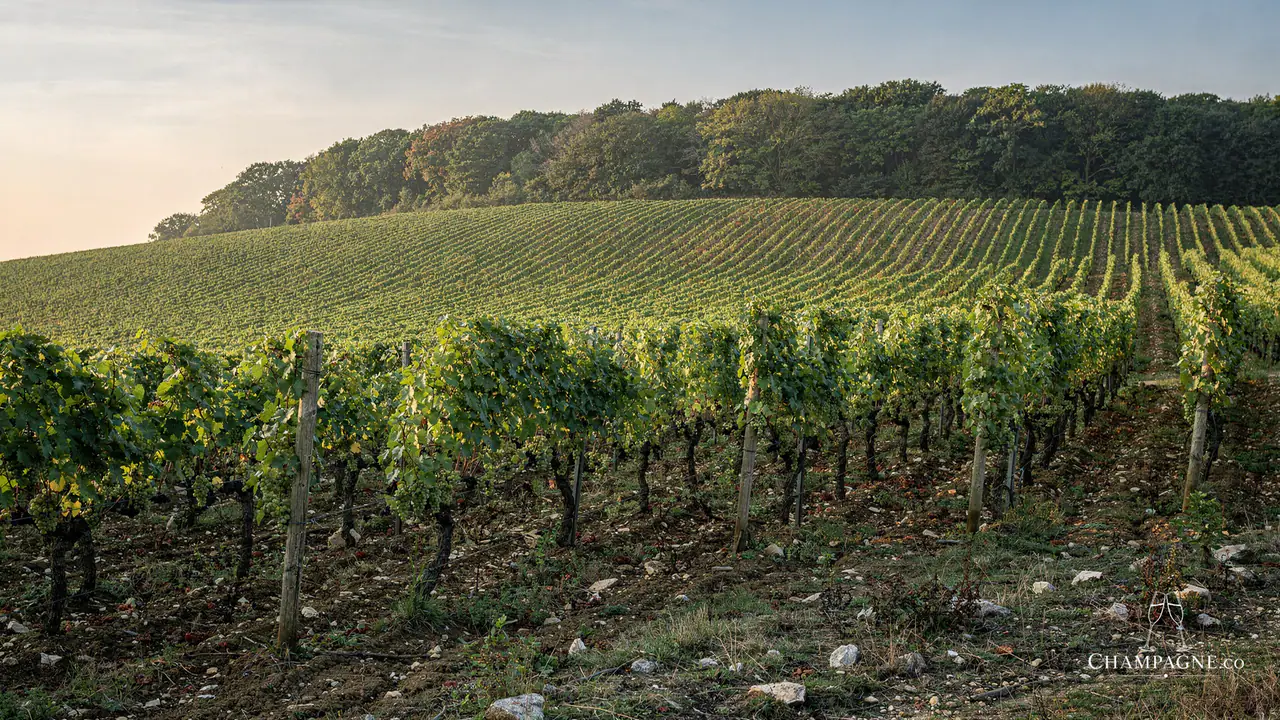
The current estate vineyard is 3 hectares, planted across Premier and Grand Cru terroirs in Ludes, Ville-Dommange, Mailly-Champagne and Vertus. The three principal Champagne grapes are represented.
The estate vineyard is certified Haute Valeur Environnementale (HVE) and Viticulture Durable en Champagne (VDC). Partner growers supplement the family's own fruit, particularly with Chardonnay and Pinot Noir from the Montagne de Reims and Côte des Blancs. The house states that most of these partners also hold HVE, VDC and/or organic credentials, but their certifications should remain distinct from the house's own 3-hectare estate status.
AB390
The most important estate parcel is AB390, immediately behind the family property in Ludes. Its name is the cadastral reference of the plot. The site is planted to Meunier on clay-influenced ground and includes old vines dating from 1955.
The current Champagne AB390 is 100% Meunier. The live product page presents the 2018 vintage, vinified with two approaches: around 20% in oak without malolactic fermentation and 80% in tank with malolactic fermentation, then dosed at about 4 g/L.
Ployez-Jacquemart has also made a separate AB390 Coteaux Champenois from the same parcel. That is a still wine and should remain outside the sparkling Champagne range.
Cellar approach
The house's current method begins with strict fruit selection and separation by grape, cru and parcel. Musts undergo two settling stages before fermentation. Wines made in tank receive light filtration, while barrel-raised wines are not filtered.
The house is particularly associated with sur pointe ageing for many of its cuvées. Rather than leaving bottles resting horizontally throughout their maturation, they are stored with the neck angled downward during part of the ageing process. The producer uses the method alongside low dosage to retain freshness through extended cellar time.
Oak and malolactic fermentation are not applied uniformly. Extra-Brut Passion, for example, uses a mixed approach: half of the current blend is oak-aged without malolactic fermentation, while the remainder follows another route. The release currently documented uses wines from the 2018 and 2019 harvests.
Champagne.co analysis
Ployez-Jacquemart is best understood as a house built around controlled freshness over long ageing. Low dosage, selective malolactic blocking, oak and sur-pointe maturation are not separate stylistic tricks; they all serve the same objective of allowing mature wines to retain definition.
The estate-versus-sourcing distinction is equally important. The house owns only three hectares, yet it produces a broader range through carefully selected partner vineyards. AB390 is therefore especially valuable because it shows what Ployez-Jacquemart looks like when provenance narrows all the way to one owned plot and one grape.
The mature Liesse d'Harbonville releases show the opposite extreme: long ageing, multi-grape prestige blends and deep cellar time. Together they explain why this small house should not be treated as either a conventional grower estate or a broad sourcing maison; it operates between those models.
Buying guidance
Extra Quality Brut is the best introduction to the overall house because it shows the blended, sourced-plus-estate model. Choose Extra Quality Blanc de Blancs for the Chardonnay side of the range.
Extra-Brut Passion is the clearest bottle for understanding the house's mixed oak and malolactic strategy. Dosage Zéro 2014 is the more direct choice for readers focused on zero dosage, while Blanc de Noirs 2018 shifts the range toward Pinot Noir and Meunier.
For estate-specific terroir, choose AB390 with the exact vintage shown. For long-aged prestige Champagne, the current Liesse d'Harbonville 2004 and 2005 releases should be approached as separate vintages rather than interchangeable versions of one permanent blend.
Loading current Champagne range…
Spotted something wrong? Report a correction
Every report goes to a human review queue. Nothing on this page changes automatically.