R.H. Coutier
Champagne R.H. Coutier is a family grower in Ambonnay Grand Cru, on the southern side of the Montagne de Reims. The domaine farms 9.3 hectares divided among about 40 parcels, with vineyards predominantly planted to Pinot Noir but with roughly one-third…
Editorial profile
Champagne R.H. Coutier is a family grower in Ambonnay Grand Cru, on the southern side of the Montagne de Reims. The domaine farms 9.3 hectares divided among about 40 parcels, with vineyards predominantly planted to Pinot Noir but with roughly one-third Chardonnay — an unusually important share of the white grape in a village more commonly associated with Pinot Noir.
The family has worked in Ambonnay for more than five generations. Nathalie and René Coutier led the estate from 1981, and their son Antoine Coutier joined in 2014 as the fifth generation. Current French company records list Antoine and Nathalie in management.
R.H. Coutier began organic conversion in 2020 and the full vineyard has been certified since the 2023 harvest. Ecocert's current public register independently confirms EU organic certification for Antoine Coutier at the Ambonnay estate.
Why this producer matters
R.H. Coutier is particularly useful for understanding a less obvious side of Ambonnay. The village's reputation is built overwhelmingly around Pinot Noir, yet the Coutier family has maintained a significant Chardonnay presence; Henri Coutier was among the early growers to plant Chardonnay here in the late 1940s.
That mixed planting gives the domaine two complementary tools. Pinot Noir can carry the power and structure associated with Ambonnay, while Chardonnay allows the house to explore a more linear expression of the same Grand Cru chalk. The range therefore makes more sense as an Ambonnay study in two grapes than as a conventional Pinot-Noir-dominant grower portfolio.
Vineyard and farming
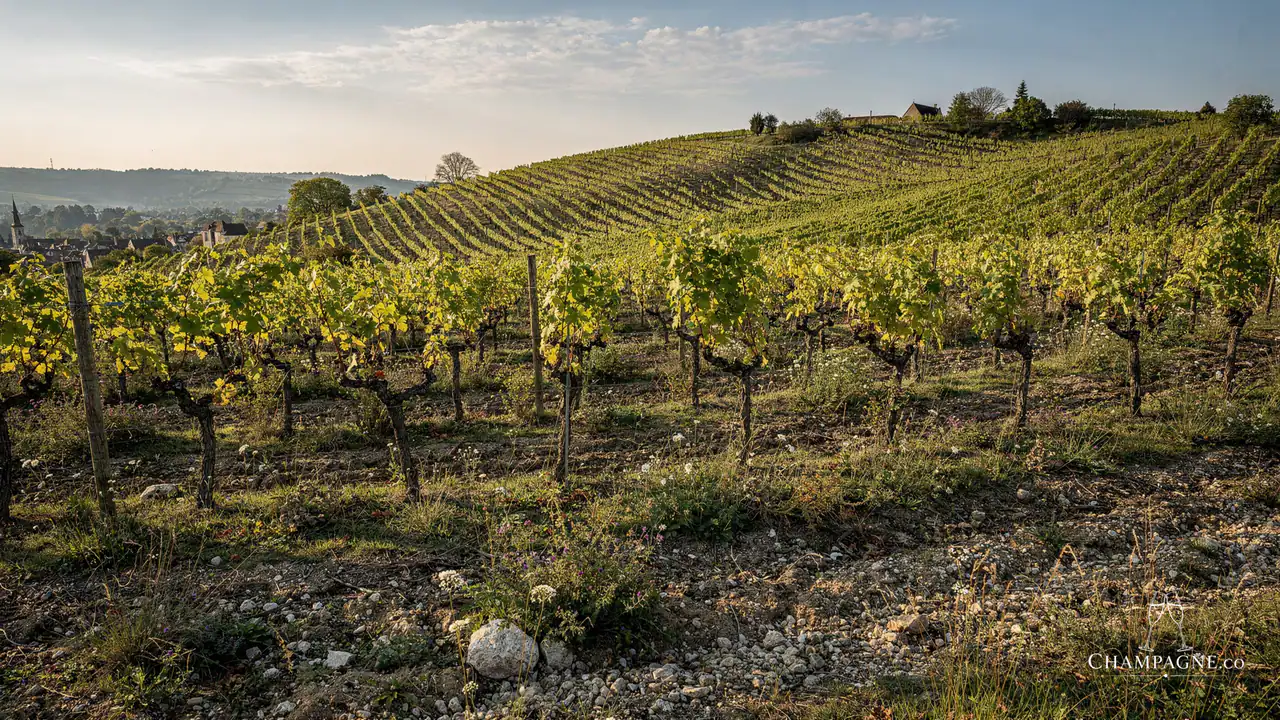
The domaine's roughly 9.3 hectares and 40 parcels lie in Ambonnay, principally on chalk-rich slopes with southern and south-eastern exposures. Average vine age is reported at around 38 years in current producer material.
Pinot Noir remains the majority planting, with Chardonnay accounting for approximately one-third of the vineyard. The estate's stated philosophy is deliberately low-intervention: reducing inputs in both vineyard and cellar so that the character of the site remains central.
Organic conversion began in 2020, and the first fully certified harvest was 2023. That current status is more meaningful than older descriptions that still refer to the domaine as merely 'in conversion'.
Champagne.co analysis
R.H. Coutier's strongest distinction is not simply that it is a small organic Grand Cru domaine. It is the way the estate uses Chardonnay inside Ambonnay. That makes the range unusually instructive: the core blends show the interaction between the village's two principal grapes, the Blanc de Blancs isolates Chardonnay, and Le Bout du Clos pushes in the opposite direction toward a highly specific Pinot Noir parcel wine.
The estate's full organic certification since 2023 also gives the current generation a clearer farming identity than older profiles suggest. Combined with low-intervention language and the emergence of parcel-led releases, it places Coutier within the modern group of growers trying to make village and site differences more legible rather than relying only on a stable non-vintage house style.
Buying guidance
For a first bottle, Cuvée Tradition Grand Cru is the most sensible reference point because it introduces the estate through its normal Ambonnay framework. Readers specifically interested in the village's less familiar Chardonnay side should go directly to the Blanc de Blancs.
For a deeper comparison, Le Bout du Clos 2018 is the more specialised purchase: it is an exact parcel-and-vintage statement, not simply a premium version of the core wine. La Sotabienne 2023 is more useful again for readers interested in still red Ambonnay and in seeing how the domaine handles Pinot Noir without secondary fermentation.
Because the range increasingly contains release-specific and parcel-specific wines, compare bottles by exact cuvée and vintage rather than assuming that fermentation vessel, malolactic policy or dosage applies across the whole domaine.
Loading current Champagne range…
Spotted something wrong? Report a correction
Every report goes to a human review queue. Nothing on this page changes automatically.