Rémy Massin et Fils
Champagne Rémy Massin et Fils is a five-generation family grower in Ville-sur-Arce, in the Côte des Bar. The family's vineyard history reaches back to Louis-Aristide, born in 1865, while the modern récoltant-manipulant house dates from 1974, when Rémy…
Editorial profile
Champagne Rémy Massin et Fils is a five-generation family grower in Ville-sur-Arce, in the Côte des Bar. The family's vineyard history reaches back to Louis-Aristide, born in 1865, while the modern récoltant-manipulant house dates from 1974, when Rémy Massin began producing and bottling the family's own Champagnes.
The current domaine covers 22 hectares around Ville-sur-Arce. Pinot Noir is the dominant grape and the central stylistic reference, but Chardonnay and Pinot Blanc both have meaningful roles in the range. The producer's current material also confirms Viticulture Durable en Champagne certification on its cuvée pages, alongside a vineyard programme that avoids herbicides and insecticides.
Why this producer matters
Rémy Massin is a useful Côte des Bar producer for three reasons. First, the domaine makes the geological contrast of Ville-sur-Arce unusually visible, distinguishing hard Portlandian limestone on the plateaux from Kimmeridgian marl on the slopes. Second, Pinot Noir remains the core of the estate without excluding other varieties. Third, the range includes a serious 100% Pinot Blanc Champagne, giving one of the region's rarer permitted grapes a standalone role.
The house also uses perpetual reserves in more than one way. Louis-Aristide is based on a long-running Pinot Noir reserve begun in 1995, while L'Inattendue is built around Chardonnay and a separate perpetual-reserve concept. These are not simply two versions of the same wine; they show how the domaine uses reserve material differently according to grape and cuvée.
Vineyards and terroir
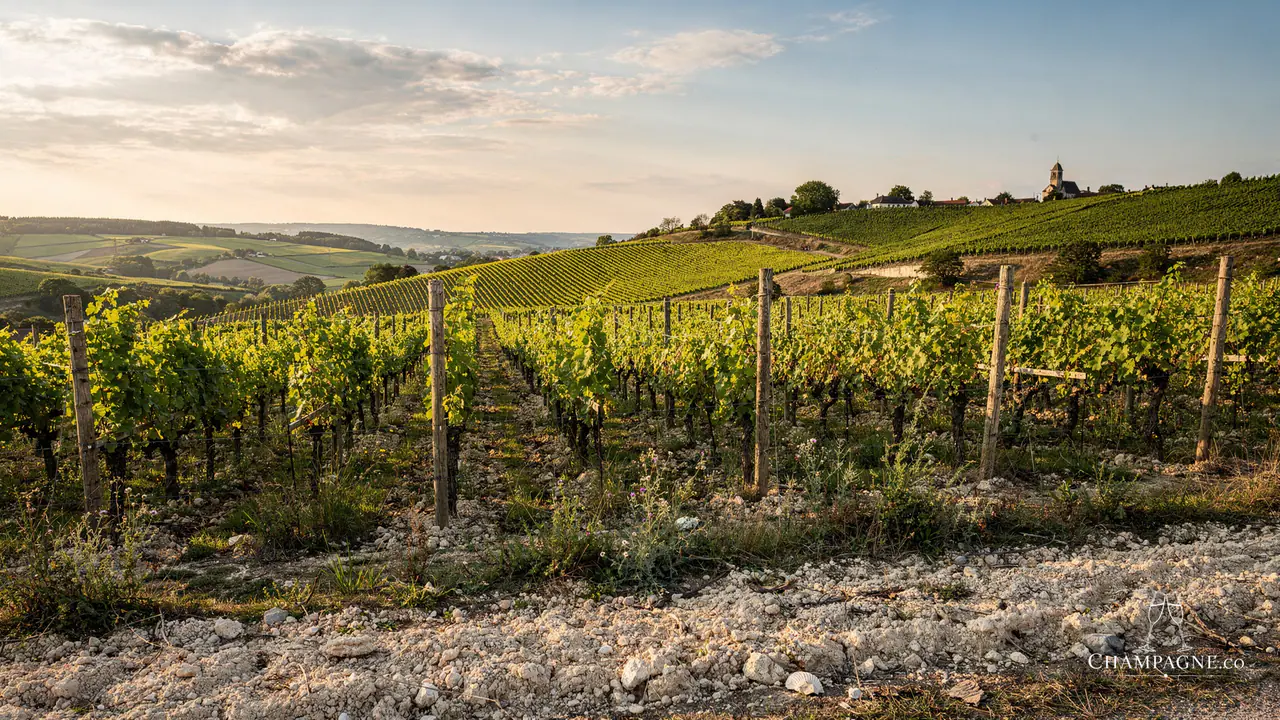
The 22-hectare vineyard lies around Ville-sur-Arce. The producer describes hard Portlandian limestone on the plateaux and Kimmeridgian marl on the slopes, the latter containing fossilised Exogyra virgula shells that are characteristic of this part of the Côte des Bar.
Pinot Noir occupies the majority of the holding and supplies many of the domaine's core cuvées. Chardonnay is important both in blends and in single-variety wines, while Pinot Blanc occupies a smaller but distinctive place in the vineyard and has its own cuvée.
Current vineyard practice is based on light ploughing, early leaf removal, manual work and preventive disease management. The estate says it has used no herbicides since 2000, and current cuvée pages identify the vineyard as certified under Viticulture Durable en Champagne.
Winemaking and cellar approach
The current technical pages show a broadly consistent cellar framework: hand harvesting, fractionated pressing, cold settling, slow alcoholic fermentation in tank, malolactic fermentation and maturation on fine lees before bottling. The exact reserve proportion, lees ageing and dosage then vary by cuvée and release.
This range of release-specific choices matters. Tradition, for example, is a multi-harvest Pinot Noir wine, while Louis-Aristide is a perpetual-reserve Pinot Noir and the Pinot Blanc cuvée is vintage-specific. The domaine therefore uses a common technical foundation without forcing every wine into one identical ageing or reserve-wine model.
Champagne.co analysis
Rémy Massin's range is broader than its Pinot Noir-dominant vineyard might suggest. Pinot Noir supplies the house's central line — Tradition, Nature, L'Intégrale and Louis-Aristide all explore it differently — but Chardonnay and Pinot Blanc prevent the portfolio from becoming one-dimensional.
The most revealing contrast is between the core multi-harvest wines and the perpetual-reserve cuvées. Tradition uses several consecutive harvests to provide continuity, while Louis-Aristide deliberately stretches that continuity much further through a reserve begun in 1995. L'Inattendue applies a related idea to Chardonnay. That makes reserve-wine architecture one of the best ways to understand the domaine beyond grape variety alone.
The geology gives those choices a clear local context. Portlandian plateaux and Kimmeridgian slopes are not treated as interchangeable, and the vineyard programme aims to preserve that distinction through low-input farming and separate cuvée identities.
Buying guidance
For a first bottle, Tradition is the clearest introduction to the domaine because it is 100% Pinot Noir and sits at the centre of the house range. Move to Réserve for a more mature reserve-wine blend or to Nature if zero dosage is specifically what you want.
Choose Louis-Aristide when the attraction is the long-running Pinot Noir perpetual reserve, and L'Inattendue if you want to explore the domaine through Chardonnay instead. Pinot Blanc / Special Club Pinot Blanc is the specialist bottle for readers interested in Champagne's rarer permitted varieties.
The rosé and Grain de Douceur occupy distinct positions: Rosé for the blended pink style and Grain de Douceur when a deliberately sweeter Champagne is wanted rather than a brut or extra-brut expression.
Loading current Champagne range…
Spotted something wrong? Report a correction
Every report goes to a human review queue. Nothing on this page changes automatically.