Robert Moncuit
Champagne Robert Moncuit is a Grand Cru grower in Le Mesnil-sur-Oger, in the heart of the Côte des Blancs, run by Pierre Amillet. The estate is based at 2 place de la Gare and farms Chardonnay-dominated vineyards in Le Mesnil-sur-Oger and Oger.
Editorial profile
Champagne Robert Moncuit is a Grand Cru grower in Le Mesnil-sur-Oger, in the heart of the Côte des Blancs, run by Pierre Amillet. The estate is based at 2 place de la Gare and farms Chardonnay-dominated vineyards in Le Mesnil-sur-Oger and Oger.
Current estate records place the planted area at roughly eight to eight and a half hectares.
The house is therefore best understood as a Chardonnay specialist built around two Grand Cru villages rather than as a broad multi-variety Champagne producer. Its range moves from blended Blanc de Blancs through a perpetual-reserve wine to individual lieux-dits such as Les Chétillons and Les Vozémieux.
Why this producer matters
Robert Moncuit offers a particularly direct view of the Côte des Blancs. Chardonnay is the defining grape, Le Mesnil-sur-Oger provides the estate's main geographic identity, and Oger extends that picture without changing the Grand Cru focus.
The parcel wines are especially important because they let the domaine move beyond a generic “Le Mesnil Blanc de Blancs” identity. Les Chétillons and Les Vozémieux are not simply premium labels; they isolate named sites with different vine histories and exposures, while the core wines show how those parcels fit into the broader house blend.
Organic conversion and certification add a more recent layer to the estate. The public record shows a transition beginning in 2020 and certification achieved in 2023, giving the current farming story a clear chronology rather than an undefined claim of “natural” viticulture.
Vineyards and terroir
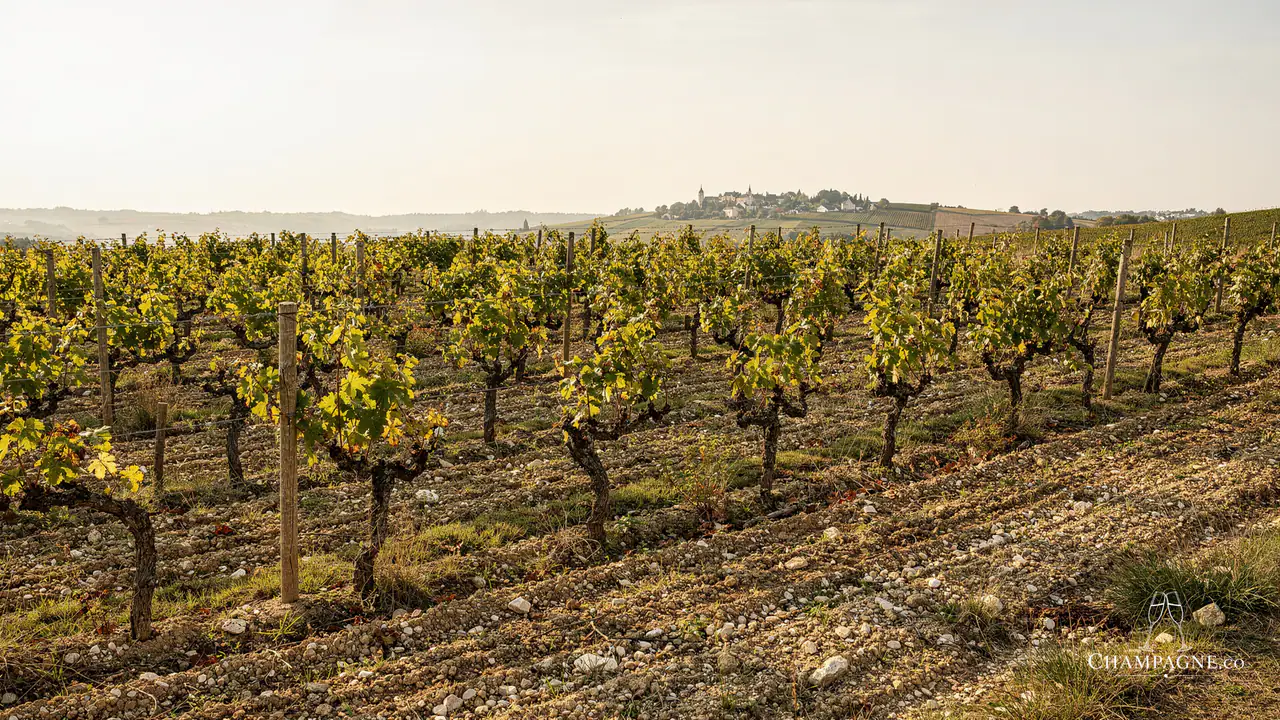
The estate's vineyards are concentrated in Le Mesnil-sur-Oger and Oger, two Grand Cru villages of the Côte des Blancs. Chardonnay dominates overwhelmingly, with only a very small red-grape component associated with still wine and rosé production.
Le Mesnil is known for shallow topsoils over chalk, and Robert Moncuit's parcel programme makes that chalk structure particularly visible. Les Chétillons is one of the estate's emblematic Le Mesnil sites, while Les Vozémieux lies in Oger.
Current sources differ slightly on total surface — around eight hectares in the 2020 organic-conversion record and 8.5 hectares in the later estate profile — so the most accurate public description is a domaine of roughly eight to eight and a half hectares rather than an artificially exact permanent figure.
Winemaking and cellar approach
Robert Moncuit's cellar work is geared toward Chardonnay and long enough ageing to let individual sites remain visible. Current estate reporting describes fermentation in 350-litre barrels for part of the range, systematic malolactic fermentation and longer bottle ageing for vintage wines than for the core non-vintage cuvées.
The producer also maintains a perpetual reserve, begun in 2006, which forms the basis of Réserve Perpétuelle. That gives the range a second axis beyond parcel and vintage: Les Chétillons and Les Vozémieux emphasise place, while Réserve Perpétuelle emphasises continuity across years.
Exact dosage, barrel proportion, vintage, disgorgement and lees time vary by wine and release and should be kept attached to the specific bottle rather than presented as one permanent recipe for every Robert Moncuit Champagne.
Champagne.co analysis
Robert Moncuit is a good example of how a seemingly narrow producer can still offer substantial internal variety. Almost everything begins with Chardonnay, yet the range separates three different ideas: blended Grand Cru identity, continuity through perpetual reserve and exact place through the parcel wines.
That makes Les Grands Blancs, Réserve Perpétuelle and Les Chétillons/Les Vozémieux useful reference points rather than steps in a simple prestige ladder. The first shows the house at village scale, the second shows how older reserve material changes the picture, and the lieux-dits reduce the focus to individual sites.
The organic chronology matters because it is recent enough to be part of the estate's modern evolution rather than an inherited marketing claim. Combined with the parcel emphasis, it reinforces the sense of a domaine increasingly organised around vineyard identity and soil expression rather than around a large branded range.
Buying guidance
Start with Les Grands Blancs for the clearest introduction to Robert Moncuit's Grand Cru Chardonnay style. Move to Réserve Perpétuelle when the attraction is reserve-wine depth and continuity across years.
Choose Les Chétillons for the classic Le Mesnil parcel direction and Les Vozémieux if you want to compare Oger within the same producer. Le Mesnil Millésime sits between those ideas, giving a vintage-focused view of the estate without narrowing all the way to one lieu-dit.
Les Romarines Rosé is the outlier for readers who want to see how the domaine handles a small red-wine component. Any Coteaux Champenois should be bought separately as still wine, not as an alternative Champagne release.
Loading current Champagne range…
Spotted something wrong? Report a correction
Every report goes to a human review queue. Nothing on this page changes automatically.