Roland Champion
Champagne Roland Champion is a family grower in Chouilly whose modern history begins in 1929, when André Champion expanded the family's vineyard holdings in the Côte des Blancs. His son Roland took over as a teenager and the house adopted the Roland…
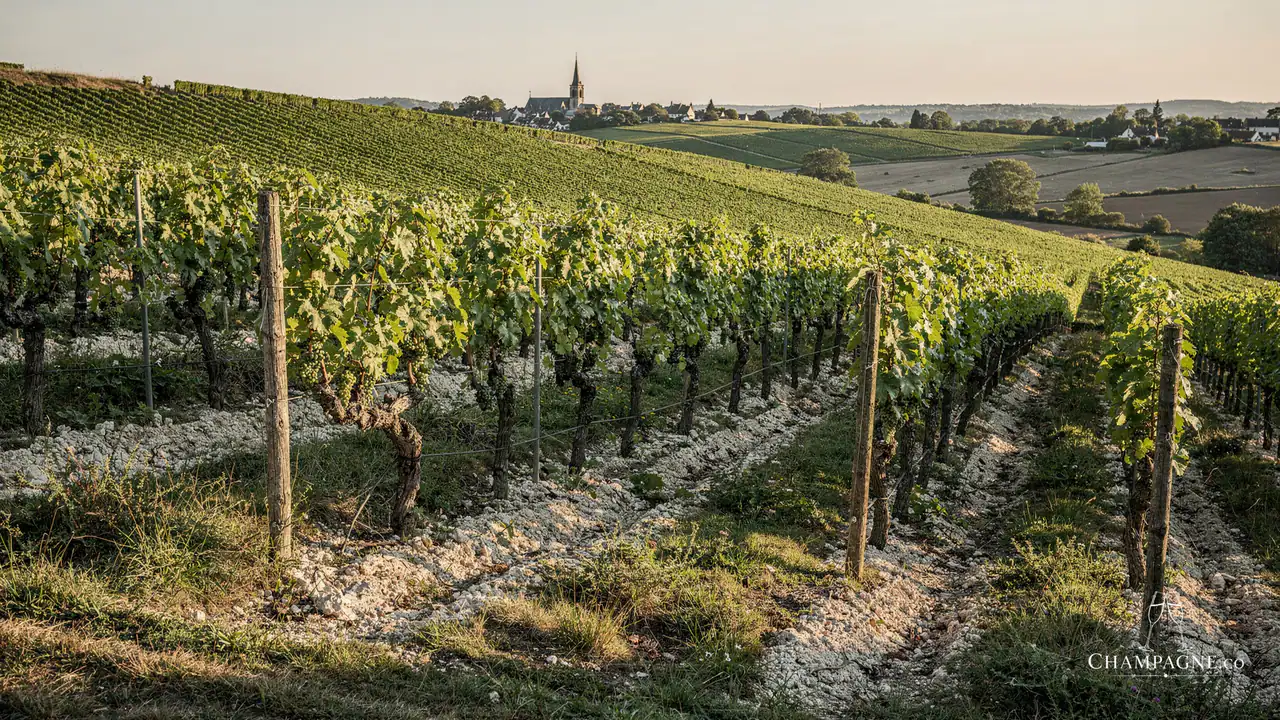
Editorial profile
Champagne Roland Champion is a family grower in Chouilly whose modern history begins in 1929, when André Champion expanded the family's vineyard holdings in the Côte des Blancs. His son Roland took over as a teenager and the house adopted the Roland Champion name in 1951. François Champion joined in the early 1970s and is now joined by his daughters Carole and Clémence, the fourth generation.
The estate farms 14 hectares across more than 30 parcels. Chardonnay from Chouilly Grand Cru is the principal grape, complemented by Meunier and Pinot Noir from Verneuil in the Vallée de la Marne. Current Club Trésors data gives the vineyard mix as 70% Chardonnay, 20% Meunier and 10% Pinot Noir.
Why this producer matters
Roland Champion is a particularly clear Chouilly reference because its range moves from a three-grape house blend to increasingly precise Chardonnay expressions without losing sight of the wider family vineyard. The estate's 14 hectares are large enough to support several styles, yet the range remains compact enough that the progression from blend to parcel is easy to follow.
The domaine also maintains a perpetual reserve begun in 2012. That reserve connects successive releases of the multi-vintage wines while the vintage and single-parcel bottlings move in the opposite direction, isolating individual harvests and sites.
Vineyards and terroir
Chouilly Grand Cru supplies the estate's core Chardonnay. The family farms more than 30 parcels and treats each separately through pressing and initial vinification. Verneuil provides Meunier and Pinot Noir, giving the domaine a second geographical anchor in the Vallée de la Marne.
Viticulture is explicitly described as sustainable rather than organic. The estate uses soil cultivation, mixed grass cover, organic and mineral amendments, sexual confusion to reduce insecticide use, and biodiversity corridors created through hedges, banks and groves.
That distinction matters: Roland Champion's current environmental programme is substantial, but it should be understood through the producer's own sustainable-viticulture framework rather than upgraded into an unverified organic or biodynamic claim.
Winemaking and cellar approach
Each parcel is pressed separately, and base wines are directed to stainless steel, large wooden vessels or barrels according to their potential. The perpetual reserve begun in 2012 is refreshed with part of each harvest and plays an important role in the multi-vintage wines.
Current technical material shows malolactic fermentation being used for the house's multi-vintage wines, followed by filtration and cold stabilisation before bottling. The producer then gives the wines substantial bottle ageing, with exact duration depending on the cuvée.
The result is a cellar programme that is technically precise but not uniform. Stainless steel supports purity in the core wines, oak is used for selected parcel or prestige cuvées, and reserve-wine depth is kept separate from the vintage-specific wines.
Champagne.co analysis
Roland Champion's range is strongest when read as a sequence of increasing terroir resolution. Secret d'Aramis explains the full family vineyard, mixing the three principal grapes and two broad regional sources. Éclat de Craie removes the black grapes and concentrates on Chouilly Chardonnay while retaining the perpetual reserve. The vintage wines then remove the multi-harvest element, and Les Partelaines narrows the origin further to a single parcel.
This makes the range unusually intuitive. Prestige is not created simply by adding a grander name; each step changes the scale of origin or the role of reserve wine. The perpetual reserve gives continuity to the house blends, while the parcel wines deliberately sacrifice that continuity in favour of a more exact place and year.
Buying guidance
Start with Éclat de Craie if Chouilly Chardonnay is the main reason for exploring Roland Champion. It gives the clearest house expression of the Côte des Blancs while remaining connected to the perpetual-reserve programme.
Choose Secret d'Aramis for the broader three-grape family style and Rosé Carat for the rosé d'assemblage. Move to a Grand Éclat vintage or Spécial Club 2018 for a more mature, vintage-specific Chardonnay.
Les Partelaines is the specialist bottle for readers who want the estate reduced to one Chouilly parcel and zero dosage. Because the vintage, tirage, dosage and reserve composition change between releases, check those details on the exact bottle rather than assuming the current technical sheet describes every historical edition.
Loading current Champagne range…
Spotted something wrong? Report a correction
Every report goes to a human review queue. Nothing on this page changes automatically.