Ruppert-Leroy
Champagne Ruppert-Leroy is a four-hectare grower estate in Essoyes, in the Côte des Bar, run by Bénédicte Ruppert and Emmanuel Leroy. They began converting the family vineyard to organic farming in 2010, started vinifying their own harvest at the same…
Editorial profile
Champagne Ruppert-Leroy is a four-hectare grower estate in Essoyes, in the Côte des Bar, run by Bénédicte Ruppert and Emmanuel Leroy. They began converting the family vineyard to organic farming in 2010, started vinifying their own harvest at the same time, achieved their first certified-organic harvest in 2013 and obtained Demeter certification for the grapes in 2014.
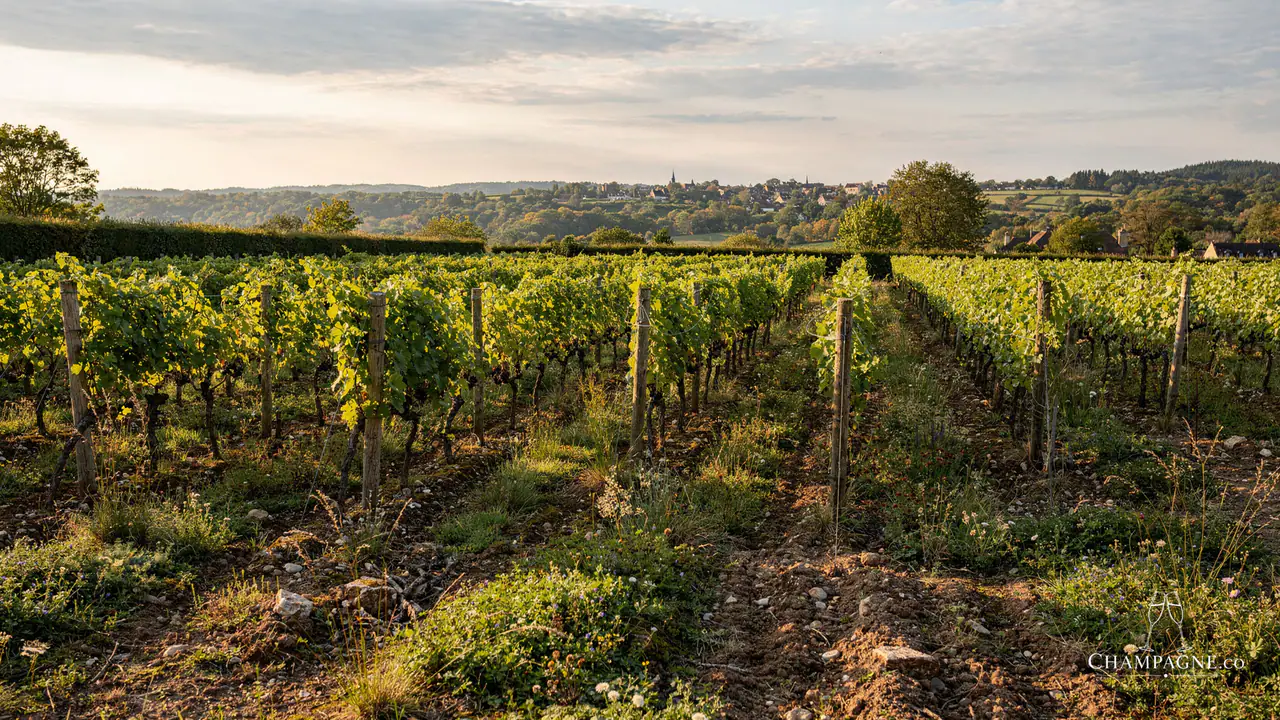
The domaine is organised around a small number of individual parcels rather than a conventional hierarchy of house cuvées. La Fosse, Martin Fontaine and Les Cognaux have different clay-limestone profiles and are generally vinified separately. Pinot Noir and Chardonnay are the two grapes, but the contrast between sites is as important as the contrast between varieties.
Why this producer matters
Ruppert-Leroy is a particularly clear example of Champagne made as part of a working biodynamic farm. Bénédicte and Emmanuel live at La Bergerie and keep cattle, horses, sheep and poultry, allowing the farm to produce its own compost and contribute directly to the vineyard cycle.
That integrated approach is more meaningful than a generic “natural Champagne” label. The estate is formally organic and Demeter-certified, while its cellar choices — indigenous yeasts, separate parcel vinification, no fining or filtration and no dosage — are designed to minimise the distance between vineyard and finished wine.
Vineyards, parcels and farming
The four hectares lie on south- and south-east-facing slopes around Essoyes. The Association des Champagnes Biologiques records the entire estate as certified organic and planted to Chardonnay and Pinot Noir.
La Fosse is a clay-limestone parcel with a strong red-clay component and supports both Pinot Noir and Chardonnay. Martin Fontaine is more strongly marked by pale limestone and is planted to Chardonnay. Les Cognaux has deeper grey clay over limestone and is associated with Pinot Noir.
The domaine works according to biodynamic principles and uses preparations made within the farm wherever possible. Animals, compost, plant life and vineyard soils are treated as parts of one agricultural system rather than as separate activities.
Winemaking and cellar approach
Each parcel is vinified separately to preserve the differences between sites. The producer uses indigenous yeasts from its own fruit, avoids fining and filtration, and allows cold stabilisation to occur naturally during winter rather than forcing it mechanically.
For the core parcel wines, fermentation and ageing take place on lees in barrels and demi-muids for about nine months. Malolactic fermentation occurs naturally. The wines are released as Brut Nature without liqueur d'expédition, and several current technical descriptions also specify no added sulphur.
Those methods are consistent across much of the range, but exact sulphur use, bottle ageing and harvest composition still belong to the individual release. “No added sulphur” should not be confused with a claim of analytically zero sulphites.
Champagne.co analysis
Ruppert-Leroy is easiest to understand as a small comparison of soils inside one biodynamic farming system. The winemaking changes relatively little from parcel to parcel; what changes is the grape, the soil and the exact site. That gives Papillon, Martin Fontaine and Les Cognaux a useful comparative logic rather than turning them into arbitrary prestige steps.
The farm itself reinforces that site focus. Biodynamic preparations and compost are not imported as an isolated cellar philosophy but emerge from a mixed agricultural setting that includes animals and pasture. This makes the estate's certification and farming practices part of its actual working structure.
The perpetual 11, 12, 13… cuvée introduces a second idea: time. Where the parcel wines separate place, the perpetual vat deliberately combines successive harvests. Together they make the range a study of both site and continuity.
Buying guidance
Start with Fosse-Grely for the broadest introduction because it combines Pinot Noir and Chardonnay in one of the estate's key parcels. Choose Papillon and Les Cognaux side by side if you want to compare two Pinot Noir wines from contrasting soils.
Martin Fontaine is the obvious choice for Chardonnay and the domaine's more limestone-focused expression. Rosé is the specialist route into the estate through saignée Pinot Noir, while 11, 12, 13… is the bottle to seek when the perpetual-reserve idea is more interesting than a single parcel.
Treat Puzzle separately.
Loading current Champagne range…
Spotted something wrong? Report a correction
Every report goes to a human review queue. Nothing on this page changes automatically.