Sadi Malot
Champagne Sadi Malot is a five-generation family estate in Villers-Marmery, on the eastern Montagne de Reims. The domaine is now run by Franck and Christine Malot with Florian and Cindy, continuing a family Champagne business that has been established in…
Editorial profile
Champagne Sadi Malot is a five-generation family estate in Villers-Marmery, on the eastern Montagne de Reims. The domaine is now run by Franck and Christine Malot with Florian and Cindy, continuing a family Champagne business that has been established in the village for close to a century.
Villers-Marmery gives the house an unusual identity within the Montagne de Reims. The producer describes the village vineyard as approximately 98% Chardonnay, making it a white-grape enclave in a sector more commonly associated with Pinot Noir. Sadi Malot's range is therefore strongly Chardonnay-led, even though the wider family vineyard also supports other grapes and more specialised parcel wines.
Why this producer matters
Sadi Malot offers a different reading of the Montagne de Reims. Instead of starting with Pinot Noir, the house begins with Chardonnay from Villers-Marmery and builds much of its range around that village's distinctive planting pattern.
A second defining feature is the perpetual reserve maintained since 1982. That reserve gives the multi-vintage Chardonnay wines continuity across harvests and provides a useful counterpoint to the estate's vintage and parcel-specific bottlings.
The vineyard is currently certified organic according to the producer, while Comité Champagne also lists the estate as Haute Valeur Environnementale and Vigneron Indépendant. These credentials sit alongside a broader biodiversity programme and progressive reduction of chemical inputs over time.
Vineyards and farming
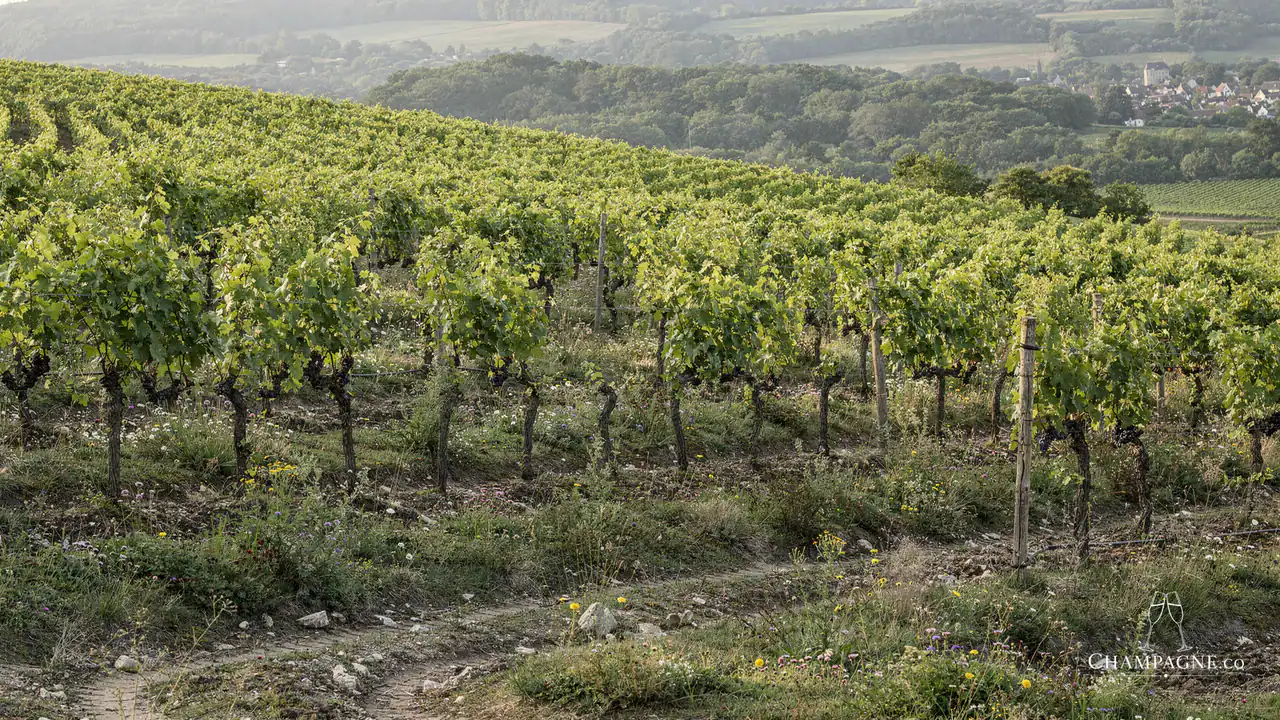
The domaine is centred on Villers-Marmery, a Premier Cru village on the eastern Montagne de Reims. Chardonnay dominates the local vineyard and the estate's own plantings, reflecting the village's unusual white-grape identity within the wider region.
Current producer material describes organic certification and a vineyard approach based on soil work, biodiversity and reduced inputs. Comité Champagne independently records HVE status. The estate does not present itself as biodynamically certified, so its current environmental story is best understood through organic farming and the HVE framework rather than a broader label.
The house also works with fruit from other sites for selected wines, including Pinot Noir-based parcel expressions, but Villers-Marmery Chardonnay remains the clearest centre of gravity.
Winemaking and perpetual reserve
The perpetual reserve begun in 1982 is one of Sadi Malot's most important cellar tools. It allows older Chardonnay to be blended with wine from the current harvest, creating continuity without turning every release into the same fixed formula.
Stainless steel is central to the core Chardonnay wines, and current technical pages show malolactic fermentation being used. Lees ageing and dosage vary according to the cuvée, while selected wines use wood or longer ageing for a more specific expression.
Because the perpetual reserve changes with each withdrawal and replenishment, base-year proportion, reserve share, dosage and lees time should always be read as release-specific information rather than permanent house statistics.
Champagne.co analysis
Sadi Malot is most useful as a reminder that the Montagne de Reims is not stylistically uniform. Villers-Marmery's Chardonnay-dominated vineyard gives the house a Côte des Blancs-like starting point in a region otherwise strongly identified with Pinot Noir.
The perpetual reserve then adds a second dimension. Cuvée d'Origine and Zéro Liqueur show how the same Chardonnay foundation can be shaped differently through dosage and ageing while still drawing on reserve wine dating back to 1982. Vintage and parcel bottlings move in the opposite direction, reducing the role of multi-harvest continuity in favour of a more exact year or site.
That makes the range easier to understand as a conversation between village identity and reserve-wine memory than as a simple prestige ladder. Chardonnay is the constant; the variables are time, dosage, vessel and degree of site specificity.
Buying guidance
Start with Cuvée d'Origine for the clearest introduction to Villers-Marmery Chardonnay and the estate's perpetual-reserve system. It combines the house's two main ideas in one bottle.
Choose Zéro Liqueur if you want the same broad Chardonnay and reserve-wine framework without dosage. Compare the base harvest and reserve percentage when buying because these details evolve between releases.
Move to a vintage Chardonnay or one of the estate's more focused parcel bottlings when you want a narrower expression of year or site. For any specialist Pinot Noir release, check the exact origin and vintage rather than assuming it represents the predominantly Chardonnay Villers-Marmery vineyard.
Loading current Champagne range…
Spotted something wrong? Report a correction
Every report goes to a human review queue. Nothing on this page changes automatically.