Salmon
Champagne Salmon is a family grower in Chaumuzy, in the Vallée de l'Ardre, with Meunier at the centre of its identity. Michel Salmon produced the family's first 500 bottles in 1958. His son Olivier joined the domaine in the 1980s, and the current…
Editorial profile
Champagne Salmon is a family grower in Chaumuzy, in the Vallée de l'Ardre, with Meunier at the centre of its identity. Michel Salmon produced the family's first 500 bottles in 1958. His son Olivier joined the domaine in the 1980s, and the current third-generation figure is Alexandre Salmon.
The estate farms about 10 hectares, with a vineyard mix currently listed by Club Trésors as 85% Meunier, 9% Pinot Noir and 6% Chardonnay. That unusually high proportion of Meunier is not simply background data: the current range explores the grape through white Champagne, rosé Champagne and still Coteaux Champenois.
Why this producer matters
Salmon is one of the clearest estates through which to understand Meunier as a principal grape rather than a supporting component of a blend. Chaumuzy's clay-limestone soils and the Vallée de l'Ardre's frost exposure suit a variety that buds relatively late, and the family has made that local fit the organising idea of the domaine.
The estate is also a member of Club Trésors de Champagne. That adds a vintage prestige route to a range otherwise built around approachable house blends and varietal Meunier wines, but the Club bottlings remain exact-vintage wines rather than a permanent fixed specification.
Vineyards and Meunier focus
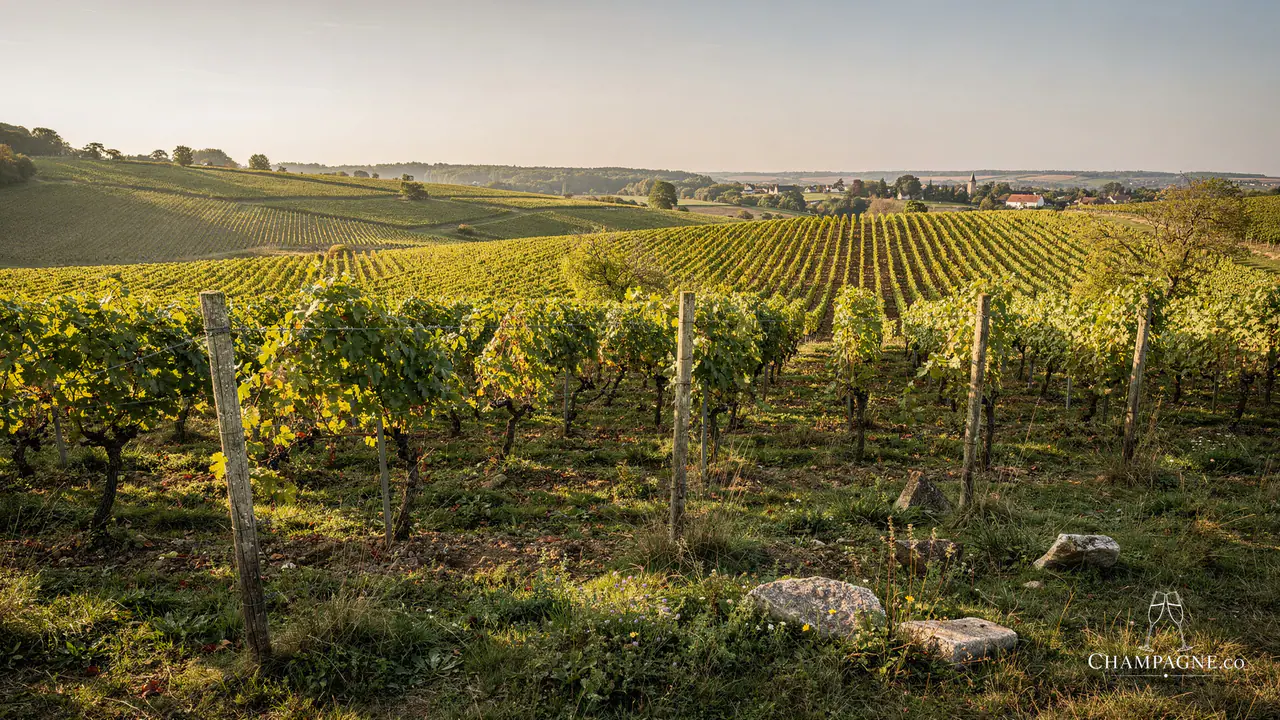
The 10-hectare vineyard is centred on Chaumuzy. Current producer material says 85% is planted to Meunier, with Pinot Noir and Chardonnay making up the balance. The soils are described as clay-limestone, with local millstone material also present in the vineyard environment.
The family works parcel by parcel and describes its viticulture as agriculture raisonnée, or reasoned/sustainable farming. There is no basis to recast that wording as organic or biodynamic certification.
Meunier's dominance gives the estate an unusually coherent range. Rather than disappearing into a generic three-grape blend, the variety can be tasted on its own in the 100% Meunier Brut, in a rosé made entirely from Meunier, and in still red and white Coteaux Champenois.
Winemaking and range approach
Club Trésors describes a plot-by-plot vinification programme and rigorous juice selection. The producer's own current range gives more detail at bottle level, so blend and dosage should be attached to the exact wine rather than generalised across the estate.
The current 100% Meunier Brut, for example, is exactly what the name suggests and is listed at 7 g/L dosage. The 100% Meunier Brut Rosé uses Meunier in three forms within the current blend, including maceration rosé and a component of red wine. Those are current-release specifications, not permanent rules for every historical edition.
Champagne.co analysis
Salmon's range works because it makes the vineyard statistics tangible. An estate that is 85% Meunier could easily produce conventional blends in which the grape's role remains hidden; Salmon instead gives it several distinct forms.
The 100% Meunier Brut is the direct reference point. The rosé shows that the same grape can also supply both white and red components within one pink Champagne. The Coteaux Champenois wines then take Meunier outside sparkling wine altogether, while Special Club places the domaine's vintage ambitions within a recognised grower framework.
That makes Salmon more useful as a Meunier study than as a conventional prestige ladder. The best way to navigate the estate is to choose the expression of the grape that interests you rather than simply move upward by price.
Buying guidance
Start with 100% Meunier Brut for the most representative bottle: it connects the dominant vineyard variety directly to the house's stated identity. Choose 100% Meunier Brut Rosé if you want to explore how the same grape behaves in a rosé built with both macerated and red-wine components.
For a broader house style rather than a pure-variety wine, look to Cuvée Sélection Brut. Seek the current Special Club when you want a vintage-specific, more selective release, but check the year and dosage because those details change between editions.
The Les Grèves and Bouxin Coteaux Champenois are for readers interested in still-wine Meunier and should be bought as a separate category rather than as alternatives to the sparkling range.
Loading current Champagne range…
Spotted something wrong? Report a correction
Every report goes to a human review queue. Nothing on this page changes automatically.