Sanchez Le Guédard
Champagne Sanchez-Le Guédard is a family grower in Cumières, in the Grande Vallée de la Marne. Bernard Le Guédard established the domaine in 1953, building it parcel by parcel before passing it to his daughter Patricia and son-in-law José Sanchez. Current…
Editorial profile
Champagne Sanchez-Le Guédard is a family grower in Cumières, in the Grande Vallée de la Marne. Bernard Le Guédard established the domaine in 1953, building it parcel by parcel before passing it to his daughter Patricia and son-in-law José Sanchez. Current company records name Patricia Sanchez and Sébastien Sanchez as managers, while the house itself continues to present José and Sébastien together in its family story.
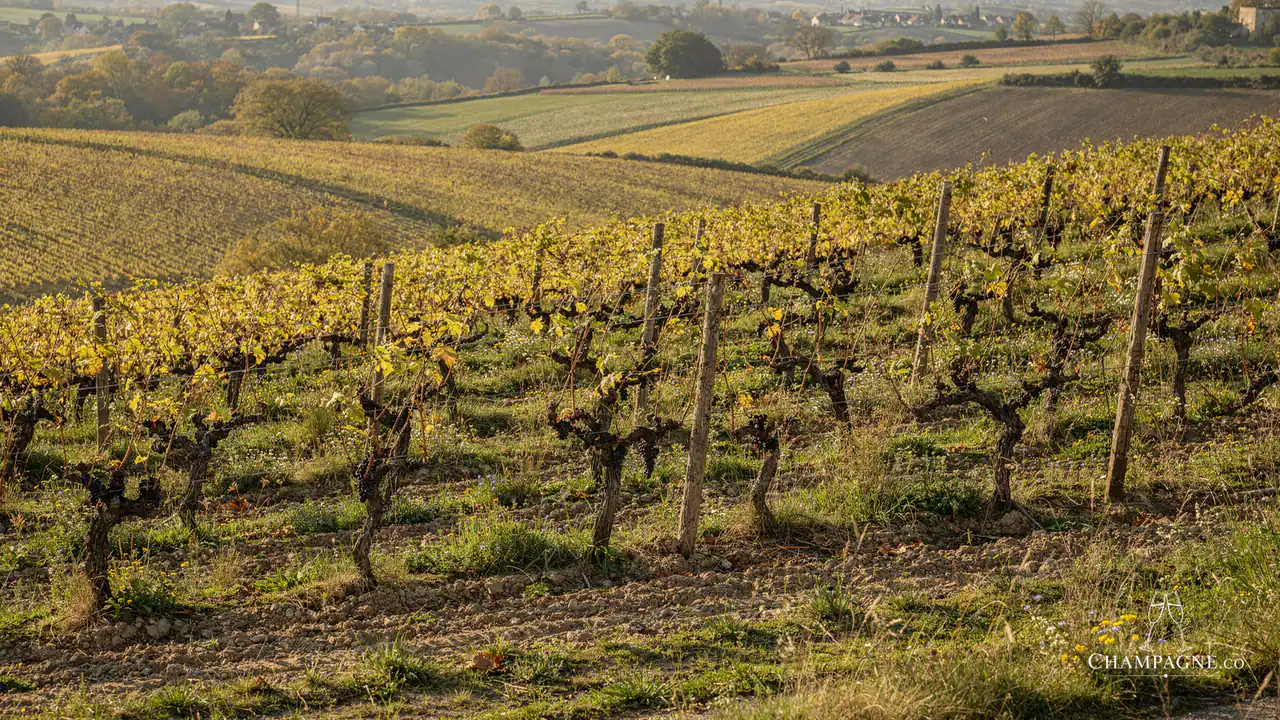
The estate is certified organic. The Association des Champagnes Biologiques' 2026 record describes a six-hectare domaine spread across four villages, with the first certified-organic harvest in 2016. Around 80% of the vineyard lies in Cumières and Damery in the Vallée de la Marne, with the balance divided between Oger in the Côte des Blancs and Sermiers on the Montagne de Reims.
Why this producer matters
Sanchez-Le Guédard has more geographical range than its compact size suggests. Pinot Noir and Meunier from the Vallée de la Marne sit alongside Chardonnay from Oger and fruit from Sermiers, allowing the family to produce both classic blends and strongly differentiated varietal or parcel wines.
The estate's organic certification is mature enough to be part of the current house identity. The family couples that vineyard work with unusually traditional cellar labour: the producer says every cuvée is riddled by hand.
Vineyards and farming
The current organic-sector record gives six hectares across Cumières, Damery, Oger and Sermiers, all certified organic. Cumières and Damery account for the great majority of the holding; Oger contributes Grand Cru Chardonnay, while Sermiers adds a Montagne de Reims component.
The house describes ploughing and grass cover as core vineyard practices. Organic certification is the clearest description of the estate's farming framework.
The vineyard footprint gives the domaine useful stylistic range. Cumières provides Pinot Noir for the single-parcel Clos Saint-Hélène, while Oger gives the family access to Grand Cru Chardonnay for Cuvée Flore.
Cellar approach
Sanchez-Le Guédard combines modern cellar equipment with traditional manual work. All cuvées are riddled by hand, and oak has a selective role rather than being used across the whole range.
The wines are deliberately differentiated by blend and ageing. Grande Réserve includes an oak component and receives longer ageing than the entry wine; Cuvée Nature uses oak-aged Chardonnay inside a three-grape Extra Brut; Flore isolates Grand Cru Chardonnay; and Clos Saint-Hélène reduces origin to one Cumières parcel and one vintage.
Dosage, vintage and release details vary by edition, making the exact bottle an important part of the buying decision.
Champagne.co analysis
Sanchez-Le Guédard's range is best read as a map of what six hectares across four villages can do. The core wines combine the estate's different sources, while Flore and Clos Saint-Hélène move toward much narrower expressions of grape and place.
That gives the portfolio a logical progression without relying on prestige hierarchy. Sélection shows the house at its broadest; Grande Réserve adds cellar depth; Nature changes dosage and oak balance; Flore isolates Grand Cru Chardonnay; Clos Saint-Hélène isolates Pinot Noir from one Cumières parcel.
The current six-hectare organic record also updates older five-hectare snapshots. The estate appears to have grown modestly while keeping its four-village structure and organic farming central.
Buying guidance
Start with Sélection Brut for the broadest introduction to the family style. Choose Grande Réserve if you want additional ageing and oak influence, or Cuvée Nature for a drier three-grape expression.
For a more focused bottle, Cuvée Flore is the Chardonnay choice and Rosé de Saignée BIO the pure-Pinot rosé. Clos Saint-Hélène Spécial Club is the specialist purchase when the attraction is a single Cumières parcel and an exact declared vintage.
For vintage and Spécial Club bottles, check the year and current technical details because dosage and ageing can change between editions.
Loading current Champagne range…
Spotted something wrong? Report a correction
Every report goes to a human review queue. Nothing on this page changes automatically.