Tarlant
Tarlant is a family grower in Œuilly, on the left bank of the Marne, with a winegrowing history dating to 1687. The estate today covers about 14 hectares and is led by Benoît and Mélanie Tarlant. Its importance is less about scale than about the way it has…
Editorial profile
Tarlant is a family grower in Œuilly, on the left bank of the Marne, with a winegrowing history dating to 1687. The estate today covers about 14 hectares and is led by Benoît and Mélanie Tarlant. Its importance is less about scale than about the way it has used a diverse patchwork of vineyards to make a particularly clear argument for Brut Nature Champagne.
The range is built around low- and zero-dosage wines, but dryness is only part of the story. Tarlant separates parcels, works with barrels as well as tanks, retains reserve wines and uses long ageing to build wines that do not depend on dosage for balance. The estate also works beyond Champagne’s three dominant varieties, giving Pinot Blanc, Arbanne and Petit Meslier a visible place in the portfolio.
Why this producer matters
Tarlant helped make zero dosage a serious stylistic proposition rather than a novelty. Its flagship Zéro establishes the house language, while the parcel wines show how that approach changes when applied to old Meunier, Chardonnay, Pinot Noir or rarer varieties on different soils.
That makes Tarlant especially useful for readers interested in Champagne as a wine of place. Instead of organising the range primarily by luxury tier, the estate increasingly asks buyers to pay attention to grape variety, parcel, geology, vintage and time on lees.
Vineyard and farming
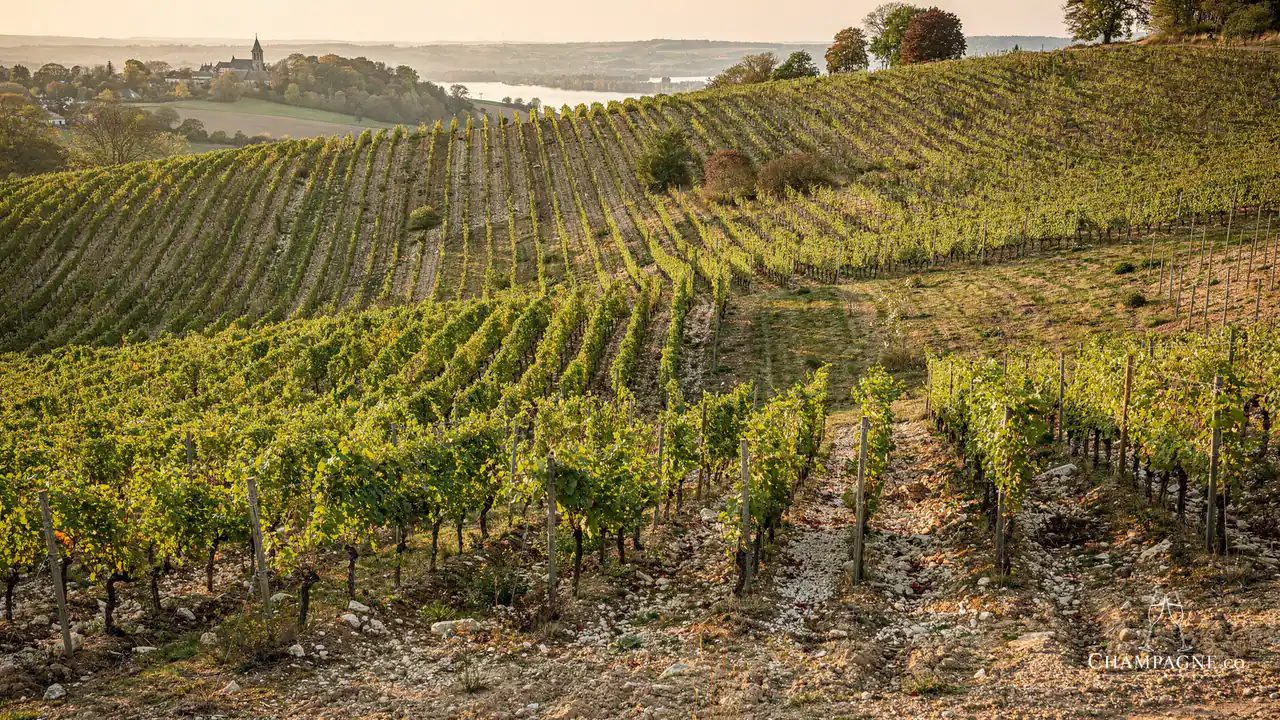
The family’s approximately 14 hectares are centred on Œuilly in the Vallée de la Marne, with vineyards divided among numerous parcels. The geological picture is varied rather than uniform, including chalk, clay-limestone and sandy sectors. That diversity underpins the estate’s parcel-specific wines.
Tarlant is currently presented as an organic producer, with certification dating from 2019 in contemporary independent records. Soil work is adapted by parcel, and horse cultivation is used on emblematic sites. The vineyard also includes the classic Chardonnay, Pinot Noir and Meunier alongside Pinot Blanc, Arbanne and Petit Meslier.
Cellar approach
Parcel separation is fundamental to the cellar logic. Wines may be fermented in small vessels or barrel, reserve wines play an important role, and malolactic fermentation is generally avoided. The result is a base-wine structure designed to retain acidity and site distinctions through extended maturation.
Brut Nature therefore functions here as an outcome of the farming and cellar programme rather than simply a dosage category. The strongest expression of the idea is the contrast between the multi-parcel Zéro and the single-site or grape-focused bottlings.
Champagne.co analysis
Tarlant makes the most sense as a progression from blend to place. Zéro demonstrates that the estate can make a complete, dry Champagne from a broader assemblage. The parcel wines then narrow the question: what does the same low-dosage philosophy reveal when the variables are an old Meunier site, an old Chardonnay parcel or a planting of Champagne’s less common grapes?
That structure gives the range unusual educational value. Tarlant is not simply a producer for people who prefer very dry Champagne; it is a producer for people interested in how dosage, reserve wine, barrel use, variety, soil and long ageing interact. The wines also show why an older vintage on sale is not necessarily an old release: extended cellar ageing is part of the programme.
Buying guidance
Zéro Brut Nature is the logical first bottle because it establishes the estate’s baseline before the more specific wines. Choose Rosé Zéro if the aim is to explore the same philosophy through rosé.
For the next step, buy according to the question you want the wine to answer. BAM! is the obvious choice for Champagne’s rarer permitted varieties. La Vigne d’Or is the route into Tarlant’s Meunier-focused parcel work, while La Vigne d’Antan or L’Enclume puts Chardonnay and site more firmly in focus. La Vigne Royale is the corresponding direction for Pinot Noir.
Because the parcel wines are released with significant age, check the exact vintage and disgorgement when comparing bottles. Two listings carrying the same cuvée name may represent materially different releases, and price differences can reflect that maturity as much as hierarchy.
Loading current Champagne range…
Spotted something wrong? Report a correction
Every report goes to a human review queue. Nothing on this page changes automatically.