Veuve Cheurlin (J. Arnoult)
Champagne Veuve Cheurlin is a Côte des Bar house based in Celles-sur-Ource. Its family vineyard history begins in 1898, when Edmond Cheurlin planted his first vines in the village. His grandson Alain Cheurlin created the Veuve Cheurlin brand and his own…
Editorial profile
Champagne Veuve Cheurlin is a Côte des Bar house based in Celles-sur-Ource. Its family vineyard history begins in 1898, when Edmond Cheurlin planted his first vines in the village. His grandson Alain Cheurlin created the Veuve Cheurlin brand and his own operation in 1978.
A second historical strand explains the institutional name Veuve Cheurlin (J. Arnoult). In 1985, Alain Cheurlin took over Champagne Jean Arnoult, a house founded in 1919 and connected to his wife Chantal Sandrin's family. The current Union des Maisons de Champagne record lists Veuve Cheurlin (J. Arnoult) with a 13-hectare vineyard estate and Alain Cheurlin as Managing Director.
Why this producer matters
Veuve Cheurlin stands out within the Côte des Bar because Pinot Blanc has a visible role in the commercial range rather than appearing only as a minor heritage variety. The house bottles Pinot Blanc on its own and also uses it alongside Chardonnay and Pinot Noir in several blends.
That makes the range particularly useful for readers interested in the wider grape diversity of southern Champagne. Pinot Noir remains important, but Pinot Blanc changes the structure of wines such as Réserve and Prestige in a way that is immediately visible from the current technical pages.
Vineyards and cellar approach
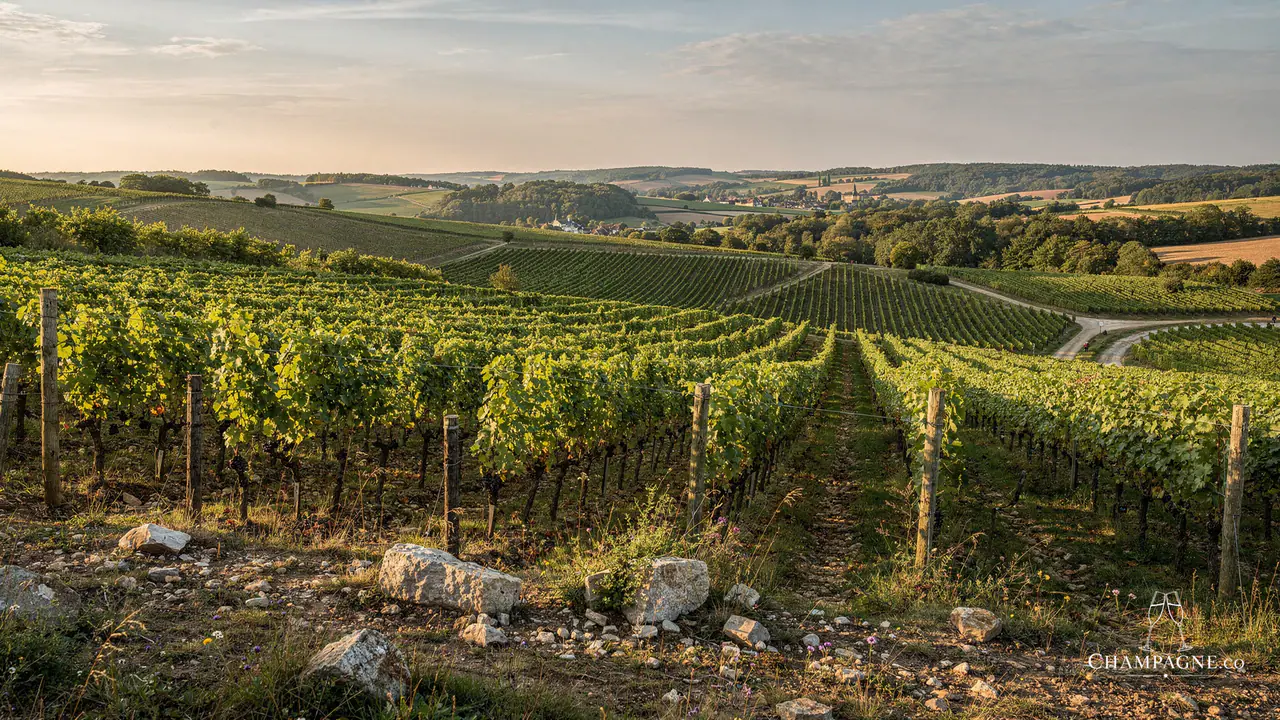
The domaine is centred on Celles-sur-Ource and states that its vineyards extend across five communes in the Côte des Bar. The soils are described as Kimmeridgian clay-limestone, and the planted varieties are Pinot Noir, Chardonnay and Pinot Blanc.
The house describes its farming as culture raisonnée and harvests by hand. Parcels are vinified separately in temperature-controlled tanks before blending. Current producer pages show that several cuvées combine more than one harvest.
Champagne.co analysis
Veuve Cheurlin is best understood through grape diversity rather than through a conventional prestige hierarchy. Many Côte des Bar producers are naturally associated with Pinot Noir; Veuve Cheurlin adds a second axis by giving Pinot Blanc enough importance to shape both varietal and blended wines.
Réserve and Prestige are therefore especially revealing. The first places Pinot Blanc alongside Chardonnay without Pinot Noir, while the second brings all three varieties together. Comparing those wines with Carte Noire or the varietal Pinot Blanc is a more useful way to understand the house than relying on one flagship bottle.
Buying guidance
Start with Carte Noire for the Pinot Noir foundation. Choose Réserve if Pinot Blanc is the main interest, or Prestige to see how it works in a three-grape blend.
The varietal Pinot Blanc is the most direct bottle for readers specifically exploring Champagne's less common permitted grapes. For Millésime or older bottles, confirm the exact vintage and technical details because the current house catalogue should not be treated as a timeless specification for earlier releases.
Loading current Champagne range…
Spotted something wrong? Report a correction
Every report goes to a human review queue. Nothing on this page changes automatically.