Vincent Couche
Vincent Couche established his domaine in 1996 in the Côte des Bar. The Champagne vineyard now covers 15 hectares, divided between 12 hectares at Buxeuil and 3 hectares at Montgueux.
Editorial profile
Vincent Couche established his domaine in 1996 in the Côte des Bar. The Champagne vineyard now covers 15 hectares, divided between 12 hectares at Buxeuil and 3 hectares at Montgueux.
The estate is 100% certified organic and also works biodynamically, with current Demeter certification. The Association des Champagnes Biologiques records certification engagement from 2008 and the first certified-organic harvest in 2011. Pinot Noir and Chardonnay are the certified varieties.
Why this producer matters
Vincent Couche brings together two very different Champagne landscapes. Buxeuil provides the Côte des Bar core, with Pinot Noir prominent on Jurassic clay-limestone soils; Montgueux contributes a separate three-hectare Chardonnay holding on chalk.
That geographic split is reflected in the wines. Some cuvées blend across the estate, while others isolate Montgueux or use long-running reserve systems. Organic and biodynamic farming is not a recent marketing layer here: it has been central to the domaine for well over a decade.
Vineyards and farming
The 12 hectares at Buxeuil are predominantly Pinot Noir, with Chardonnay also planted. The 3 hectares at Montgueux are Chardonnay on chalk, giving the domaine a markedly different source for its white-grape wines.
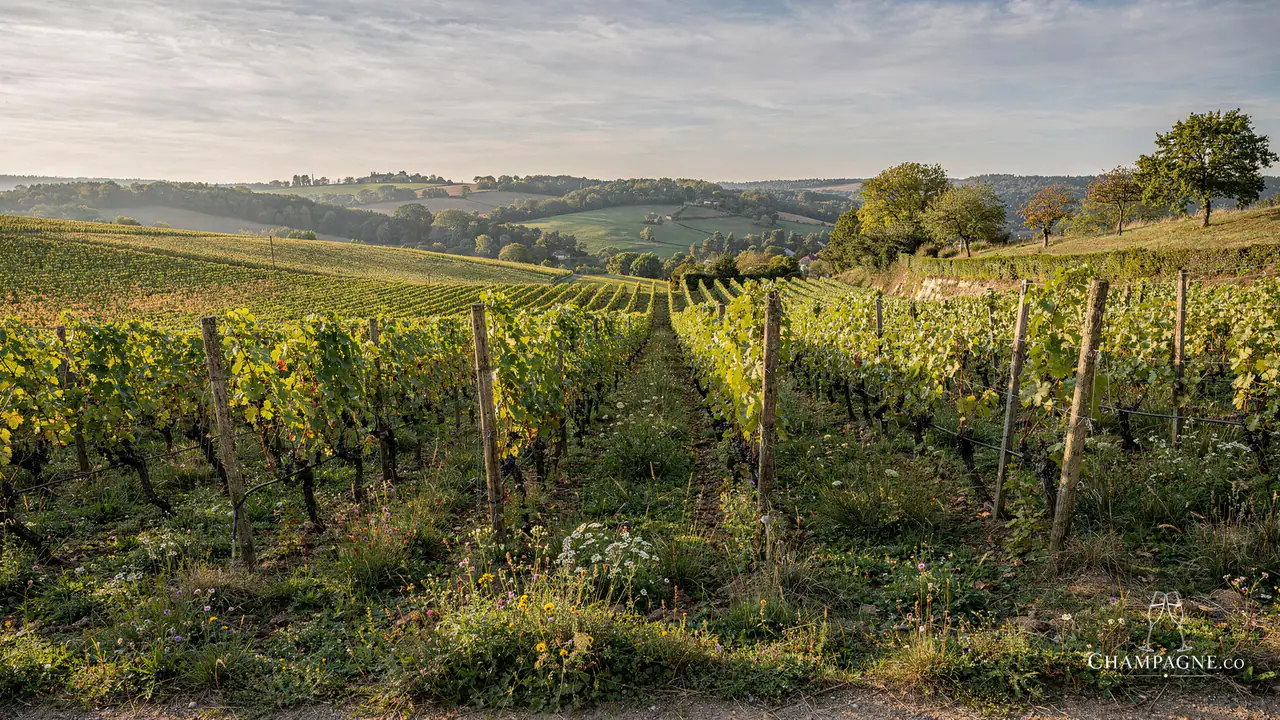
The organic association confirms all 15 hectares as certified organic. The domaine also uses agroforestry and livestock as part of its biodiversity work, including fruit trees planted among the vines.
Champagne.co analysis
Vincent Couche is easiest to understand through the contrast between Buxeuil and Montgueux. The former supplies the Pinot Noir-heavy Côte des Bar foundation; the latter gives the domaine a distinct Chardonnay source on chalk.
Chloé adds a second axis through time, using a multi-harvest solera, while ADN Montgueux narrows the focus to a single place and vintage. The estate therefore moves between blending, reserve history and terroir specificity without abandoning its organic and biodynamic farming framework.
Buying guidance
Start with Élégance for the broadest house introduction. Choose Chloé if the interest is reserve-wine complexity and Brut Nature, or ADN Montgueux for the clearest Chardonnay expression from the domaine's separate Montgueux holding.
For vintage and œnothèque wines, check the exact year and format. Older Sensation, ADN and Millésime releases are not interchangeable with the current standard range simply because they remain available from the estate.
Loading current Champagne range…
Spotted something wrong? Report a correction
Every report goes to a human review queue. Nothing on this page changes automatically.