Voirin-Jumel
Voirin-Jumel is a family grower based in Cramant, one of the Grand Cru villages of the Côte des Blancs. The domaine is now run by Patrick with his daughters Julie and Pauline, the fifth generation. The Voirin-Jumel name dates from 1968, following the…
Editorial profile
Voirin-Jumel is a family grower based in Cramant, one of the Grand Cru villages of the Côte des Blancs. The domaine is now run by Patrick with his daughters Julie and Pauline, the fifth generation. The Voirin-Jumel name dates from 1968, following the marriage of Gilles Voirin and Françoise Jumel, bringing together two winegrowing families.
The Comité Champagne currently describes an 8.5-hectare holding spread across 12 crus and 44 parcels. The domaine has its own press and vinifies its wines on site. Chardonnay is the natural centre of gravity in Cramant, but the contemporary range is broader than a conventional Blanc de Blancs portfolio, moving from multi-village Chardonnay to zero dosage, a Cramant-focused cuvée, parcel Blanc de Noirs and saignée rosé.
Why this producer matters
Voirin-Jumel is useful for understanding how an established Côte des Blancs grower can make increasing distinctions between origins without abandoning a recognisable house range. La V.1 and La V.2 provide two readings of Grand Cru Chardonnay; Cuvée 555 combines selected Chardonnay sites; Cramant 100% narrows the lens to the home village; and Les Carelles brings a black-grape parcel wine into a domaine otherwise strongly associated with Chardonnay.
The result is a range that can be approached by place, grape and dosage rather than by a simple prestige hierarchy.
Vineyard and terroir
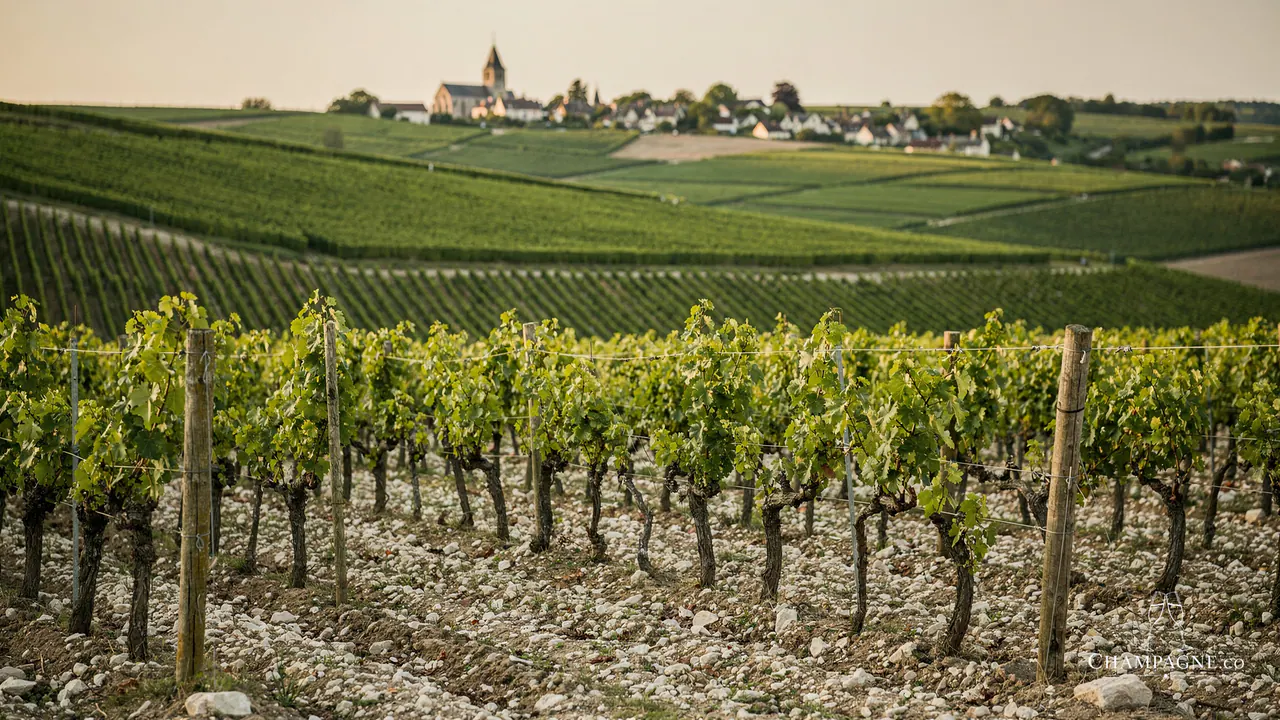
Cramant is the domaine's base and remains the clearest reference point for its identity. The current Comité Champagne listing gives 8.5 hectares across 12 crus and 44 parcels, a sufficiently dispersed holding to support both blending and more narrowly defined wines.
The estate's own current technical pages make those distinctions concrete. Cuvée 555 is 100% Chardonnay from Grand Cru Côte des Blancs sites, while the current La V.2 release draws Chardonnay from Chouilly, Oiry and Cramant. Because the composition of individual bottlings can change, village, base-year and parcel information should be attached to the relevant release rather than treated as permanent specifications for the label.
Cellar and winemaking
Voirin-Jumel presses and vinifies its wines at the domaine. Its current range deliberately varies vessel, reserve-wine use and dosage according to the cuvée.
For example, the producer's current La V.2 technical page identifies a 2022 base, 40% reserve wine, stainless-steel vinification, malolactic fermentation and zero dosage. The currently documented Cuvée 555 is a 2019-base Chardonnay, vinified in used oak, bottled in 2020 and dosed at 4 g/L. These are useful illustrations of the domaine's range, but they are release-specific rather than universal house rules.
Champagne.co analysis
Voirin-Jumel is most interesting when read as a progression in resolution. The domaine can move from a broad house blend to Grand Cru Chardonnay, from Brut to zero dosage, from a multi-site Chardonnay selection to Cramant itself, and then outside the expected Chardonnay frame with Les Carelles and La Saignée.
That makes the range particularly useful for drinkers who want to compare how origin and winemaking choices alter the expression of one producer. It is better understood horizontally than as a ladder in which every more specialised bottle is automatically "better" than the one before it.
The principal catalogue caution is release specificity. Base year, reserve-wine proportion, dosage, vessel and village composition should follow the technical information for the bottle being offered. They should not be carried forward automatically to later releases.
Buying guidance
For a first bottle, La V.1 is the clearest introduction to the domaine's Grand Cru Chardonnay identity. Choose La V.2 to explore the same broad territory through zero dosage. Cuvée 555 is the more cellar-led Chardonnay comparison, while Cramant 100% is the natural choice when the home village itself is the priority.
Drinkers looking beyond Blanc de Blancs should look to Les Carelles for the parcel Blanc de Noirs direction or La Saignée for rosé. For vintage Champagne, buy by the exact declared year rather than assuming continuity between releases.
Loading current Champagne range…
Spotted something wrong? Report a correction
Every report goes to a human review queue. Nothing on this page changes automatically.