Champagne Regions and Villages
Montagne de Reims, Vallée de la Marne, Côte des Blancs and Côte des Bar are useful shorthand, but serious Champagne gets more local than that.
Published 2026-09-28

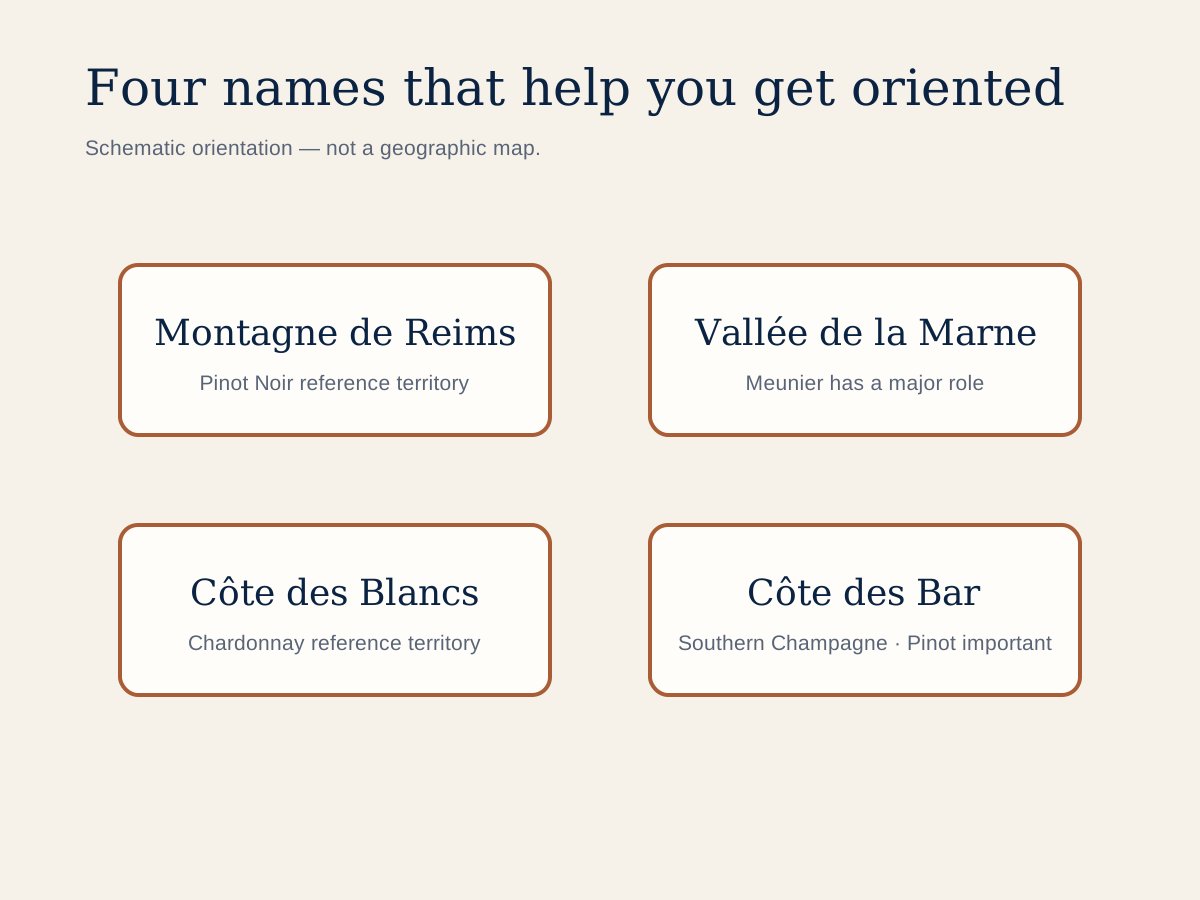
Champagne is not one uniform vineyard. It stretches across distinct landscapes, exposures, soils and village traditions. Regional names are useful orientation, but the producer and village often tell you more.
Montagne de Reims
The Montagne de Reims sits between Reims and Épernay and is strongly associated with Pinot Noir, although Chardonnay and Meunier are also present.
Villages such as Aÿ, Ambonnay and Bouzy are famous for structured Pinot-based wines, while other sectors show different exposures and soil patterns.
Vallée de la Marne
The Marne valley follows the river westward from Épernay. Meunier has a particularly important role in many villages because it can suit the valley’s conditions.
The area is far from stylistically uniform. Increasing numbers of growers bottle village- and parcel-specific wines that reveal how much local variation sits behind the broad valley label.
Côte des Blancs
South of Épernay, the Côte des Blancs is Champagne’s best-known Chardonnay territory. Villages including Avize, Cramant, Oger and Le Mesnil-sur-Oger are reference points for Blanc de Blancs.
Chalk and Chardonnay dominate the popular story, but producer decisions still matter enormously.
Côte des Bar
Farther south in the Aube, the Côte des Bar is closer to Burgundy than to Reims. Pinot Noir is important and the area has become central to the modern grower-Champagne conversation.
Many ambitious estates here have distinctive farming and cellar approaches.
Other sectors
Champagne includes additional sectors and villages outside the four names most consumers hear first. The official appellation is broader and more complex than a simple sub-region map.
Why village matters
Village names can indicate grape emphasis, exposition and local tradition. But they are not flavour guarantees.
A producer’s parcels may cross multiple communes, and blending can be intentional.
How to learn geography
Pick one producer with several village-specific wines, or compare producers from neighbouring villages. Geography becomes meaningful when you taste it rather than memorise a map.

Grand Cru and Premier Cru Champagne Explained
These terms belong to Champagne’s village-based classification history. They matter, but not in the same way as Burgundy’s vineyard hierarchy.
The Grapes of Champagne
Chardonnay, Pinot Noir and Meunier dominate, but the appellation has more permitted varieties. Here is what each contributes.

Grower Champagne vs Champagne Houses
RM, NM and other producer codes reveal how a bottle reaches the market, but the grower-versus-house debate is more nuanced than the initials suggest.