What Does Brut Mean?
Brut is the reference dryness level in Champagne, but it is not the driest. Here is how dosage, acidity and the legal sugar bands fit together.
Published 2026-09-28

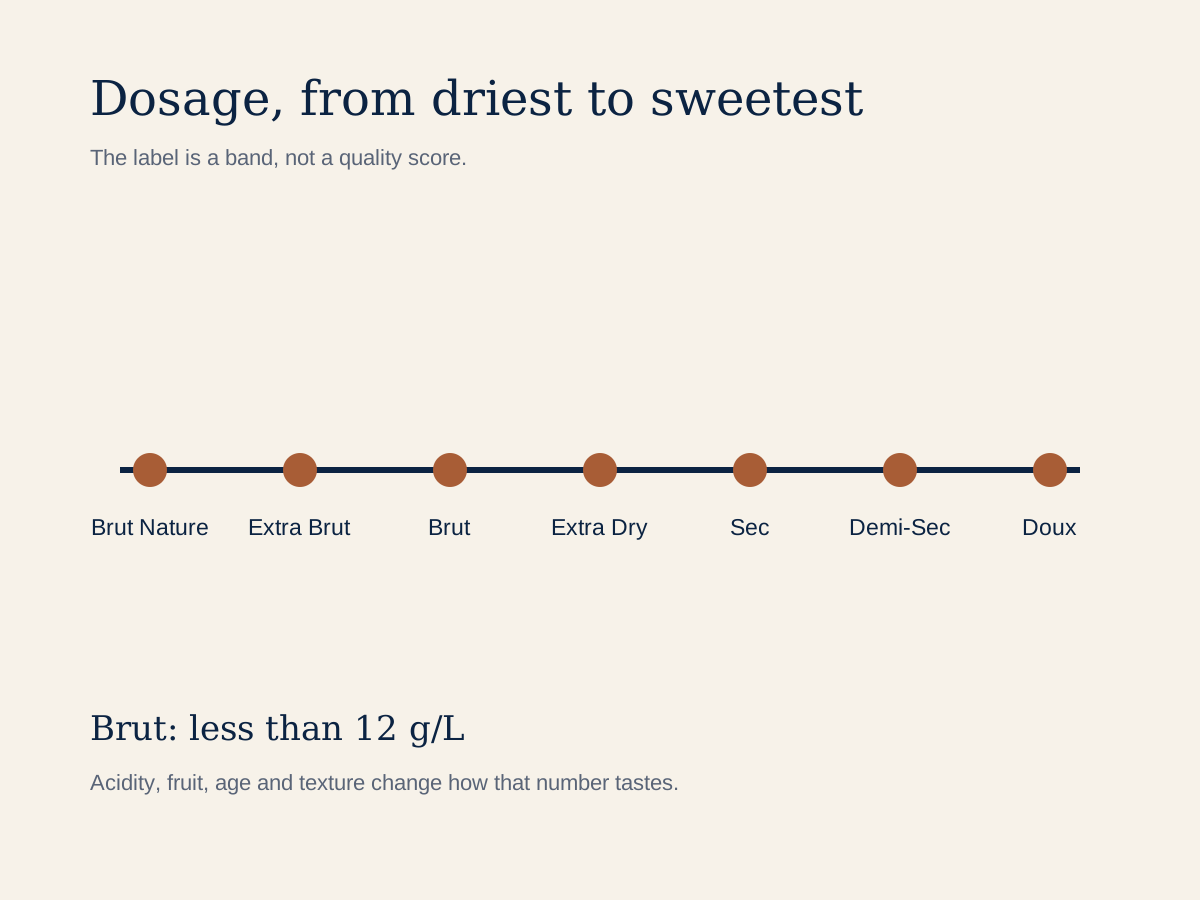
Brut is the word most people see most often on a Champagne label, but it is easy to misunderstand. It does not mean “bone dry”, and it does not tell you how sweet the wine will taste on its own. It tells you which regulated dosage band the finished Champagne falls into.
The legal scale
From driest to sweetest, the principal label terms are Brut Nature, Extra Brut, Brut, Extra Dry, Sec, Demi-Sec and Doux. Brut is the broad middle of the dry end of that scale: the finished wine must contain less than 12 grams of sugar per litre.
That number sounds surprisingly high if you are thinking about still wine. Champagne is different because its natural acidity is usually high. Sugar and acidity are perceived together, so two wines with the same dosage can feel quite different depending on their acid structure, fruit ripeness, age and texture.
Dosage is not the whole story
After disgorgement, the producer replaces the small amount of wine lost from the bottle. That finishing addition is the dosage. It may contain wine alone or wine with sugar, depending on the style.
A lower dosage does not automatically mean a better or more serious Champagne. A very dry wine can feel severe if the base wine lacks depth; a Brut with a little more dosage can feel precise if the acidity and fruit need it. The useful question is not “How little sugar is there?” but “Does the dosage make the wine feel balanced?”
Brut Nature and Extra Brut
Brut Nature is the driest category and is sometimes described as zero dosage, although the legal category allows a very small residual level. Extra Brut sits above it but remains markedly dry.
These styles can make vineyard character and acidity feel more exposed. They can be brilliant when the base wine has enough concentration. They can also feel angular when opened too young. Dryness on the label is therefore a style clue, not a quality ranking.
Why Extra Dry is sweeter than Brut
The terminology is historical rather than intuitive. Extra Dry is actually sweeter than Brut. If you are new to Champagne, that is one of the label traps worth remembering.
What to look for when buying
If you regularly find mainstream Brut too rounded, try Extra Brut. If you like a softer aperitif style, Brut may suit you better than Brut Nature. If you are pairing Champagne with dessert, look further up the sweetness scale rather than assuming all Champagne is equally dry.
The producer matters as much as the category. Compare two wines from the same house at different dosage levels and you can learn far more than by comparing random bottles.
The Champagne.co view
Treat dosage as one coordinate in the wine, not the verdict on it. The best examples taste integrated: acidity, fruit, lees ageing, texture and dosage all point in the same direction.
Dosage Explained: What Happens After Disgorgement
Dosage adjusts the finished Champagne after disgorgement. It influences balance and sweetness, but low dosage is not a quality score.
How to Read a Champagne Label
Dryness, vintage, producer code, village, grape style and bottle information: the label can tell you much more than the brand name.
How Champagne Is Made
From pressing and base wines to second fermentation, lees ageing, riddling, disgorgement and dosage: the traditional method explained properly.